A Levitating Sphere Measures Invisible Forces express
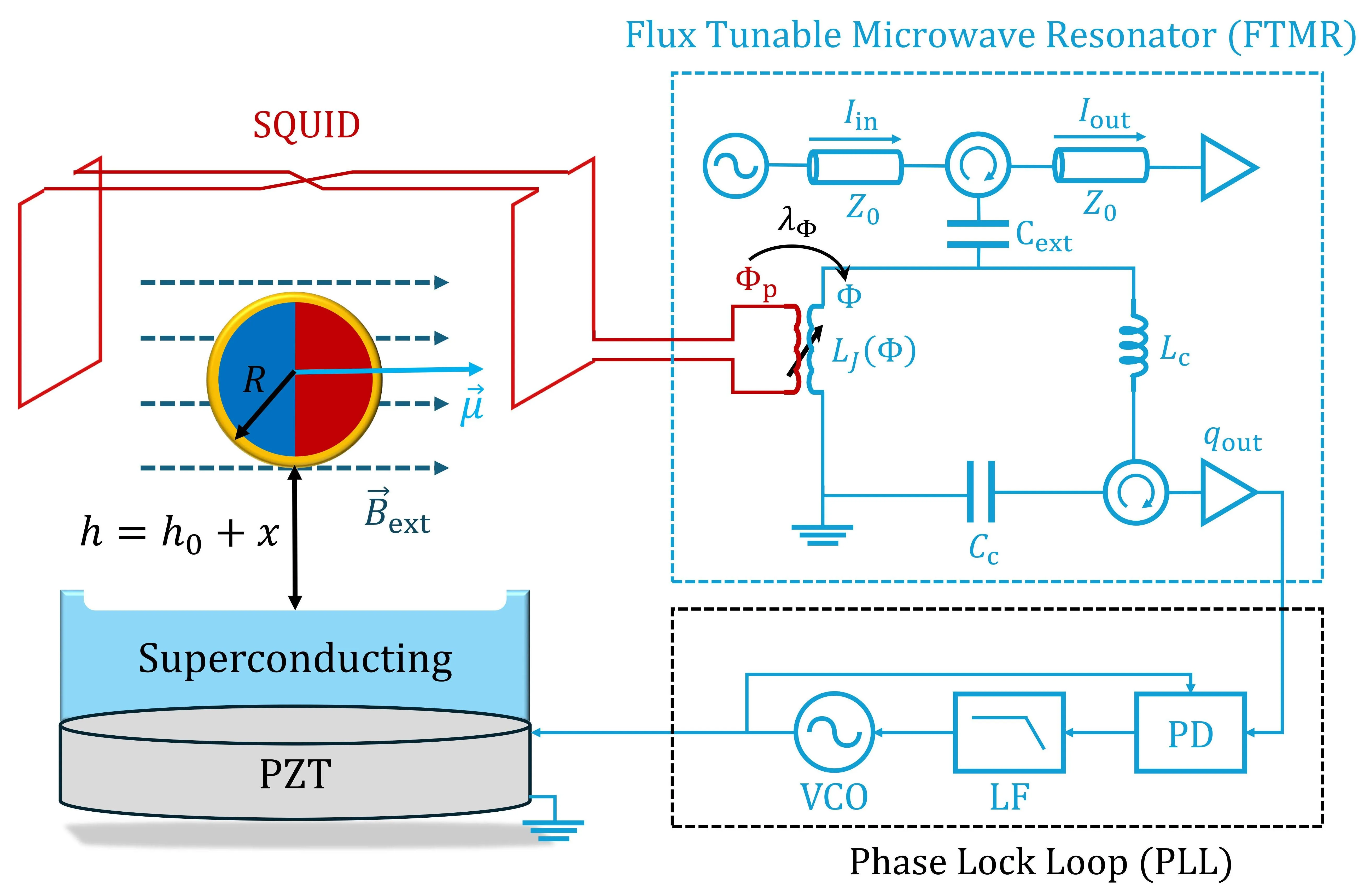
A magnetic sphere hangs in a vacuum above a cold metal plate. No strings, no stands — only the invisible field of a superconductor keeps it from falling. Give the sphere a gentle nudge, and it starts to oscillate up and down; the frequency of those oscillations depends on how strongly the plate pulls on it.
That's the idea behind the new force sensor. Instead of a spring or a cantilever, there's a levitating sphere; instead of measuring displacement directly, it tracks the shift in resonant frequency picked up by an ultra-sensitive microwave circuit. The trick is that the larger the sphere, the more its motion affects the signal, so fewer photons are needed for a precise measurement. This opens the door to quantum metrology with macroscopic objects.
Such precision is needed to test whether Newton's law of universal gravitation breaks down at distances of fractions of a micrometer. Some theories predict that extra forces, called Yukawa forces, appear at these scales. The sensor could either detect them or place new constraints on them. It could also measure the Casimir effect, the attraction arising from quantum fluctuations of the vacuum between closely spaced surfaces.
The plate is cooled to near absolute zero, and the sphere is coated in gold to suppress stray electric fields. The gold, however, creates eddy currents that damp the motion, so there's a trade-off to balance. But if it all works, we'll get our first look at how a macroscopic object behaves at the boundary of the quantum world.
Original abstract
as written by the authors arXiv:2602.13829
Near-field force measurements at submicron separations can probe Casimir effects and hypothetical short-range interactions, but require cryogenic operation and stable, \textit{in situ} control of separation-dependent backgrounds. We propose a self-calibrating quantum force-gradient sensor in which a ferromagnetic microsphere is Meissner-levitated above a type-I superconducting plane, while a bias magnetic field reproducibly tunes the equilibrium gap for in situ separation scans without mechanical approach. The force gradient is encoded as a resonance-frequency shift tracked by a phase-locked loop, and the motion is read out with a SQUID-coupled, flux-tunable microwave resonator that provides adjustable measurement strength without optical heating. Using the input--output formalism, we derive the conditions for reaching the standard quantum limit (SQL) and identify a counterintuitive scaling law: because displacement-to-flux transduction increases with microsphere size, larger microspheres require fewer photons to reach the SQL, enabling a pathway to macroscopic quantum metrology. We quantify the trade-off between suppression of electrostatic patch potentials (via Au coating) and eddy-current dissipation, project force sensitivities of $$\sim 10^{-19}\,\rm{N\,Hz^{-1/2}}$$ at millikelvin temperatures, and outline protocols to extract Casimir pressure and constrain Yukawa-type deviations from Newtonian gravity over $$0.1$$--$$10\,\mu\mathrm{m}$$.
A superconductor expels magnetic fields, so the sphere levitates without any support, as if resting on an invisible cushion.
In Arthur C. Clarke's novel The Fountains of Paradise, levitating building blocks are described for a space elevator: this sensor uses a similar principle of magnetic levitation for scientific measurements.