Proton Reveals Its Hidden Threads express
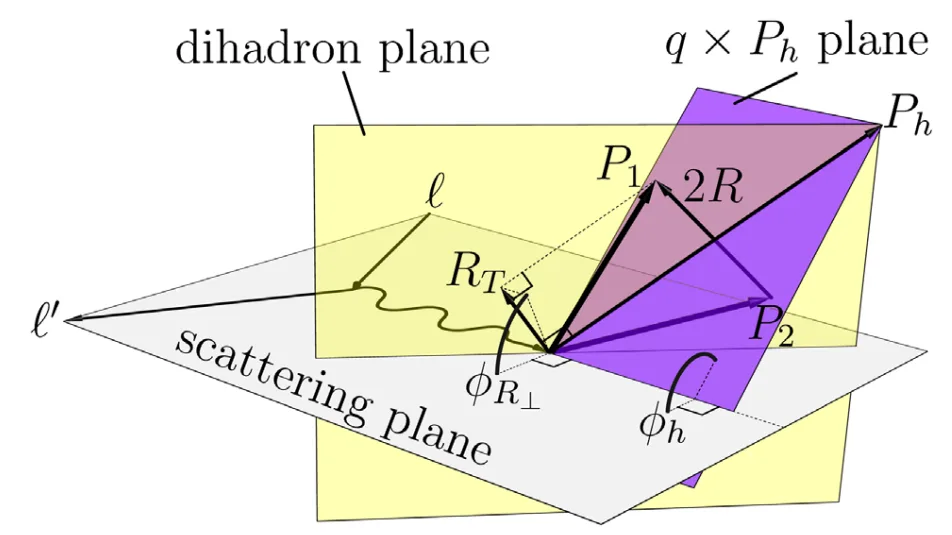
A beam of electrons, twisted like a corkscrew, slams into a proton. From the collision point, pairs of particles, a positive and a neutral pion, fly out. For the first time, physicists measured how often such pairs scatter at different angles when the electron's spin points left or right.
The difference in these rates, the asymmetry, turned out to be nonzero. This means that inside the proton, quarks and gluons are not just moving chaotically but are linked by specific correlations. One of them is described by a quantity that previously could hardly be measured directly.
Another finding: the behavior of the pairs depends on their charge. Pairs of a positive and a neutral pion behave differently from pairs of a negative and a neutral pion. This is the first time a dependence on isospin, the property that distinguishes protons from neutrons, has shown up in this way.
Now physicists have a new tool: by measuring the angles at which pairs fly apart, they can extract, point by point, that very quantity that describes quark–gluon correlations. The proton is no longer a smooth ball; it reveals its internal threads.
Original abstract
as written by the authors arXiv:2602.14271
A first measurement of beam spin asymmetries for $$\pi^+\pi^0$$ and $$\pi^-\pi^0$$ pairs in semi-inclusive deep inelastic scattering is reported. The asymmetries in the dihadron angular distributions were measured from the scattering of a 10.6 GeV longitudinally polarized electron beam off a proton target, using the CLAS12 detector at Jefferson Lab. A photon classifier using a Gradient Boosted Trees (GBTs) architecture was trained with Monte Carlo simulations to reduce the amount of false combinatorial background $$\pi^0$$s, increasing statistics by up to five-fold compared to previous CLAS12 $$\pi^0$$ analyses. A nonzero $$\sin\phi_{R_\perp}$$ asymmetry is observed. This measurement is sensitive to the underexplored collinear twist-3 PDF $$e(x)$$, which encodes quark-gluon correlations in the proton, and presents a new avenue for its point-by-point extraction. The asymmetries also provide the first experimental evidence for the isospin-dependence of the helicity-dependent dihadron fragmentation function $$G_1^\perp$$, revealed by a sign-difference between the $$\pi^+\pi^0$$ and $$\pi^-\pi^0$$ channels in the $$\sin(\phi_h-\phi_{R_\perp})$$ modulation. In contrast, a large, same-sign enhancement near the $$\rho$$ mass for the $$\sin(2\phi_h-2\phi_{R_\perp})$$ modulation is observed, matching spectator model predictions in $$\pi^+\pi^-$$ pairs.
The CLAS12 detector at Jefferson Laboratory is about the size of a small house and contains thousands of particle-detection channels operating simultaneously.