S. Fegan

5 articles · 30 co-authors · latest: 2026-09-03
768 citations · h-index 14 · 127 papersData: Semantic Scholar

We have retold 5 papers by this author. 2 of them with a full read. most often about: gluon, hadron, Standard Model. 30 co-authors across our retellings.

Links in the knowledge graph
HEP Experiment2026-02-151 minarXiv:2602.14271express
Proton Reveals Its Hidden Threads
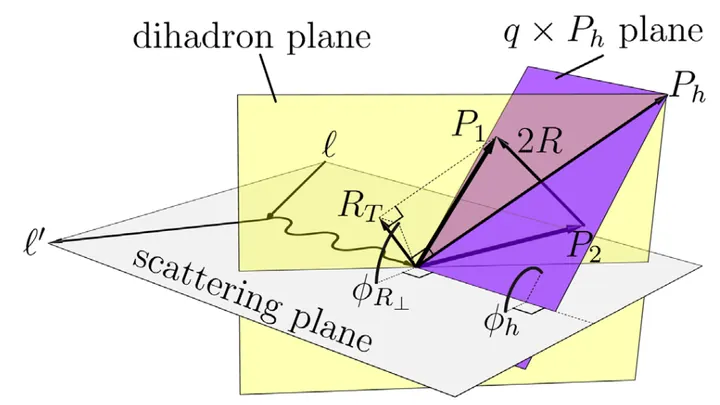
A beam of electrons, twisted like a corkscrew, slams into a proton. From the collision point, pairs of particles, a positive and a neutral pion, fly out. For the first time, physicists measured how often such pairs scatter at different angles when the electron's spin points left or right.
Nuclear Experiment2026-04-151 minarXiv:2604.14385express
How Photons Spin Protons
Light twisted in one direction hits a proton. The particle can absorb the photon or deflect it — depending on how its own spin, a tiny internal top, is oriented. In the experiment at the MAMI accelerator in Mainz, a beam of polarized photons struck targets of polarized protons and deuterons (nuclei of heavy hydrogen).
Nuclear Experiment2026-08-112 minarXiv:2608.11467express
How Photons Spin the Omega
At the Jefferson Lab accelerator, a beam of light strikes protons, and the collisions give birth to short-lived particles — omega mesons. They live for less than a billionth of a second, but they still manage to tell us about the forces inside the atomic nucleus.
The Galactic Center Ridge: A Break in the Gamma-Ray Spectrum
At the center of the Milky Way, where the supermassive black hole Sagittarius A* churns gas clouds like a millstone, astronomers have caught an irregular pulse. Gamma-ray emission, the most energetic light in the universe, arrives not as a smooth wave but with a break, as if the Galaxy's heart beats with arrhythmia.
Neutron Shows Its Gluons for the First Time
A neutron confined in a nucleus behaves differently from a free one. Its gluon cloud, which holds quarks together, compresses like a spring under load. Previously, this could only be assumed, but now physicists have directly observed the effect for the first time. At Jefferson Lab, an electron beam struck liquid deuterium, knocking photons out of the nuclei.