Are you one of the authors of this paper? Email us from your institutional or work email address mentioning this article's arXiv ID and we'll verify you and give you edit access to this page.
Are you an author who sees something we missed or got wrong? Write to us — the subject line already carries the paper id. We read every note and correct the write-up.
A beam of electrons forced the proton to expose details of its internal structure.
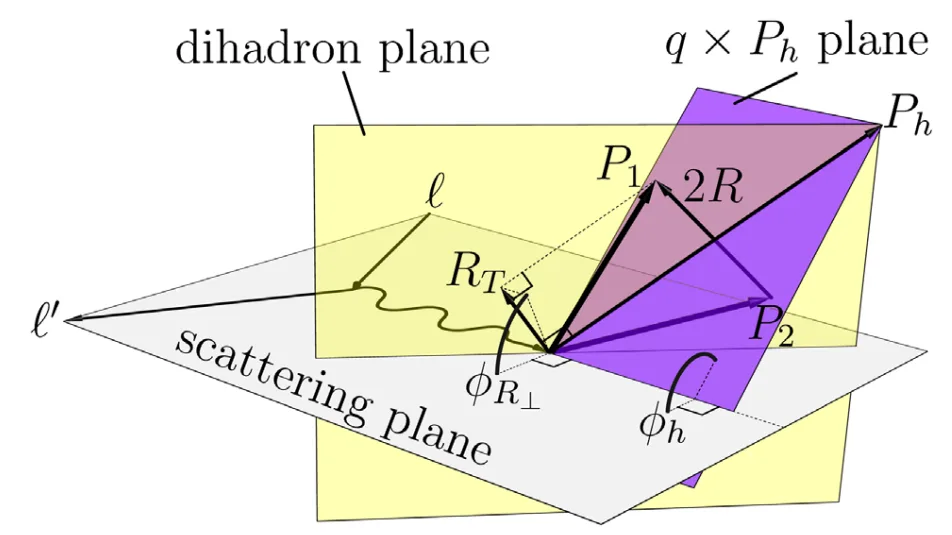
A beam of electrons, twisted like a corkscrew, slams into a proton. From the collision point, pairs of particles, a positive and a neutral pion, fly out. For the first time, physicists measured how often such pairs scatter at different angles when the electron's spin points left or right.
The difference in these rates, the asymmetry, turned out to be nonzero. This means that inside the proton, quarks and gluons are not just moving chaotically but are linked by specific correlations. One of them is described by a quantity that previously could hardly be measured directly.
To weed out false signals, the scientists trained a computer program to recognize genuine neutral pions. This allowed them to collect five times more useful events than in previous experiments.
Another finding: the behavior of the pairs depends on their charge. Pairs of a positive and a neutral pion behave differently from pairs of a negative and a neutral pion. This is the first time a dependence on isospin, the property that distinguishes protons from neutrons, has shown up in this way.
Near the mass of a particle called the rho meson, the asymmetry sharply increases. This matches the predictions of a model where the pion pair is formed through a short-lived rho meson.
Now physicists have a new tool: by measuring the angles at which pairs fly apart, they can extract, point by point, that very quantity that describes quark–gluon correlations. The proton is no longer a smooth ball; it reveals its internal threads.
The CLAS12 detector at Jefferson Laboratory is about the size of a small house and contains thousands of particle-detection channels operating simultaneously.