Group theory is the mathematical study of symmetries, and in physics it provides a powerful framework for classifying and understanding the properties of physical systems. In the context of magnetism, group theory is used to analyze the symmetry of crystal lattices and the magnetic order that arises from the arrangement of electron spins. It helps classify different types of magnetic structures, such as ferromagnets, antiferromagnets, and the recently discovered altermagnets, which exhibit a unique spin-splitting of electronic bands.
History
Group theory was developed in the 19th century by mathematicians like Évariste Galois and Sophus Lie, and was first applied to physics by Eugene Wigner and Hermann Weyl in the 1920s and 1930s. Its use in classifying magnetic structures became systematic in the 1950s with the work of Lev Landau and others. The concept of altermagnetism was introduced in 2022 by Libor Šmejkal and colleagues.
How it works
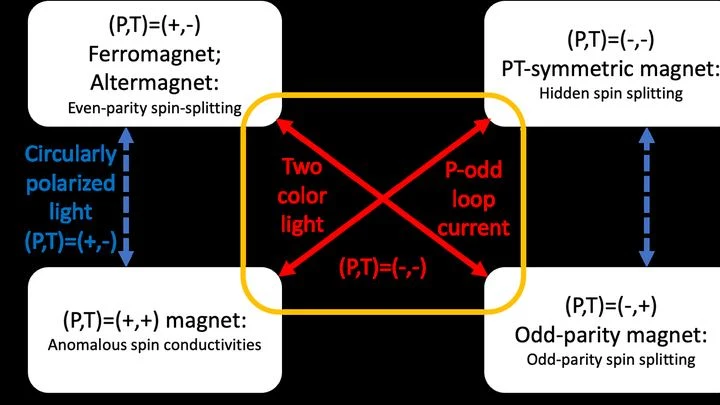
Group theory works by identifying the set of symmetry operations (like rotations, reflections, and translations) that leave a physical system unchanged. These operations form a mathematical group. For magnetic systems, the symmetry group includes both spatial symmetries and time-reversal symmetry (which flips the direction of spins). By analyzing how the electronic wavefunctions transform under these symmetries, one can determine which magnetic orders are allowed and how they affect the electronic band structure. For altermagnets, group theory reveals that certain symmetries combine to produce a spin-splitting that is neither fully symmetric (like in ferromagnets) nor fully compensated (like in antiferromagnets), leading to novel electronic properties.
Group theory is so fundamental that it also underlies the Standard Model of particle physics, where the symmetries of the strong, weak, and electromagnetic forces are described by the groups SU(3), SU(2), and U(1).
Two dancers on one stage: one pulls the partner in one direction, the other in the opposite. In the crystal Cu2(OH)3Br, known as botallackite, copper atoms form chains where the spins (magnetic moments) of neighboring ions align either parallel, as in a ferromagnet, or antiparallel, as in an antiferromagnet.
In a mountain range, there are trails that can be contracted to a point if you walk through a flat valley. But there are also loop routes that cannot be shrunk without crossing a ridge.
In 2015, the LIGO detectors caught the first ripple of spacetime from a black hole merger. Since then, hundreds of such events have piled up, each carrying the imprint of its ancestry: whether the holes were born together from a single pair of stars or met by chance in a dense cluster. The difference shows in the direction of their spin axes.
A sunspot, a dark island on the fiery surface, lives its own turbulent life. Beneath it, in invisible depths, giant magnetic loops drift like twisted cables. When such a loop emerges, it can discharge as a flare, and hurl clouds of charged particles into space.
Scientists have long tried to understand what determines the strength and suddenness of these events.
A black hole is like a perfect safe: everything that falls in disappears without a trace. But quantum mechanics whispers that on the microscopic level, information is not lost but recorded on an invisible "surface." Understanding this record means unraveling the fabric of gravity.
A carousel doesn't just spin you around in a circle — with each revolution, it also slightly screws itself into the ground. This corkscrew-like motion is the essence of the NUT charge, a special property of spacetime that physicists have been studying since the mid-20th century.
In 2022, physicists described a new type of magnetism — alternagnetism. In it, electrons with different spin directions are split in energy depending on their direction of motion, like runners who speed up on one track and slow down on another. But spin is not the only degree of freedom particles have.
In a crystal that for centuries was called 'fool's gold,' physicists have spotted genuine treasure. The compound MnTe2 with a pyrite structure has become the stage for a quantum ballet: spin waves here twist into left- and right-handed vortices, with the twist direction firmly tied to momentum.
In the world of magnetism, a simple dichotomy long reigned: ferromagnets, where spins point in one direction, and antiferromagnets, where they line up in a checkerboard pattern, canceling each other out. But a recent 'third player' — altermagnets — forced a rewrite of the rules.
Inside a crystal, an invisible ballet unfolds: the magnetic moments of atoms, like dancers, sometimes align in unison, sometimes scatter in antiphase. The choreography is dictated by quantum exchange — music sensitive to the geometry of bonds.
A thin magnetic film is like a row of toy soldiers with tiny magnetic arrows. In the flat world, thermal jostling quickly disrupts this formation — even the slightest heating destroys the order. This is the Mermin–Wagner prohibition: in two dimensions, continuous symmetry cannot survive at finite temperature.
An ordinary magnet is like a compass: its needle points north. But a quantum compass can look in both directions at once. If a magnet floating in a vacuum is gently spun, its electron 'tops' synchronize so the whole piece of metal starts living by the rules of the microworld — freezes in a superposition, like a split pointer.
Two teams pull a rope with equal force in opposite directions — the rope doesn't move, and the net force is zero. That's how many antiferromagnets behave: the magnetic moments of atoms are aligned oppositely and cancel each other out.
A rubber band stretches and snaps back. A steel spring compresses and expands. Elasticity seems like a property of simple things — a piece of metal or a drop of gel. But the authors of this work looked deeper.
They showed that the electron's spin, its own tiny rotation, can also be elastic.
In a piece of ordinary magnet, all electron spins, tiny magnetic arrows, point in the same direction. It's a formation of soldiers facing their commander. This order is called a collinear altermagnet.
Picture a crowded hall where each person is a molecule, and their private conversation is the motion of electrons within it. Normally, everyone talks to themselves, and the overall buzz is chaotic. But if a bright spotlight is turned on in the center, it begins to conduct the crowd: people synchronize their movements, even though the light merely reflects off the walls.
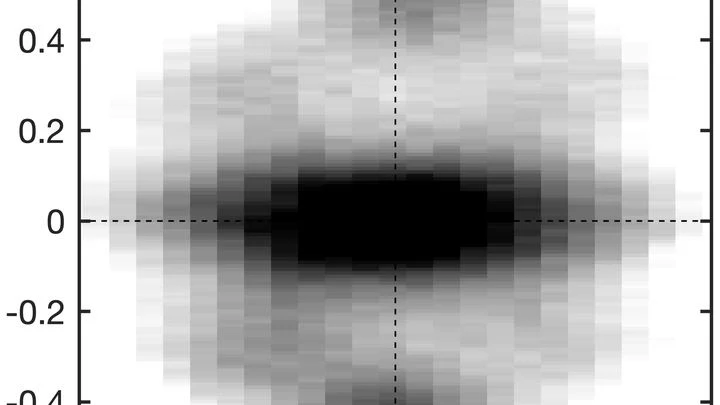
In the crystal Rb1-xV2Te2O, the spins of vanadium atoms arrange in a checkerboard pattern: each spin is surrounded by opposite spins. This pattern is called G-type antiferromagnetism. Neutrons passing through the sample scatter off this pattern and reveal its geometry, like light from a flashlight shining through blinds casting stripes on a wall.
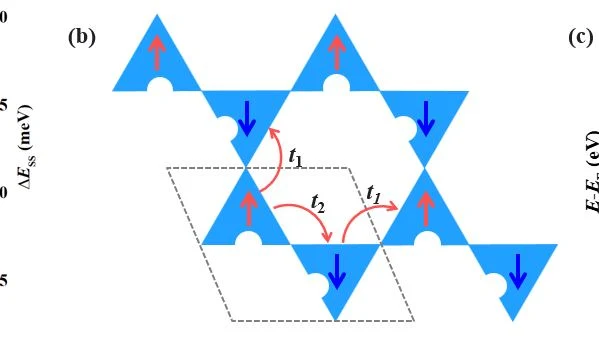
Honeycombs are built from identical cells, but tweak the shape of just one, and the whole structure gains new properties. Researchers did something similar to create a magnet without a single metal atom. They took flat carbon molecules shaped like triangles, triangulenes, and arranged them in a hexagonal lattice, just as bees build honeycombs.
A regular fridge magnet attracts iron because all its tiny magnetic arrows point in the same direction. But there are materials where the arrows arrange themselves more cunningly: neighboring rows point in opposite directions, so from the outside it looks like there's no magnetism at all. Such materials are called altermagnets.
In a thin magnetic film, like in an overcrowded hall, each 'person' is a spin arrow that wants to align with its neighbors. But in the corners of the hall, jams occur — vortices where the arrows twist and cannot straighten out. These vortices live in pairs: one spins left, the other right, and together they prevent the hall from fully settling down.
The atomic nucleus is not just a ball of protons and neutrons. Inside it, like a tiny magnet, there is its own distribution of magnetization. Until now, it has been difficult to see: nuclei live for tiny fractions of a second, and their magnetic field is weak. Now physicists at CERN have found a way to look inside.
If you hold an iron nail near a magnet, it will be attracted. Inside the magnet, tiny atomic magnetic arrows point in the same direction, like soldiers in formation. But in some crystals, the formation is different: neighboring arrows point in opposite directions. This order is called altermagnetism, and it is hard to see directly.
Altermagnets resemble a ballroom where couples spin in opposite directions: the hall itself is still, but inside, ordered motion seethes. Similarly, electron spins (the direction of their rotation) in these materials form intricate patterns without creating an overall magnetism.
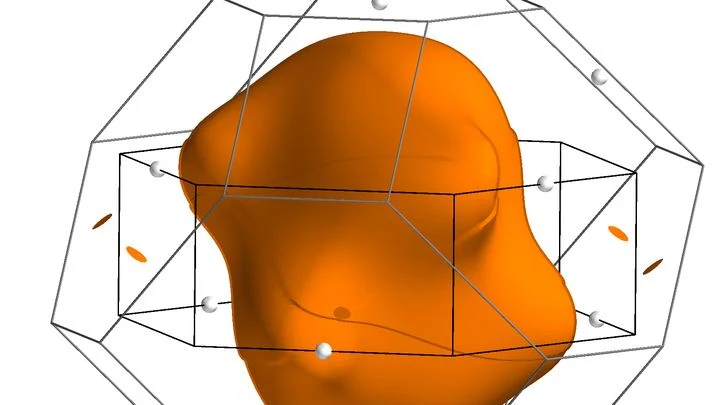
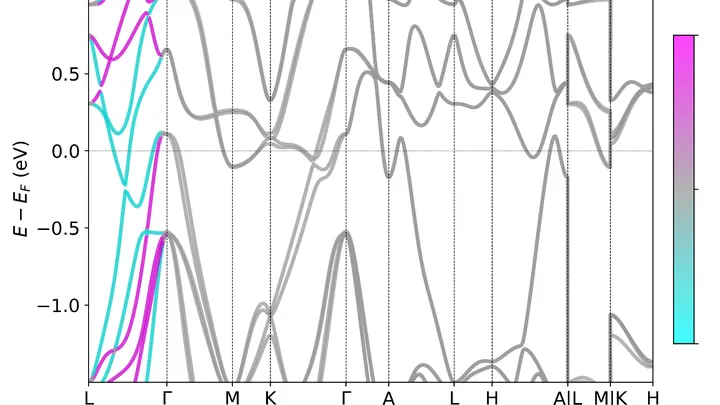
Electrons in a CrSb crystal behave like a school of fish: inside the material, they dart along their "corridors," and at the boundary with vacuum, they arrange themselves into intricate patterns. These patterns are the Fermi surface — a map of all allowed electron velocities. You can't reach out and touch it, but you can "feel" it with a magnetic field.
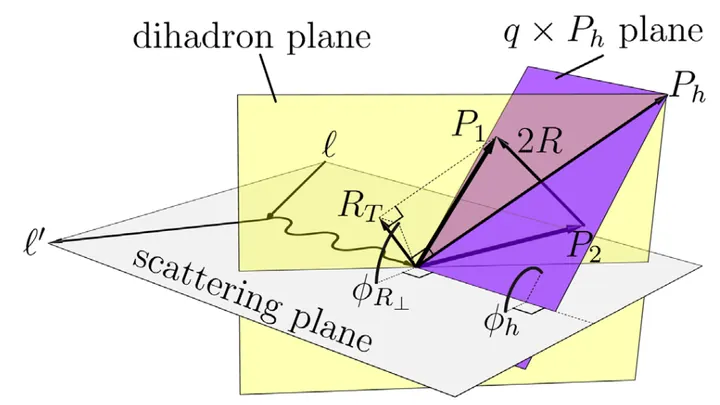
A beam of electrons, twisted like a corkscrew, slams into a proton. From the collision point, pairs of particles, a positive and a neutral pion, fly out. For the first time, physicists measured how often such pairs scatter at different angles when the electron's spin points left or right.
The CrSb crystal behaves like an intersection where electrons with different spins choose different lanes. In a conventional magnet, all electrons align in one direction, but in an altermagnet, spins alternate like squares on a chessboard. This creates a complex map of velocities that is hard to see directly.
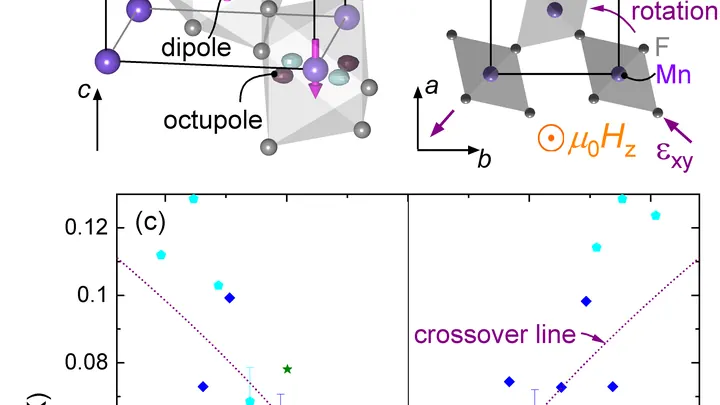
In a manganese fluoride crystal, atoms are lined up like soldiers in formation. But within this formation lies a hidden pattern: the magnetic moments of the atoms point in opposite directions, and the pattern itself changes when the crystal is rotated.
In a typical magnet, all spins of electrons (internal ‘arrows’-magnets, discovered by Pauli) point one way. Altermagnets, like MnTe, are trickier: these arrows alternate direction, like ripples spreading from a pebble tossed into water. But here’s the twist — the ripple arises from the electrons’ own motion.