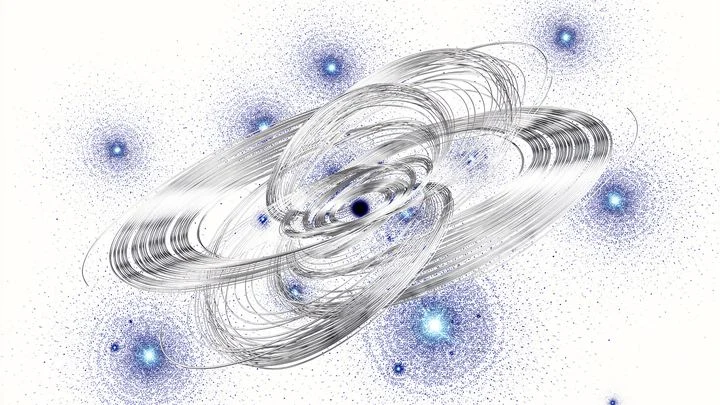
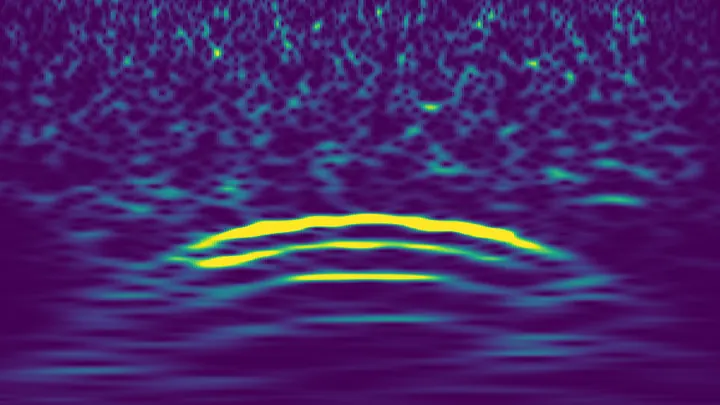
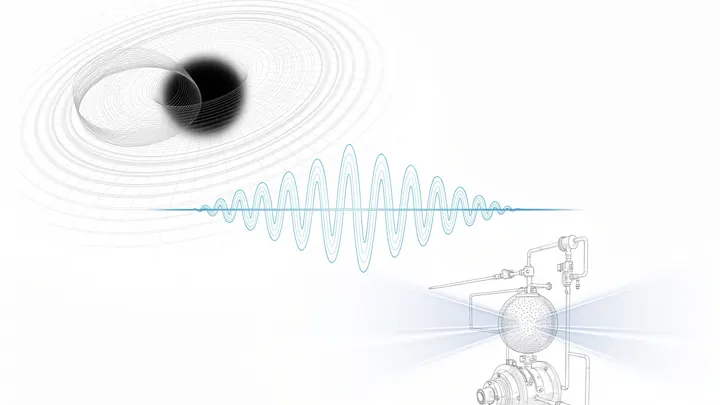
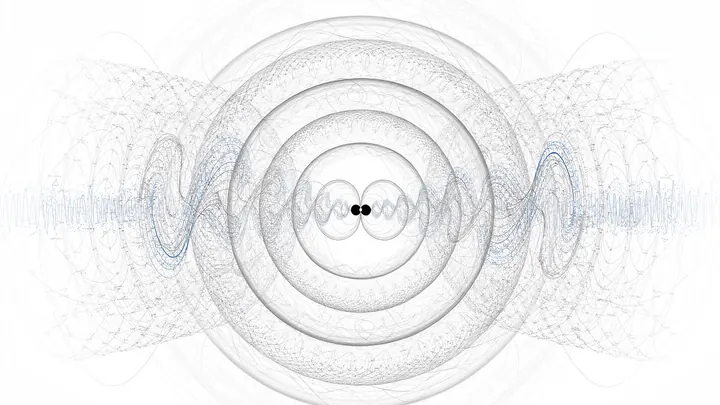
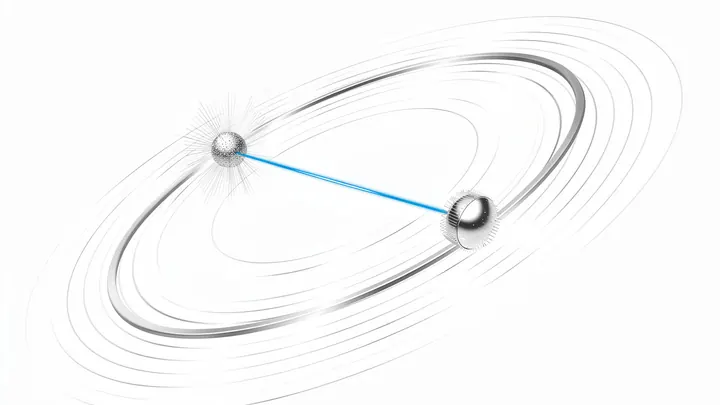
Effective spin is a parameter used in gravitational wave astronomy to describe the combined spin of a binary black hole system, projected along the orbital angular momentum axis. When two black holes orbit each other and eventually merge, their individual spins (rotations) affect the gravitational waves they emit. The effective spin, often denoted as χ_eff, is a mass-weighted average of the components of the two black holes' spins aligned with the orbital axis. It is a crucial observable because it influences the dynamics of the inspiral and the properties of the final merged black hole, and it can be measured from the gravitational wave signal.
History
The concept of effective spin was introduced in the early 2000s in the context of post-Newtonian approximations for binary black hole systems, notably by Alessandra Buonanno and others. It became widely used after the first gravitational wave detection in 2015, as it is one of the key parameters inferred from signals.
How it works
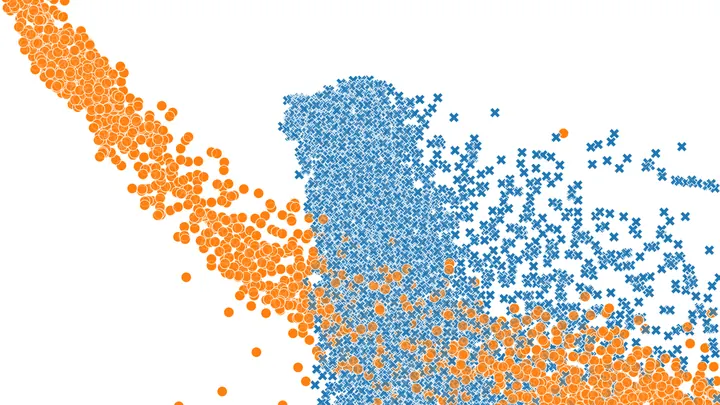
For a binary system with black hole masses m1 and m2 and spin vectors S1 and S2, the effective spin is defined as χ_eff = (m1 * S1_z + m2 * S2_z) / (m1^2 + m2^2) (in units where G=c=1), where S1_z and S2_z are the components of the spins along the orbital angular momentum direction. This quantity is conserved during the inspiral phase to a good approximation, making it a robust observable. A positive χ_eff indicates that the spins are aligned with the orbital motion, while a negative value means they are anti-aligned. The magnitude ranges from −1 to +1, with 0 indicating no net alignment.
In practice
Effective spin is used to infer the spin properties of black hole binaries from gravitational wave signals detected by LIGO and Virgo, helping to understand how black holes form and evolve in stellar binaries.
Fun fact
The first detected gravitational wave event, GW150914, had an effective spin consistent with zero, suggesting that the two black holes were either non-spinning or had spins that canceled out along the orbital axis.
In 2015, the LIGO detectors caught the first ripple of spacetime from a black hole merger. Since then, hundreds of such events have piled up, each carrying the imprint of its ancestry: whether the holes were born together from a single pair of stars or met by chance in a dense cluster. The difference shows in the direction of their spin axes.
Imagine two spinning tops set on a table. If they spin in the same direction, their combined rotation is large; if they spin toward each other, the total rotation can be zero even though each top spins rapidly on its own. In a pair of neutron stars approaching merger, their individual rotations, spins, play the role of such tops.
A black hole is like a spinning top that never stops on its own. But if a cloud of ultra-light particles, bosons, forms around it, the picture changes. This "fog" acts like an invisible brake: the particles drain the hole's spin, slowing it down.
A dance floor where couples whirl. At the center, an invisible master of ceremonies sets the rhythm. This is the supermassive black hole at the heart of the Milky Way, and the couples are stars whose orbits astronomers have tracked for years. But what if the master himself is wrapped in a fluffy fur coat of tenuous matter?
Drop two stones of different shapes into a pond — the ripples will tell you which one was smooth and which was jagged. Gravitational waves work the same way: when two ultra-dense objects merge, the trembling of spacetime carries details about their inner workings.
A black hole spun up almost to its limit is like an athlete balancing on the edge of a record. The most interesting action isn't inside the hole itself, but in the thinnest film of spacetime at its horizon. It's there that tiny corrections to Einstein's gravity can suddenly swell to gigantic proportions.
A black hole is like a perfect safe: everything that falls in disappears without a trace. But quantum mechanics whispers that on the microscopic level, information is not lost but recorded on an invisible "surface." Understanding this record means unraveling the fabric of gravity.
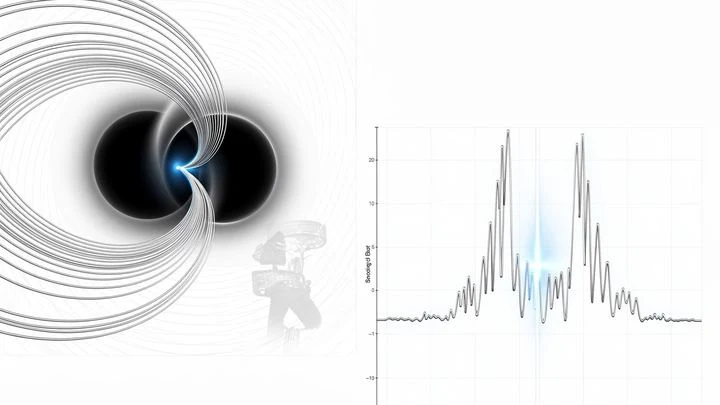
Two black holes circle in a cosmic dance, spiraling closer together. In the end, they merge into one, and that moment unleashes a powerful burst of gravitational waves, ripples in spacetime itself. But what remains after the merger?
Hidden within thin layers of tantalum selenide (TaSe₂) is a property that defies conventional physics. When guest atoms were added between the layers of this material, the structure lost its center of symmetry, and inside, superconductivity with armor emerged.
A whirlpool gulps down water, but splashes most of it back out. That's roughly how a black hole behaves when too much matter falls onto it. In a new study, astrophysicists ran 32 computer simulations to understand how a black hole's parameters — mass, spin, and "appetite"—control these cosmic fountains.
A cosmic object spins, but its shadow isn't round. Astrophysicists examined a black hole in an unusual version of gravity — the so-called brane world (where our universe is a three-dimensional surface in a space of higher dimensions).
A star circles a rotating black hole like a figure skater at the center of a rink. While it is far away and can be treated as a point, the dance remains predictable: the orbit follows clear laws, like music that is easy to glide to. But as it approaches, gravity begins to act unevenly.
A galaxy collision is like a slow dance in which two partners gradually draw closer. Hidden at the center of each is a supermassive black hole — an invisible flywheel with a mass of millions or billions of suns.
At the center of a galaxy sits a supermassive black hole, surrounded by a vast, tenuous cloud of dark matter. It doesn't shine or heat, but its gravity warps space and changes the rules of the game for everything orbiting nearby.
Layer by layer, artifact by artifact — an archaeologist reconstructs the history of an ancient settlement. Similarly, astrophysicists sifting through 259 records from LIGO–Virgo–KAGRA saw a clear layered structure among merging black holes.
Three milliseconds before the merger. A gargantuan black hole spinning at breakneck speed drags in a neutron star — a ball the size of a city but with 1.5 times the Sun's mass. Tidal forces stretch the star into a thread as thin as a needle and fling its matter outward.
The spiral of water draining into a sink spins faster and faster toward the center. In an ordinary black hole, that funnel ends in an infinitely sharp point — a singularity where the laws of physics break down. But this new work considers a different picture: the funnel doesn't taper to a needle but ends in a smooth, swelling bubble.
In May 2020, the LIGO and Virgo detectors picked up a gravitational-wave burst known as GW200105. Among the many similar gravitational waves recorded, this one stood out for an oddity: the orbit of the colliding neutron star and black hole was not a perfect circle, but a stretched ellipse.
Dark matter is invisible to telescopes, but its gravity was revealed half a century ago by Vera Rubin. Since then, physicists have explored dozens of hypotheses, and one of the most elegant is primordial black holes, formed in the first moments after the Big Bang.
Gravitational-wave detectors are like sensitive microphones, listening for the whispers of distant cataclysms. But every now and then, a sharp crack bursts in — a brief noise spike known as a glitch.
The LIGO detectors caught the signal GW250114—a gravitational wave from the merger of two black holes. After the main burst, a decaying 'tail' remained — direct waves from the newborn hole's horizon. It was expected that their damping would reveal the gravitational strength at the horizon's surface. But the measured value came out smaller.
Hot gas spirals inward, falling onto an invisible superdense object. Such a disk resembles a giant whirlpool, but it is often tilted: its axis does not align with the rotation axis of the central body. The gravity of the massive object makes the disk wobble slightly, like a spinning top losing its balance.
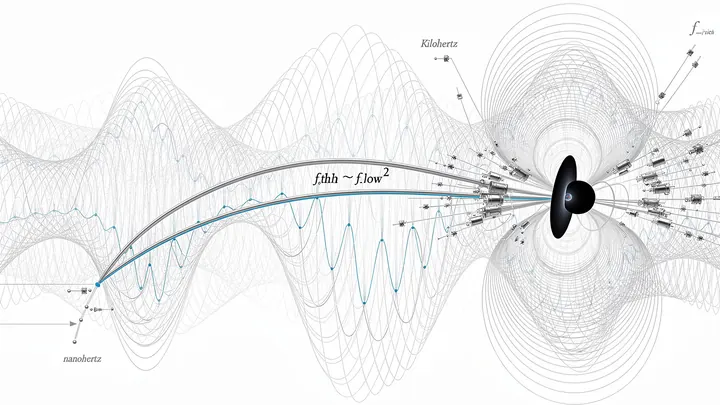
In the ocean of space, every storm of birth or merger of supermassive black holes generates ripples — gravitational waves traveling at the speed of light. Over billions of years, these waves superimpose, merging into a low-frequency hum, like a distant surf.
In the heart of a dense star cluster, a true forge reigns: here stars, like glowing blanks, collide and merge under gravity, and these mergers are not a catastrophe but an opportunity. Each strike of the stellar hammer transfers spin to the future black hole.
The mystery of dark matter has puzzled physicists for nearly a century. Among the candidates for its role are primordial black holes (PBHs), born in the fiery embrace of the first moment after the Big Bang.
The mergers of black holes, first predicted by Karl Schwarzschild, are the main source of gravitational waves picked up by LIGO detectors. Over the years, 259 events have accumulated, each one an encrypted birth story of a pair. But is there a hidden system in this data?
A detective story unfolded in the GWTC-5 catalog. Hundreds of signals from merging black holes, captured by the detectors of Rainer Weiss and his colleagues, held the secret to the origin of the most massive and rapidly spinning stellar-scale objects.
After the Big Bang, the universe underwent a rapid expansion — inflation, smoothing out the cosmic microwave background and sowing the seeds of galaxies. But at the quantum level, chaotic fluctuations brewed in the inflaton field.
The cosmos sets its own lenses in the path of gravitational waves. When two black holes merge, the resulting ripple travels through the universe. If it encounters a massive galaxy cluster along the way, its gravity bends the path of the waves — much like glass focuses light.
At the center of galaxy M87, 55 million light-years away, lurks a black hole with a mass of 6.5 billion Suns. In 2019, the Event Horizon Telescope (EHT) gave us its first portrait: an orange donut with a dark core. But the donut is not the abyss itself.
A figure skater spins on the ice, gradually spiraling inward. Similarly, a small star or black hole orbiting a massive black hole loses energy. It emits gravitational waves — ripples in spacetime that detectors on Earth pick up.
But the dance of this pair is more intricate than it seems. The small companion isn't just a point.
In the centers of distant galaxies, X-ray 'beacons' sometimes light up. They don't flash randomly but on a strict schedule: every few hours or days. These bursts are called quasi-periodic eruptions (repeating at nearly regular intervals).
Gravitational-wave detectors picked up a strange burst — the signal GW241011. Two black holes merged, but the pair looked unusual: one hole was about three times lighter than the other, and the system as a whole was spinning rapidly. Such a combination is a rare guest in the catalogs.
A black hole with a magnetic field resembles a whirlpool in a river, where water doesn't flow into the vortex but swirls in place. Usually, the hole's rotation picks up waves and amplifies them: this is called superradiance. But add a magnetic field, and everything changes.
Two dead stars circle in a final dance. Their approach creates ripples in space — gravitational waves. But there may be a third, invisible partner in this dance. Its gravity accelerates the pair, and the signal changes pitch slightly, like the siren of a passing car.
A pair of neutron stars, locked in a gravitational embrace, traces invisible circles in the void. A century ago, Albert Einstein described this dance as waves of curved geometry, but for a long time we could only catch glimpses — through the feverish flicker of radio pulses.
At the center of a galaxy, a huge black hole is shrouded in an invisible cloud — a swarm of ultralight particles that it itself spawned. Into this cloud dives another black hole, about the size of a star, and begins a long spiral dance. The approach takes millions of years, but the most dramatic events unfold right at the horizon.
A tightrope walker spirals over an abyss, each loop drawing closer to the center. Their path is not a smooth glide but a series of sharp jerks and pauses. That is roughly how a tiny black hole behaves when it is pulled toward a supermassive neighbor.
A black hole is a place where gravity is so strong that even light cannot escape. But around it there is a glowing ring of gas, and in the center a dark void known as the shadow. The size of this shadow depends on how spacetime is curved.