Light That Tunes Itself express
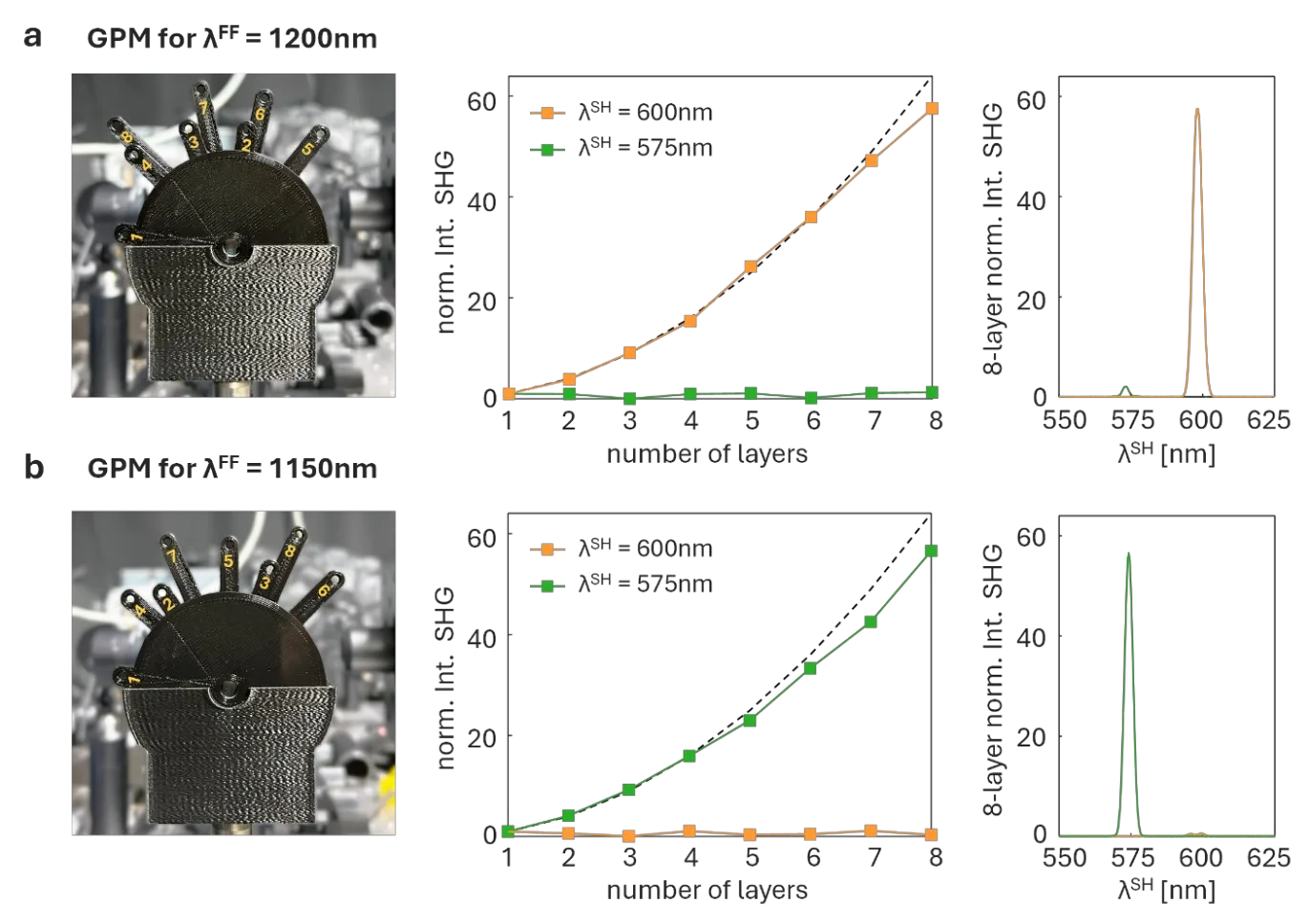
When two light beams meet in a crystal, they can generate a third beam with a different frequency. For this process to be efficient, the waves need to stay in step, like two people walking side by side without breaking stride. Previously, two old tricks were used: either picking a crystal with the right properties, or slicing it into thin layers. Both methods were invented more than sixty years ago, and each has its limitations.
The authors propose a third way. They stack thin crystal films on top of each other and slightly rotate each one. This 'layer cake' allows controlling the step of light waves without changing the material itself. In their experiment, they assembled a stack of eight layers and achieved nearly perfect phase matching. And with a stack of two layers, they could completely switch the generation of the new beam on and off.
This approach makes light-mixing devices flexible: the tuning can be adjusted on the fly. It could be useful in lasers, quantum devices, and new materials that control light.
A stack of eight thin crystal films, thinner than a human hair, can replace a bulky system of lenses and prisms.