Tuning, in the context of axion detectors, refers to the precise adjustment of the detector's resonance frequency to match the mass of the hypothetical axion particle. Because the axion's mass is not known in advance, detectors must be able to scan a range of frequencies. Traditionally, this is done by changing the magnetic field strength, but a more elegant method involves physically tilting the detector's resonant cavity. This tilting changes the effective path length for photons, thereby shifting the resonance frequency without requiring any moving mechanical parts that could introduce noise or instability.
History
The technique of tuning axion detectors by tilting was developed as part of the ADMX (Axion Dark Matter eXperiment) collaboration in the 1990s, building on the original axion detection concept proposed by Pierre Sikivie in 1983.
How it works
The detector typically consists of a microwave cavity placed in a strong magnetic field. When an axion converts into a photon inside this cavity, it produces a tiny electromagnetic signal at a frequency proportional to the axion's mass. By tilting the cavity relative to the magnetic field, the effective electromagnetic boundary conditions change, which alters the cavity's resonant frequency. This allows researchers to sweep through a range of possible axion masses by simply rotating the cavity, a process that can be controlled with high precision and repeatability.
In practice
This tuning method is used in haloscope experiments searching for dark matter axions, such as ADMX and HAYSTAC, enabling continuous frequency scanning over a wide mass range.
Fun fact
The tilting mechanism is so precise that it can adjust the resonance frequency in steps of less than one part per million, allowing researchers to probe extremely narrow axion mass windows.
Picture a radio receiver with a single tuning knob that moves all of its internal coils at once, like one living organism. That is exactly how a new instrument for the search for the axion works, a particle that may fill galaxies with invisible mass. Inside a copper cylinder the height of a coffee can sit rods of aluminum oxide.
In the basement of the laboratory, an 8 tesla magnet hums. Inside it, like a bell in a bell tower, hangs a hollow copper cylinder tuned to a single note. If an axion, a dark matter particle, flies by, the cylinder responds with a faint ring. The trouble is that ordinary copper muffles this ring: at high frequencies, current flows only through a thin skin of the metal, and losses grow.
An interpreter in a crowded room tries to make out one person's speech but hears the murmur of hundreds of voices. A molecule storing quantum information in its spin finds itself in a similar situation: its spin is surrounded by the thermal jitter of atoms, and it is this jitter that gradually erases memory.
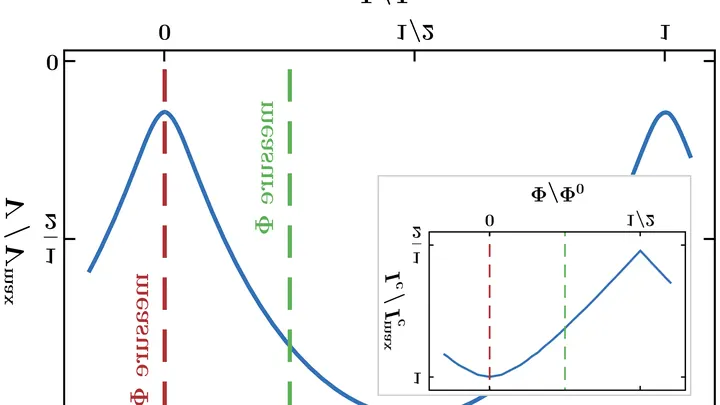
A lighthouse at sea doesn't just rotate: its lamp itself dims and brightens on its own. Magnetic white dwarfs, the ultra-dense remnants of stars like our Sun, behave in much the same way. Their powerful magnetic fields can convert light into axions — hypothetical particles that could explain the Universe's hidden mass.
In the pitch darkness of a vacuum chamber, a tiny magnet floats. It touches no walls and loses almost no energy — an ideal sentinel, ready to catch the faintest nudge. Such a sentinel is exactly what you need for axion hunting. These particles are prime suspects in the case of the Universe's hidden mass, which we call dark matter.
In a dark room, a glass bead the size of a dust grain hangs on a laser beam. Beneath it are two mirrors: one aluminum, one silver. If axions (light, invisible particles that could make up the mysterious dark matter) whiz by, they exchange with the mirror atoms, and the bead shifts ever so slightly.
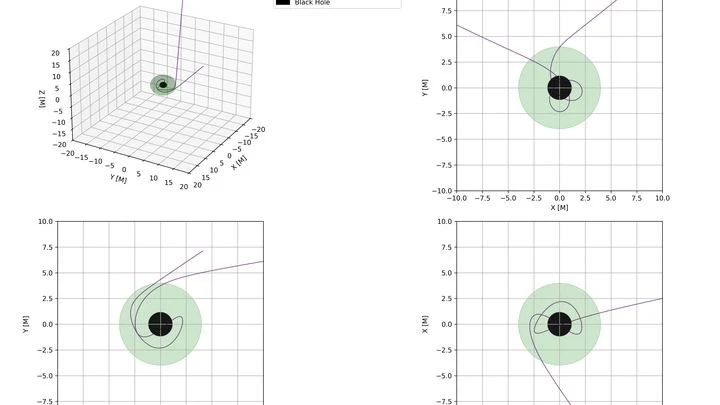
Light passing by a black hole falls into a gravitational trap: its trajectory curves and the particle bounces along a nearly closed orbit, like a pinball.
Dark matter has eluded direct observation so far, even though its gravity holds galaxies together. One hypothesis: it’s made of axions — ultra-light particles predicted by theory.
In a noisy city, you try to hear a cricket. It's quiet, and cars are humming all around. To catch its chirp, you set up a sensitive microphone and hit the noise-cancellation button. That's roughly how physicists hunt for axions — hypothetical particles that could be the very dark matter holding galaxies together.
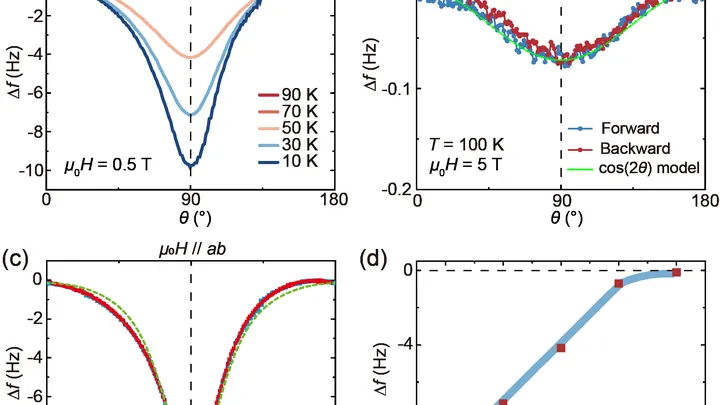
A magnet, like a compass needle, likes to point in a certain direction. But what if the material is layered, like a stack of pancakes? Scientists took just such a magnet made from a compound of chromium, germanium, and tellurium and set out to find out how stubbornly it resists having its magnetization turned.
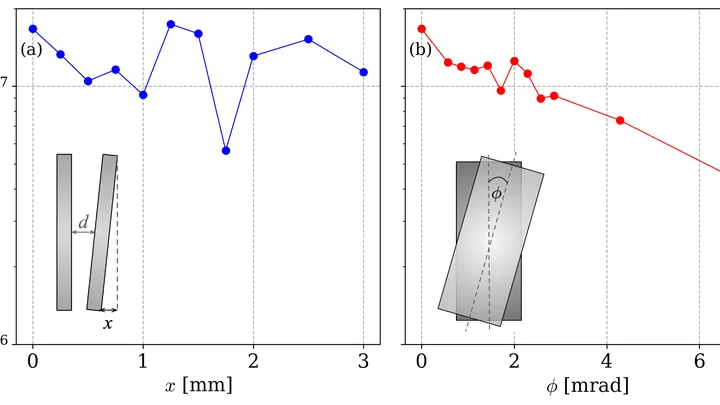
A radio receiver hunting for dark matter is like a bell: it responds to only one note. The trouble is, nobody knows what note dark matter plays, so the bell needs to be retunable. Usually, a metal rod is inserted inside, but it creates extra noise.
In collisions of heavy nuclei, a fireball of thousands of particles is born. Among them are pions and kaons, two kinds of light particles that look very much alike. To understand what happens in this fireball, physicists need to know exactly how many of each particle flew out.
A storm is brewing somewhere far away, and the Geiger counter is already clicking more often. That's how cosmic rays, a stream of charged particles from deep space, make themselves known. When they slam into the atmosphere, they create showers of secondary particles, including muons: heavy cousins of electrons that can reach the ground.
In its infancy, the universe was a hot, plasma-like mixture of particles. Microseconds after the Big Bang, as it cooled, the temperature fluctuated slightly.
A pot on the stove rings when the water boils. An empty copper cup can also "ring"—at radio frequencies — if a dark matter particle is born inside it. These particles are called axions, and according to one hypothesis, they fill the entire galaxy as an invisible cloud.
Dark matter doesn't emit or reflect light, yet its gravity holds galaxies together. What it's made of is a mystery. One leading candidate is the axion, an ultra-light particle. Searching for axions is like listening for a very faint radio signal, but the receiver's own noise gets in the way.
Dark matter is five times more massive than ordinary matter, yet it emits no light. Its nature remains unknown. One candidate is the ultra-light axion particle. Axions could pierce right through the planet, barely noticing atoms.
Deep inside a cryostat, beneath layers of superconducting coils, lies a stack of hundreds of semiconductor layers. Each layer is just a few nanometers thick: gallium arsenide, then aluminum gallium arsenide. The electrons within these layers are confined to a plane, like ants on a sheet of paper.
The ARCADE2 radiometer on a high-altitude balloon detected an excess radio emission, while the ground-based EDGES experiment found an anomalously deep trough in the hydrogen spectrum at 21 cm. Both signals do not fit the standard cosmological model and point to an unknown source of soft photons.