Solar Spicules: How the Corona Gets Its Heat express
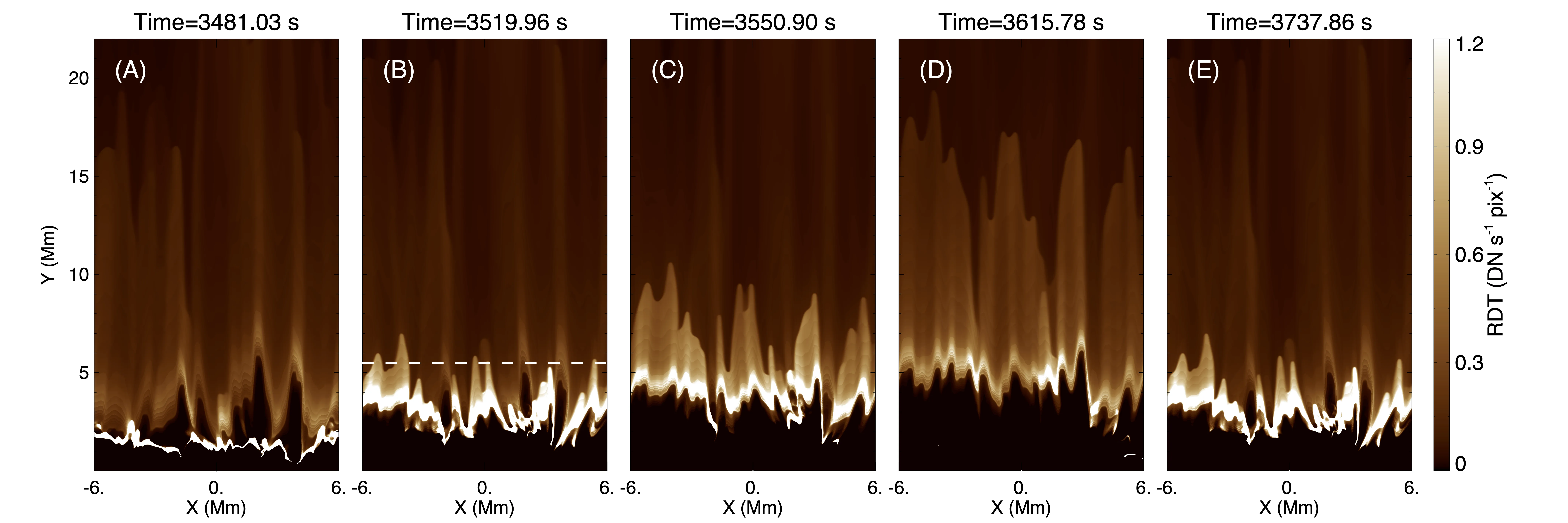
The Sun's surface boils like water in a pot. Hot gas rises, cools, and sinks: that's convection. Magnetic fields churn around, tearing and reconnecting. In this frenzy, spicules are born: narrow plasma jets that shoot thousands of kilometers upward. They live only a few minutes, but they manage to transfer energy to the Sun's outer atmosphere.
Spicules don't just shoot up: they push waves and shock fronts ahead of them. These waves compress the gas and heat it. That's how energy from the surface reaches the corona — the tenuous outer layer that is hundreds of times hotter than the surface itself. Without spicules, the corona would cool, and the solar wind in coronal holes would dry up.
So one little jet after another, like a pump, drives heat into the corona. Spicules are not just a pretty sight at the Sun's limb. They are the key to a puzzle that has stumped astrophysicists for 80 years: why the corona is hotter than the surface.
Original abstract
as written by the authors arXiv:2602.19953
How the solar atmosphere is heated from a temperature of about $$5,000-6,000$$\,K in the lower atmosphere to about $$1-2$$\,MK in the corona has challenged the astrophysical community for about 80 years. The same puzzle exists for the stellar coronae heating as well. In this study, we present a series of findings on solar spicules and their subsequent impact on the corona within a coronal hole environment, characterized by locally open magnetic field lines, combining insights from MHD simulations with observations. We find that the convective and turbulent motions around the solar surface cause plenty of shocks and small-scale magnetic reconnection in the lower atmosphere. The combined effects of shock compression and reconnection outflows then drive the formation of groups of spicules with a quasi-period of about $$300$$\,s and width of $$\sim 200-500$$\,km. The spicule upflows provide an averaged mass flux above $$10^{-9}$$\,kg\,m$$^{-2}$$\,s$$^{-1}$$ in the lower corona to sustain the solar wind in coronal holes, and they continuously trigger further new local slow-mode waves and shocks. These waves supply an energy flux of $$10-100$$\,W\,m$$^{-2}$$ in the lower corona, and they are dissipated by heat conduction and compression heating to sustain the corona temperature of about $$1$$\,MK. The results also indicate that the upward propagating disturbances (PDs) observed in extreme ultraviolet (EUV) passbands are caused by both spicule upflows and slow-mode waves and shocks. Our findings help to understand the long standing problem of coronal heating and the origin of solar winds in coronal hole regions.
The temperature of the Sun's corona is about a million degrees, while the surface is only 5500 degrees. That's like the air around a campfire being hotter than the flame itself.