A black hole corona is a region of extremely hot, tenuous plasma that surrounds the inner part of a black hole's accretion disk. It is analogous to the corona of the Sun, but far more energetic: temperatures here can reach billions of degrees, causing the gas to emit intense X-rays. This corona is not a static halo; it can exhibit rapid variability, produce outflows of material, and even launch jets. The corona plays a crucial role in our understanding of how black holes 'feed' and how the energy released during accretion is transported.
History
The concept of a hot corona around a black hole was developed in the 1980s, following the discovery of hard X-ray emission from accreting black holes, which could not be explained by the cool disk alone. The term 'corona' was borrowed from solar physics due to the analogous role of a hot, tenuous outer layer.
How it works
The corona is thought to be powered by the accretion disk itself. As matter spirals inward, it heats up and emits thermal radiation, mostly in ultraviolet and soft X-rays. The corona, likely a layer of hot plasma above the disk, can then upscatter these lower-energy photons to much higher energies via inverse Compton scattering. This process, where fast-moving electrons in the corona transfer energy to photons, produces the hard X-ray spectrum we observe. The corona's variability is linked to changes in the accretion flow, and its outflows can be driven by magnetic fields or radiation pressure, influencing the surrounding galaxy.
In practice
Studying black hole coronae is essential for interpreting X-ray observations from space telescopes like Chandra and XMM-Newton, helping astronomers measure black hole masses and spin rates.
Fun fact
The corona of a black hole can be so hot that it emits X-rays with energies thousands of times higher than those from the Sun's corona.
At the center of nearly every large galaxy sits a supermassive black hole. It doesn't just devour infalling gas; it also blasts some of it back out in powerful jets. These jets act like giant pistons, shoving the surrounding gas and heating it. Astronomers have long suspected that this is how black holes keep galaxies from cooling into cold star factories.
In the distant Cigar Galaxy, there is an unusual beacon. It doesn't shine in the usual sense: its rays are born in a scorching cloud around a black hole that is devouring matter from a companion star. Such objects are called ultraluminous X-ray sources. Their X-ray brilliance is so intense that it outshines entire galaxies.
This cloud, the corona, is like a boiling cauldron.
May 2022. The space polarimeter IXPE, the spectroscope NuSTAR, and the monitor NICER simultaneously stared at one spot in the sky — at the black hole in the Cygnus X-1 system, where it orbits a blue supergiant in a close binary system with a period of 5.6 days.
At the heart of the giant galaxy Hydra-A, there's a hive of activity. A supermassive black hole shoots out two powerful plasma jets. They punch through the surrounding cloud of hot gas and inflate giant bubbles within it.
Active galactic nuclei (AGN) are the universe’s powerhouses: their X-ray coronae blaze millions of times hotter than stellar atmospheres. But what strikes the spark? A ten-day X-ray campaign by the XRISM and XMM-Newton satellites, aimed at NGC 3783, provided the answer: it’s actual thunderstorms.
A powerful spotlight flickers on and off. Light reflects off surrounding clouds, and by measuring the delay of the reflected signal, you can figure out how far away the clouds are. That's roughly how astronomers study the hot corona — a scorching cloud of plasma above the black hole at the center of an active galaxy.
But there's a catch.
In astrophysics, some numbers seem random yet recur with the persistence of a spell. One such number is the ratio of X-ray brightness to H-alpha hydrogen emission in turbulent gas tails. From galactic winds to ‘jellyfish’ slicing through clusters, this ratio steadily holds at around three.
Cosmic black holes at the centers of galaxies are like giant banyan trees: their aerial root‑filaments stretch for kiloparsecs to harvest nourishing matter. For decades astronomers have debated: how does cooling gas from cluster atmospheres fall into the sphere of influence of a supermassive hole?
A supernova is the final explosion of a massive star, scattering its material over light-years. Inside the expanding shell, a neutron star remains, and the shell itself continues to plow through interstellar gas for thousands of years.
Around our Galaxy, like an invisible crown, stretches a tenuous cloud of gas heated to millions of degrees. It is called the galactic halo. Seeing this glow directly is difficult: it emits soft X-rays that are absorbed by Earth's atmosphere.
A lantern shines through thick fog. Light scatters off water droplets, and the lantern appears blurred. Something similar happens around a black hole: hot gas, like fog, envelops it, while X-rays from the inner parts of the disk struggle through this cloud. Only here, the "droplets" are electrons, and the "fog" itself is called the corona.
A giant cauldron of simmering soup stretches across millions of light-years. This is the atmosphere of the Perseus galaxy cluster — a cloud of scorching gas held together by gravity. Until recently, astronomers thought that in the center of this cauldron, the gas was calmly cooling, ready to condense into new stars.
At the center of the distant galaxy MCG-6-30-15 lies a supermassive black hole. Around it swirls a disk of incandescent gas, and above the disk hangs a cloud of even hotter particles — the corona. In February 2024, three X-ray telescopes (XRISM, NuSTAR, and XMM-Newton) observed this system simultaneously.
At the center of the Milky Way, among dense clouds of gas and dust, lies a region called Sagittarius C. It's like a bustling crossroads: stars are born here, streams of matter collide, and the whole scene is illuminated by X-rays. For a long time, this glow remained a mystery.
In the Norma cluster, the nearest rich galaxy cluster to us, astronomers have spotted a shock wave. It arose when one cluster plowed into another, like the bow wave of a ship cutting through water. This wave compressed and heated the gas between the galaxies.
Two galaxies sit right behind the wave front.
During its 2021 outburst, the black hole in the GX 339-4 system behaved like an actress changing costumes between scenes. In the hard state, it wore two coronas at once: a hot, rarefied one, and over it, a warm, dense one. In the soft state, only the hot corona remained.
Not all water in a whirlpool goes down the drain: some splashes back up in narrow sprays. Gas near a black hole behaves similarly. It falls, heats up, collides with itself, and part of it is ejected back into space in two narrow jets that fly in opposite directions.
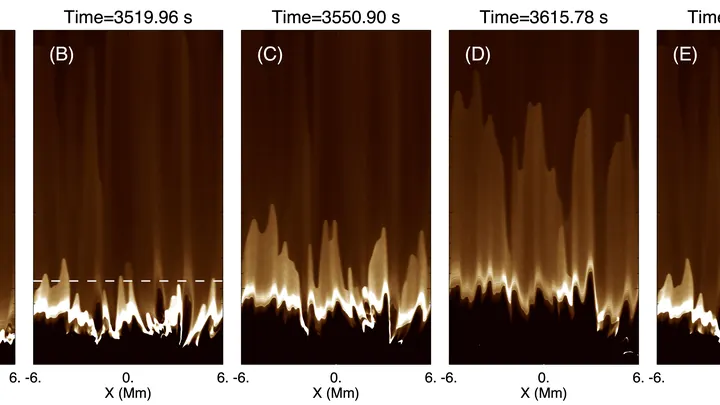
The Sun's surface boils like water in a pot. Hot gas rises, cools, and sinks: that's convection. Magnetic fields churn around, tearing and reconnecting. In this frenzy, spicules are born: narrow plasma jets that shoot thousands of kilometers upward.
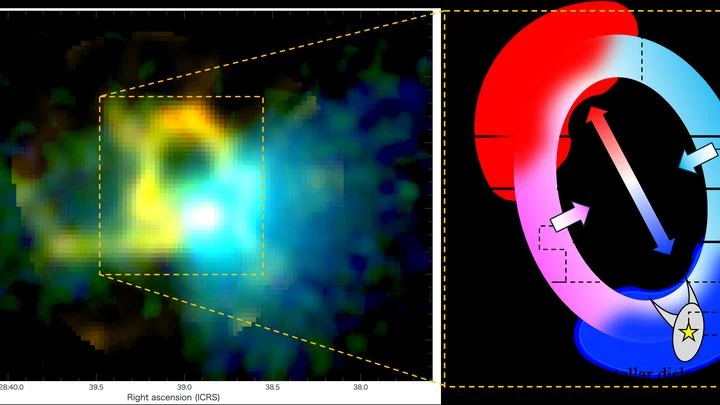
In a cold, dark cloud of gas where a star is just beginning to form, the ALMA telescope has spotted an unusual ring. It is made of gas that is warmer and denser than its surroundings. Such details were previously hidden because the gas at the cloud's center is opaque to ordinary observations.
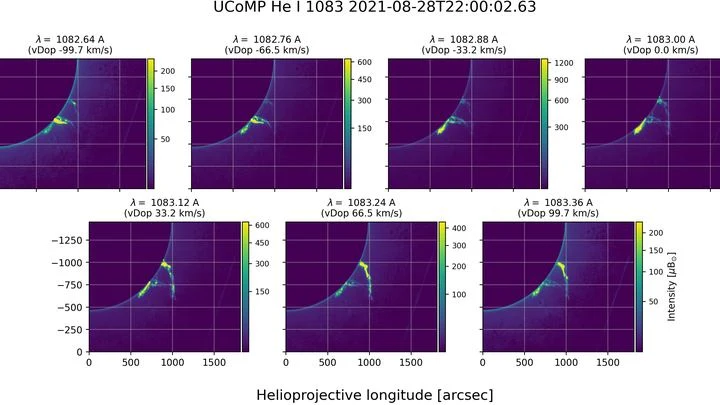
The Sun occasionally hurls enormous clouds of plasma into space — coronal mass ejections. Often tangled within these clouds are prominences: cooler, denser clumps of material. These contain plenty of neutral atoms that shine brightly in specific spectral lines.
One night in 2008, something in the core of the distant galaxy J1047+5907 flared sharply in X-rays. That's how the neighborhood of a supermassive black hole sometimes behaves: a scorching cloud of gas above it suddenly blasts out a powerful stream of light. The black hole itself emits nothing, but its surroundings can light up like a neon sign.
Astronomers observed seven times how a black hole tears apart a passing star. They measured the flares with high precision in X-rays and noticed: the more energetic radiation always outpaced the soft by 500 seconds. It's like a sound echo in the mountains — first you hear the direct shout, then its reflection off a cliff.
At the heart of the galaxy cluster RXCJ1558.3-1410, an invisible drama unfolds. Hot gas there is cooling, but something prevents it from collapsing and birthing new stars. Astronomers pointed a radio telescope at this cluster and saw a faint glow — a mini-halo.
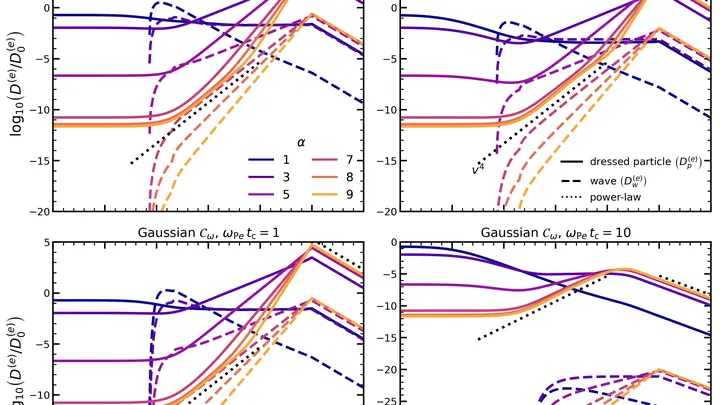
In a hot gas of charged particles — plasma — chaotic electric fields work like a sieve. A slow particle gets surrounded by a cloud of opposite charges, which cancels the external field. A fast one sheds this armor and gets accelerated.
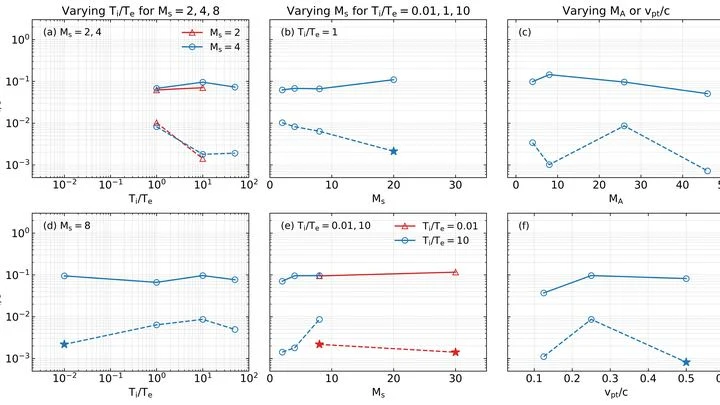
A new study confirms: shock waves in plasma around supermassive black holes at the cores of galaxies act like ocean swells, shoving protons to near-light speeds. Even a weak wave passes on a tenth of its energy, like a gentle surf launching a surfer into space.
At the center of many galaxies lurks a black hole — an object predicted by solutions to the equations of Karl Schwarzschild. Around it stretches a scorching corona — a region of tenuous plasma heated to billions of degrees.