Mountains on Exoplanets Prevent Eternal Winter express
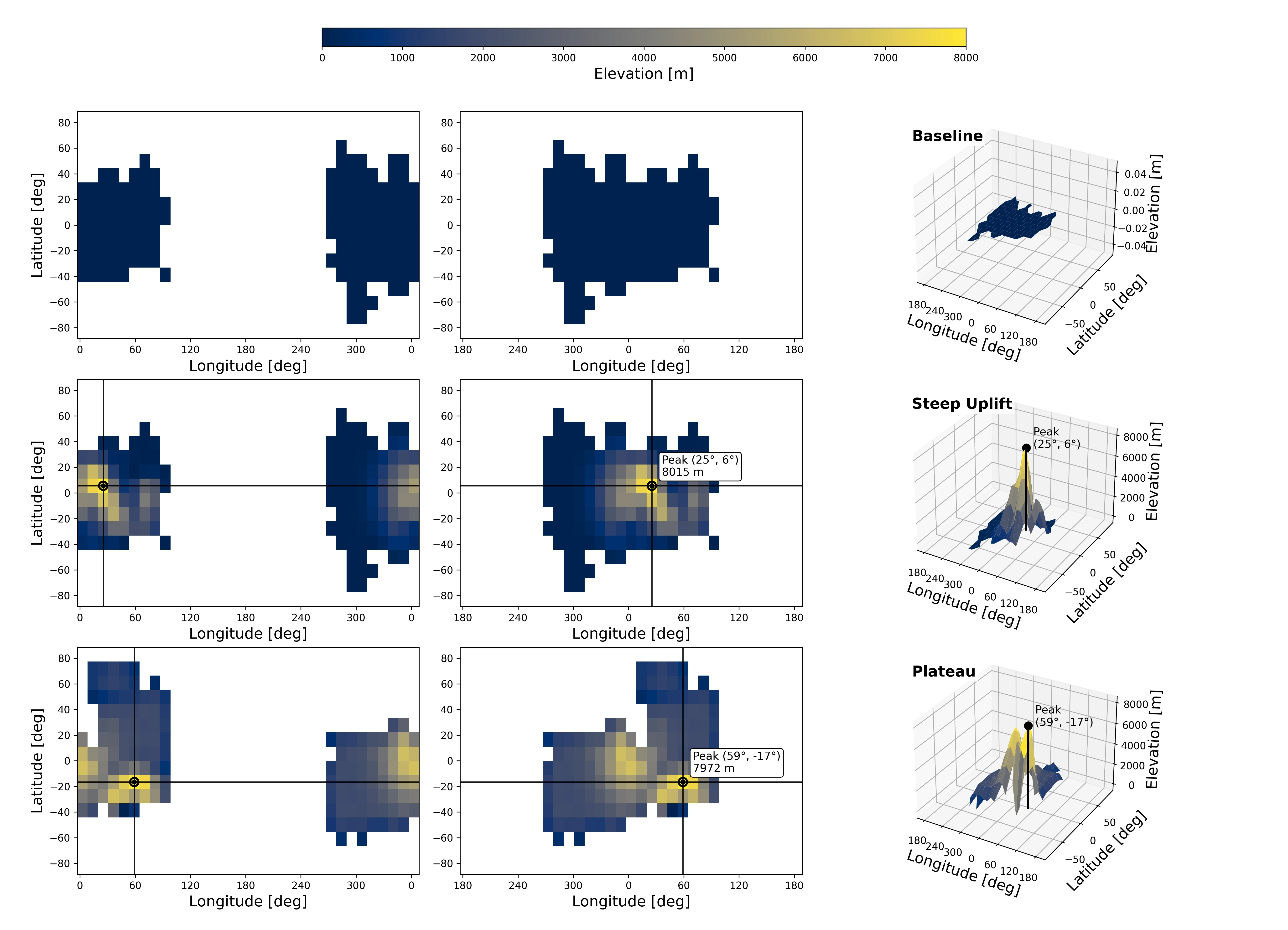
For exoplanets that always face their star with one side, the night side is doomed to eternal cold. But mountains can turn things around. Surface irregularities shake up the ocean of air, steering moisture flows across the day-night boundary. Once in the dark, water freezes into clouds, and clouds act like a blanket: they trap heat and keep the world from cooling down. Computer models show that even modest hills (not the Himalayas, just small uplifts) break symmetrical air vortices and give birth to a jet stream. Like a conveyor belt, it hauls moisture into the night, making the blanket thicker. The planet thaws, even under a weak-star glow. The James Webb Space Telescope can check this by analyzing light filtering through the atmosphere (spectroscopy). So the fate of distant worlds hinges not just on distance from their star, but on every wrinkle of their surface.
Original abstract
as written by the authors arXiv:2602.20155
Among potentially habitable worlds, rocky planets orbiting M dwarfs offer the most favorable prospects for atmospheric characterization, yet their climates may differ substantially from those of Earth analogs. In the tidally locked limit, the nightside's tendency to radiatively cool and potentially trap volatiles as permanent ice introduces a strong dependence of habitability on the planet's surface and atmospheric boundary conditions. We perform a suite of synchronously rotating experiments spanning a wide range of topographic and orographic realizations with different mean elevations and landmass distributions. Across a grid of $$p_{\mathrm{N2}} = 0.5$$-$$8~\mathrm{bar}$$ and $$F_{\star} = 1200$$-$$1700~\mathrm{W\,m^{-2}}$$, we find that surface relief breaks the flow symmetry, replacing the circumpolar vortices with mechanically forced stationary waves. Steep orography produces standing Rossby gyres that strengthen the cross-terminator jet and align vertical uplift with the day--night boundary. These new circulation regimes enhance moisture transport, increasing the infrared optical depth and promoting additional nightside cloud formation, which produces a stronger cloud-greenhouse feedback and lower the critical fluxes required for global planetary deglaciation. Broad, elevated plateaus drive a similarly fragmented but slightly weaker circulation, yielding less effective moisture transport. These results show that the relief and spatial distribution of landmasses, parameters unconstrained for most exoplanets, can exert strong controls on the climatic bifurcations of tidally locked M-dwarf exoplanets.
On Earth, mountain ranges spawn atmospheric waves that cause drought on one side and downpours on the other. But on exoplanets, that very mechanism can thaw an entire frozen world.