The dayside of a planet is the hemisphere that faces its star and receives direct stellar radiation. This is the side where it is 'day' — the sun is above the horizon, and the surface is bathed in starlight. The opposite hemisphere, the nightside, faces away and is dark. For planets that rotate slowly or are tidally locked (always showing the same face to their star), the contrast between dayside and nightside can be extreme, shaping the planet's climate, atmosphere, and even its geology.
History
The concept of a planetary dayside is as old as astronomy itself, but the term became particularly important with the discovery of tidally lockedexoplanets in the 1990s and 2000s, when scientists began modeling their extreme day-night contrasts.
How it works
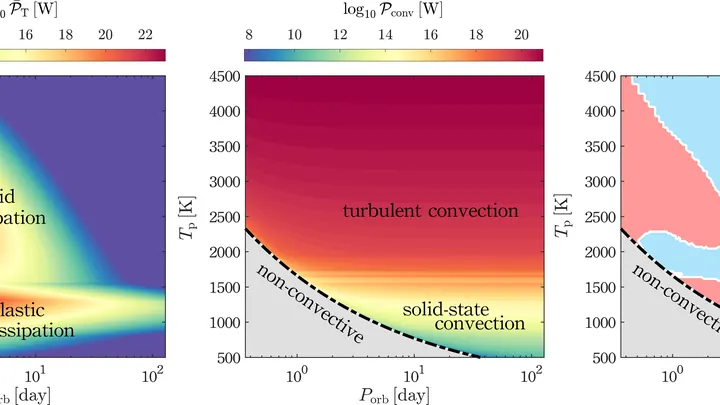
The dayside receives the bulk of the star's energy, which drives heating of the surface and atmosphere. This energy input powers atmospheric circulation, weather patterns, and can evaporate volatile materials. On tidally lockedplanets, the dayside is permanently hot, while the nightside is permanently cold, creating strong temperature gradients that drive powerful winds and may cause exotic phenomena like 'rocky waves' in magma oceans or atmospheric collapse on the nightside.
In practice
Understanding the dayside is crucial for interpreting observations of exoplanet atmospheres, as telescopes often measure the combined light from both hemispheres, and for modeling the habitability of planets around red dwarfstars.
Fun fact
On some tidally lockedexoplanets, the dayside is so hot that it melts rock, creating global magma oceans with waves driven by the relentless stellar heat.
Hundreds of light-years away, there's a planet that looks like a giant mirror. LTT9779b reflects most of the light that hits it — far more than you'd expect from a Neptune-sized body. Astronomers have long debated what makes it so shiny: a thick carbon-rich haze or a layer of clouds.
The James Webb Space Telescope has helped settle the debate.
WASP-121 b is not just a hot ball. It's a world where iron vaporizes and the sky glows with its own heat. A fresh look at it has revealed what 'ingredients' went into making it.
The James Webb Space Telescope has for the first time clearly detected vaporized silicon monoxide in its atmosphere — a refractory substance usually locked inside dust grains.
The planet WASP-121 b is a gas giant, heated to 2500°C. It always faces its star with one side, like a globe frozen under a lamp. But as it passes in front of the star's disk, its rotation reveals different facets to us — as if that globe were slowly turned, letting us peer into every corner.
A planet glides across a star's disk, and for a moment becomes a flashlight. It blocks a tiny patch of surface, revealing details that otherwise escape our view. That's exactly how astronomers peered into the dark spots on V1298 Tauri, a young twin of our Sun. They were aided by the James Webb Space Telescope JWST and three giant planets in orbit.
A streetlamp flickers as someone walks past. That's roughly how our nearest star, Proxima Centauri, behaves: it flares in response to the motion of its planets.
Astronomers observed the star with a highly sensitive instrument, the ESPRESSO spectrograph. It captures light and splits it into colors, much like a prism.
When the light of a distant planet is split into colors, it suddenly jumps at the boundary between red and invisible infrared, as if someone flipped a switch. This is how the vegetation red edge manifests itself: chlorophyll is transparent to near-infrared radiation, and the leaf, to avoid overheating, reflects it away.
Planet WASP-121 b always shows the same face to its star, like a rock in a campfire. The dayside is so hot that ordinary hydrogen, the very stuff most of the universe is made of, can't take it: its molecules tear apart into individual atoms, and the temperature flips upside down: the higher you go, the hotter it gets.
A planet's magnetic field is like an invisible shield: it catches charged particles from the solar wind and stretches out behind the planet into a long tail, like a fluttering scarf.
The carousel spins all the horses in one direction, but one stubbornly gallops against the flow. That's exactly how the planet TOI-1710 b behaves around its star. Using the HARPS-N and GIANO-B instruments, astronomers measured its tilt at 149 degrees. That's nearly a 180-degree flip, meaning the planet orbits "backward" relative to the star's rotation.
A hot skillet on the stove glows in the dark, but if you cover it with a lid, the heat escapes more slowly and the surface doesn't look as bright. That's roughly the situation on planet HD 3167 b: it always shows the same face to its star, and the dayside is heated to temperatures that melt rock.
The Sun is not a calm sphere. Waves constantly ripple through its interior, like a bell after being struck. These oscillations reach the surface and reveal what's happening on the far, invisible side. Astronomers have long been able to 'listen' to this ringing and find large sunspot groups there.
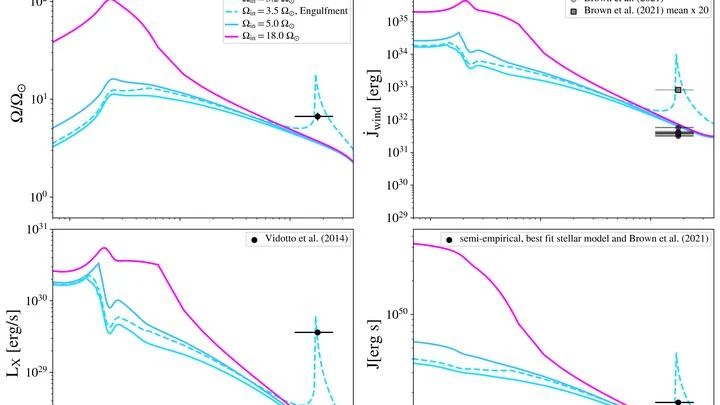
GJ 504, a star almost the same age as our Sun, is spinning with remarkable vigor: it completes a full rotation in just 3.4 Earth days, while actively emitting X-rays. For comparison, typical stars of the Sun's age rotate much more slowly, as if they've lost their youthful energy. GJ 504, however, behaves like a figure skater who has received a powerful push and launched into a rapid spin.
If you build a giant blanket around a star, you get a Dyson sphere. It absorbs all the radiation and glows in invisible heat rays. No such sphere has been seen yet, but astronomers know: to find it, look for this thermal glow.
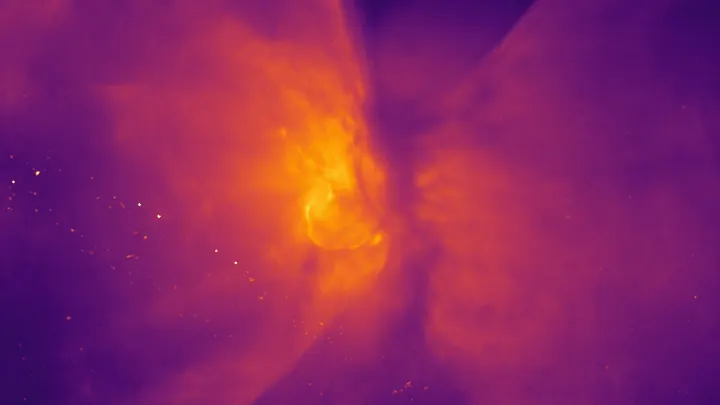
In a blazing foundry, any ice cube would vanish instantly. But tucked inside a thick mitten, it survives. Nature pulled a similar trick in the planetary nebula NGC 6302.
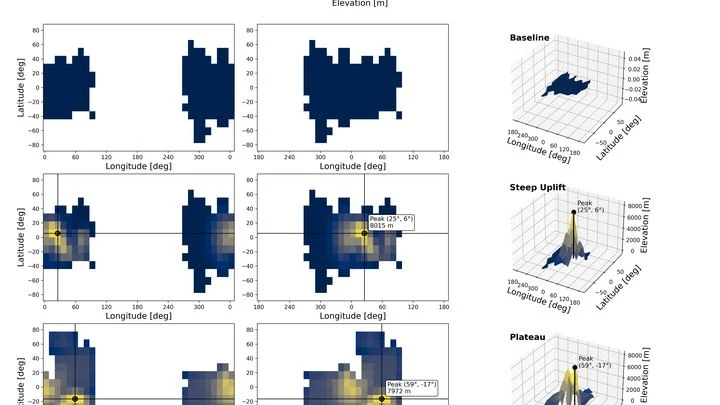
For exoplanets that always face their star with one side, the night side is doomed to eternal cold. But mountains can turn things around. Surface irregularities shake up the ocean of air, steering moisture flows across the day-night boundary. Once in the dark, water freezes into clouds, and clouds act like a blanket: they trap heat and keep the world from cooling down.
Earth is like dough mixed to a precise recipe: two parts water to one part land. Too much water, and the planet becomes a vast ocean where intelligence has nothing to grasp onto. Too much land, and water retreats deep, leaving a desert. Scientists put this culinary analogy to the test with statistics.
A young star is surrounded by a flat, rotating disk of gas and dust — the construction site for future planets. The disk lives its own life: gas flows toward the star, dust clumps together, and from outside, harsh ultraviolet light from neighboring hot stars presses down on it all, like wind blowing leaves off a path.
An exoplanet — a planet outside our solar system — follows a slightly elongated orbit. With each revolution, it swings closer to its parent star and then farther away.
The Sun doesn't rotate as a solid body: its equator spins faster than its poles. This difference in rotation speed creates layers that move at different speeds, like ocean currents at different depths.
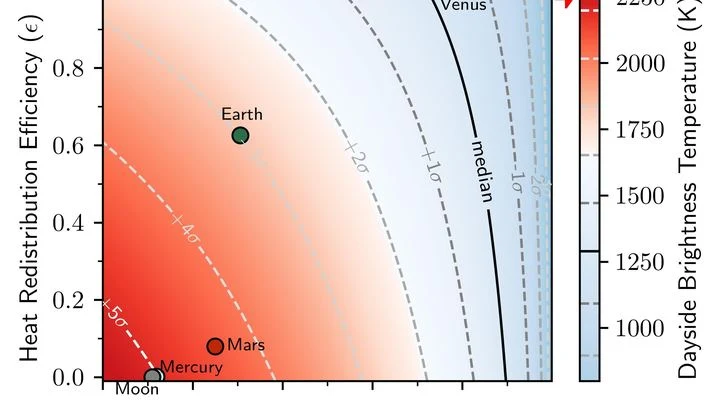
The super-hot super-Earth TOI-561 b completes an orbit around its star in just 10.7 hours. It is a scorched rocky sphere, so close to its star that its dayside should heat up to 2950 K, a temperature at which many minerals melt.