instrument

habitable worlds observatory

A future space telescope designed to directly image and characterize exoplanets.
36 related articles

Description

The Habitable Worlds Observatory is a planned space telescope mission aimed at directly imaging and characterizing exoplanets, particularly Earth-like planets in habitable zones. It would study their atmospheres for biosignatures and assess their potential to host life. This observatory is a successor to missions like James Webb Space Telescope, focusing on direct imaging rather than transit methods.

History

The concept emerged from the 2020 Decadal Survey for astronomy, which recommended a future space telescope dedicated to exoplanet direct imaging. It is still in planning stages, with no launch date set.

How it works

It would use a large mirror and advanced coronagraphs to block starlight, allowing direct observation of faint exoplanets. Spectroscopic analysis of the reflected light would reveal atmospheric composition, temperature, and potential signs of life. The observatory might also use gravitational lensing techniques to enhance imaging of distant worlds.

In practice

It would be used to search for habitable exoplanets, analyze their atmospheres for oxygen, methane, and other biosignatures, and potentially identify the first truly Earth-like world.

Fun fact

The observatory could potentially use the Sun's gravitational lens, focusing light from distant exoplanets at a distance of about 550 astronomical units from Earth.


Concept graph →

Related articles · 36

Stellar2026-08-272 minarXiv:2608.27344
X-ray passports for habitable worlds
Twelve stars have received X-ray passports. Now, for each of them, we know the exact radiation dose received by a planet in the habitable zone, the region where liquid water is possible.
Exoplanets2026-08-211 minarXiv:2608.21129express
A Needle in a Stellar Haystack
A telescope stares at a star for many nights in a row. Somewhere in the stream of light hides a tiny dip in brightness — an Earth-sized planet briefly blocking part of the star. Such a dip lasts a few hours and repeats once a year or less. Catching it is like hearing a single quiet click in a noisy hall.
Exoplanets2026-08-161 minarXiv:2608.15912express
Stellar Recipes for Planets
Two stars, AF Lep A and ε Indi A, have become the focus of close attention. Using the GHOST spectrograph on the Gemini telescope, astronomers split their light into colors and, from absorption lines, determined how much carbon, oxygen, sulfur, and thirteen other elements are in the stars' atmospheres.
Instrumentation2026-08-072 minarXiv:2608.07357express
The Telescope Listens to Itself
The orchestra plays, but the musicians can't hear each other. The conductor keeps stopping the music and walking over to each player to tune the instrument. That's roughly how space telescopes with segmented mirrors work.
Instrumentation2026-08-011 minarXiv:2608.00734express
Conducting a Thousand Cameras for the Sharpest Telescope
When an orchestra of thousands of musicians plays in harmony, the credit goes not only to each player's talent but also to the invisible work of the conductor.
Exoplanets2026-07-212 minarXiv:2607.19579express
Heavy Water on a Hot Jupiter: WASP-39 b Surprises Astronomers
Water comes in different varieties. Not just fresh or salty, but also "heavy"—when one of its hydrogen atoms is replaced by deuterium, its heavier cousin. Such water is called HDO, and it's a true cosmic passport: the amount of deuterium in water reveals where and when that water was born.
Molecular Melodies: How ELT/ANDES Will Tune Into the Breath of Exoplanets
The light of a distant star carries within it the silent hum of the atmospheres of planets orbiting it. For a long time, capturing it was like trying to make out a whisper over a roaring waterfall. But with the advent of the 39-meter Extremely Large Telescope (ELT) and the ANDES spectrograph with a resolution of 100,000, this task is no longer hopeless.
Optics2026-07-082 minarXiv:2607.06931express
How to Spot a Pale Planet in a Star's Blinding Light
A spotlight blazes straight into your eyes, and a few steps away a tiny firefly flickers. That's roughly what it's like hunting for an Earth-like planet around a neighboring star: the planet is a hundred million to ten billion times fainter than its star, and in the sky they almost merge into a single point.
Invisible Planet in Warped Light
The light of a distant star is no perfect beacon. Passing through the gravitational field of another star, it bends, splits, and magnifies, creating a fleeting Einstein ring in the sky. This is how gravitational microlensing manifests, predicted by Fritz Zwicky back in the 1930s.
Instrumentation2026-06-282 minarXiv:2606.29138express
A Sun-Sized Lens Searches for Life Around Distant Stars
The Sun is not just a source of heat; it's also the largest lens in the solar system. Its gravity bends light rays like glass, focusing them into a bright ring far beyond Pluto's orbit. If light from a distant planet enters this ring, astronomers could reconstruct its portrait — not a point, but a map with surface details.
Cosmic Tan: How Stellar Flares Repaint Water Worlds
When astronomers peer at distant worlds, they often don't see crisp lines of water vapor or methane, but a blurry silhouette, as if the planet has thrown on a thick veil. This veil, a haze of organic particles, behaves like a temperamental photographic plate: it darkens under harsh ultraviolet light, revealing hidden chemical patterns.
Exoplanets2026-05-212 minarXiv:2605.22931express
Catching a Sunset on a Distant Planet
When a planet slips behind the edge of its star, the star backlights the planet's atmosphere, just as a setting sun illuminates clouds on the horizon. This brief moment, lasting only minutes, carries the imprint of the gases through which the starlight has passed.
Cosmology2026-05-192 minarXiv:2605.19841express
The Universe as a Layered Cake
Imagine a huge layered cake, where the layers of dough are space and the filling is a special region resembling an invisible wall. This wall is not made of bricks but of energy, and it could be as thick as the entire universe. If such a wall exists, it should stretch the dough layers differently: those lying along it spread apart faster, while those across it spread slower.
Exoplanets2026-05-141 minarXiv:2605.15337express
How Not to Mistake Life for Lifeless Chemistry
The search for extraterrestrial life is like a detective investigation: from tiny clues, you must distinguish traces of life from random imprints of non-living nature. On Saturn's moon Enceladus, the investigators are lucky — geysers burst from cracks in the icy crust, ejecting water from the subsurface ocean straight into space.
Exoplanets2026-05-112 minarXiv:2605.10646express
The Red Edge of Life and Its Mineral Mimics
When the light of a distant planet is split into colors, it suddenly jumps at the boundary between red and invisible infrared, as if someone flipped a switch. This is how the vegetation red edge manifests itself: chlorophyll is transparent to near-infrared radiation, and the leaf, to avoid overheating, reflects it away.
Exoplanets2026-04-251 minarXiv:2604.23448express
Giant Planet or Twin World?
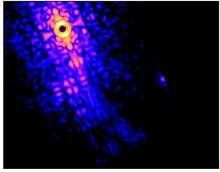
Astronomers pointed JWST at a planet near the star Epsilon Indi — a giant gas ball resembling Jupiter, just 12 light-years away. In thermal images, the planet shone like a lantern. But nearby they noticed a faint dot — like a firefly. Calculations showed that two objects describe the picture better than one. However, it's most likely a lens flare — like a ghost of a lamp.
Exoplanets2026-04-232 minarXiv:2604.21848express
Planet's Breath: How Gas Flows Reveal the Secret of Life
The smell of fresh bread unmistakably signals a nearby bakery. But to know if baking is happening right now, it's better to catch not the aroma itself but its intensification — the continuous stream of hot air from the oven. This everyday analogy helps grasp a revolution in the search for extraterrestrial life on exoplanets — planets beyond our solar system.
Instrumentation2026-04-221 minarXiv:2604.20182express
A Swarm of Tiny Sails Heads to Proxima b
A handful of coins accelerates to one-fifth the speed of light. That's what Coracle interstellar probes will be like — tiny spacecraft weighing just a few grams, each with an ultrathin sail film. A powerful laser beam pushes them forward: light presses on the sail like wind fills a yacht's sails, except instead of air, it's a stream of photons.
Instrumentation2026-04-021 minarXiv:2604.02242express
Mars Without Biology: Three Paths to Warmth
Mars is an icy desert with an average temperature of minus 60. To warm it without biology, scientists propose three approaches with a single idea: create a thick heat-trapping blanket. First, deploy transparent film-blankets over bases. They let sunlight in but keep heat from escaping, allowing us to harvest water from the soil and grow plants.
Exoplanets2026-03-262 minarXiv:2603.24944express
Stellar Flares as a Source of Life
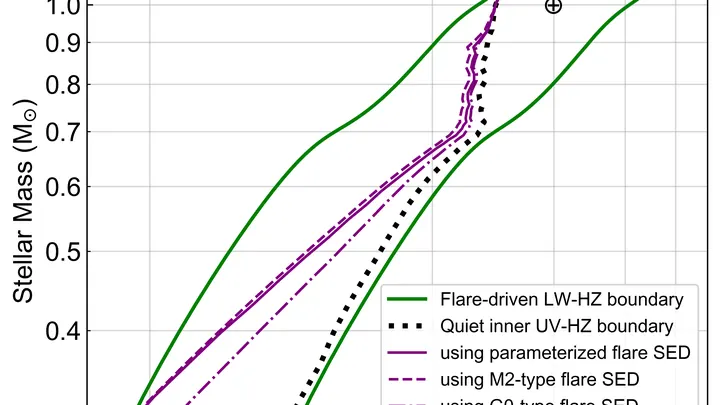
Water isn't the only thing life needs. To assemble the first RNA-like chains from simple molecules, you need ultraviolet light, like the sunlight that helps plants, but harsher and with shorter wavelengths. Big stars like the Sun emit plenty of this light. Small, dim stars, however, have almost none: they shine mostly in red and infrared, like a glowing ember.
Exoplanets2026-03-231 minarXiv:2603.22491express
How Bacteria Battle on Water Planets
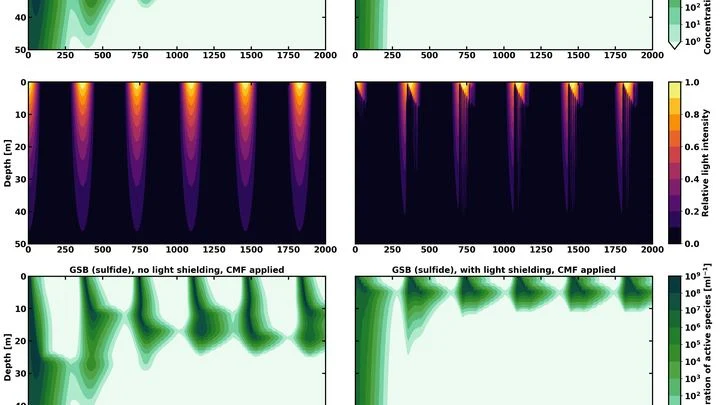
Simple equations that describe fox and rabbit cycles have been turned to bacteria on distant exoplanets, like K2-18 b. These worlds hold deep oceans under thick hydrogen skies. Like duckweed on a pond, light-eating microbes cover the sunlit water surface, stealing light from those below.
Exoplanets2026-02-231 minarXiv:2602.20155express
Mountains on Exoplanets Prevent Eternal Winter
For exoplanets that always face their star with one side, the night side is doomed to eternal cold. But mountains can turn things around. Surface irregularities shake up the ocean of air, steering moisture flows across the day-night boundary. Once in the dark, water freezes into clouds, and clouds act like a blanket: they trap heat and keep the world from cooling down.
Exoplanets2026-02-021 minarXiv:2602.02267express
Life Not Needed: A Lifeless Earth Appears Inhabited
Scientists built a model of Earth with all living organisms removed — from bacteria to trees. Over billions of years, this 'empty house' didn't turn into an icy desert. Volcanoes, like a furnace, release carbon dioxide, and rock weathering, like a thermostat, absorbs it.
Exoplanets2026-01-122 minarXiv:2601.07465express
Space Telescope Searches for a Second Earth
The night sky is dotted with stars, and many of them have planets. But how do you spot a tiny dark disk against the glare of a distant sun? The Kepler telescope spent nine years watching hundreds of thousands of stars, waiting for a planet to pass in front of its star and briefly dim it. That 'wink' is the only way to find worlds like ours.
Instrumentation2026-01-121 minarXiv:2601.08883express
The Colors of Life on Distant Planets
To spot life on other planets, you don't necessarily need to search for oxygen in the air. Living beings paint the surfaces of their worlds: Earth's plants in green, bacteria in purple. The future HWO space telescope will capture these "paints of life" on exoplanets.
Exoplanets2026-01-011 minarXiv:2601.00325express
Rogue Planet Gave Itself Away with Warped Light
The lone planet KMT-2024-BLG-0816, one of many free-floating planets, was discovered when its gravity acted like a magnifying glass for a few hours. Passing in front of a distant star, the invisible body warped space like a glass marble, and boosted the background light.
Exoplanets2025-12-081 minarXiv:2512.07695express
Instrumentation2025-11-291 minarXiv:2512.00492express
Mission: Catch a Guest from Another Star System
The Comet Interceptor mission launches without a target. The spacecraft freezes at a point of space equilibrium, like a fighter jet on combat standby: engine warmed up, but takeoff only on alert.
Exoplanets2025-11-181 minarXiv:2511.14407express
New Schedule for Faraway Worlds
A bus schedule drifts: if you don't check it, you'll miss your ride. Planets around other stars have the same problem – their crossings of the star's disk gradually shift. The ExoClock project pooled 30,000 observations from Earth and space to refine the schedule for 620 distant worlds. For 45% of the planets, transits were found to be off by hours.
Cosmology2025-10-312 minarXiv:2510.27416express
Earth's Gravitational Lens: Hunting Axions in the Focus of Spacetime
Dark matter is the invisible scaffold of the Universe, revealing itself only through gravity. Vera Rubin, studying the rotation of galaxies, found that stars at the periphery move too fast, as if held by an unseen mass. This became compelling evidence for the existence of dark matter, yet its particles still elude direct detection.
Exoplanets2025-10-161 minarXiv:2510.14229express
Exoplanets2025-10-081 minarXiv:2510.07378express
Hydrogen Atmospheres on Scorching Planets: The Volcano Secret
Many planets around other stars — exoplanets — have elongated orbits. With each close approach, the star’s gravity squeezes and stretches them, like kneading dough. Friction heats up the interior to the point where rock melts, creating underground oceans of magma.
A Radio Beacon at the Edge of the Ecliptic: How Our Signals Give Us Away to the Universe
Every few hours, narrow beams of radio waves leave the Mojave Desert, near Madrid, and near Canberra, heading into the sky. This is NASA's Deep Space Network: three antenna complexes that keep in touch with spacecraft across the solar system.
A Beacon Near Our Nearest Sun: First Glimpse of a Planet around Alpha Centauri A
In August 2024, the MIRI coronagraph on the James Webb Space Telescope stared at Alpha Centauri A, the nearest Sun-like star to our Sun. At 1.5 arcseconds from the star, a point source, S1, blinked into view. Flux: 3.5 mJy, contrast: 5.5×10⁻⁵. Four to six sigma. A lighthouse flashing in the fog.