X-ray passports for habitable worlds
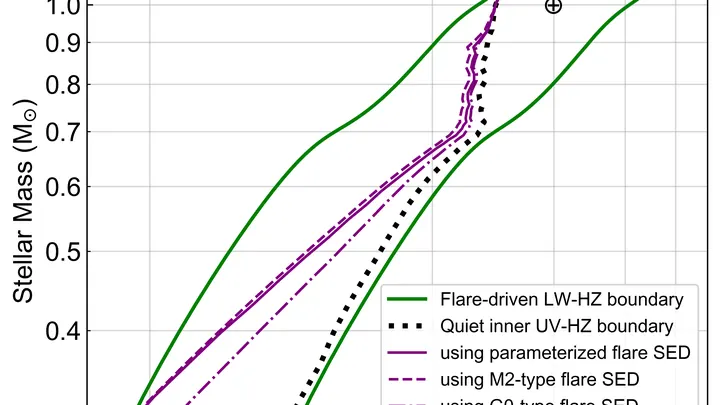
Twelve stars have received X-ray passports. Now, for each of them, we know the exact radiation dose received by a planet in the habitable zone, the region where liquid water is possible.
The star around which a planet or planetary system orbits.A host star is the star around which a planet or a planetary system orbits. It is the gravitational anchor of the system, providing the primary source of light and heat that determines the climate and habitability of any orbiting planets. The properties of the host star—its mass, luminosity, age, and chemical composition—profoundly influence the formation, evolution, and potential for life on its planets.
The concept of a host star is as old as the heliocentric model, but the modern understanding of its role in planetary systems developed with the discovery of the first exoplanets in the 1990s.
Planets form from the protoplanetary disk of gas and dust that surrounds a young star. The star's gravity dominates the orbital dynamics of the system, while its radiation drives the thermal environment. The star's lifetime and stability set the timescale for planetary evolution; for example, more massive stars burn out quickly, leaving little time for complex life to develop. The star's chemical makeup, particularly its metallicity, affects the composition of the planets that form around it.
In exoplanet research, characterizing the host star is essential for determining planet properties, such as radius and habitability, and for interpreting transit and radial-velocity data.
Some host stars are so close to their planets that they cause tidal deformation, leading to volcanic activity on the planet, as seen with Jupiter's moon Io and its host planet.