How a calm flow turns itself into a storm express
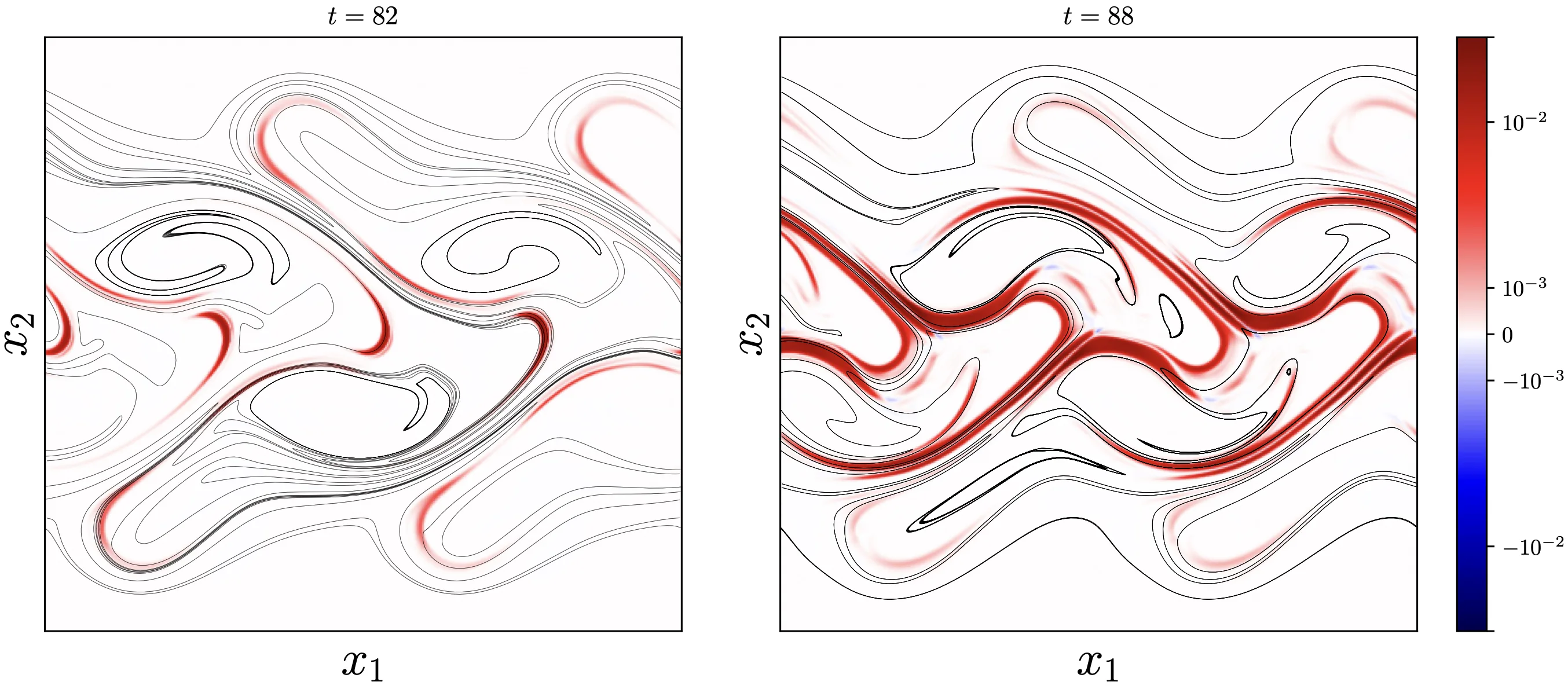
A calm river suddenly starts churning in the middle of a flat stretch: that's the puzzle the authors of a new study set out to solve. They took a thin layer of charged gas with a very weak magnetic field and tracked on a computer what would happen to it. At first, everything flows smoothly, like water from a tap. Then, in one spot, the layer thins out, and the magnetic field lines, which previously lay parallel, begin to snap and reconnect.
This reconnection is like a rubber band in a tangle of yarn snapping, its ends whipping in opposite directions. Each such snap injects a bit of chaos into the flow. At first the chaos is weak, but the snaps repeat, and soon the whole flow is boiling: vortices appear, eddies, tiny jets. And no one pushed the flow: it stirred itself up.
This matters for understanding the cosmos. The solar wind, plasma jets from the vicinity of black holes, comet tails — all of them are turbulent. Previously, scientists thought turbulence came from outside. Now we see it can be born from within, out of a smooth flow, thanks to magnetic reconnection.
Original abstract
as written by the authors arXiv:2602.21422
Magnetic reconnection and turbulence are deeply intertwined in magnetohydrodynamic flows, yet how reconnection self-generates turbulence remains unclear. Using an ensemble of high-resolution three-dimensional direct numerical simulations of an unstable magnetised jet with an initially weak mean field, we demonstrate a self-sustained transition from laminar reconnection to fully developed turbulence in the absence of external forcing. We show that a three-dimensional current-sheet instability triggers stochastic reconnection, leading to persistent turbulent energy injection. Energy-budget analysis reveals that the coupling between the turbulent electromotive force and the magnetic mean shear dominates turbulent production, with magnetic fluctuations subsequently transferring energy to the kinetic field through a nonlinear cascade.
The solar wind at Earth travels at about 400 kilometers per second—20 times faster than a bullet. And nearly all of that flow is turbulent: vortices constantly form and vanish, ranging in size from hundreds of meters to thousands of kilometers.