Training Neural Networks on Less, but Smarter express
Proteins in nature are as numerous as grains of sand on a beach, and each has its own job: some break down food, others build cells. But to understand what a specific protein does, it must be studied in the lab — a slow and expensive process. Neural networks can guess a protein's function from its 'text'—the amino acid sequence, but training them requires vast numbers of labeled examples. The problem is that labeled proteins are scarce: for every one verified in the lab, there are a million unknowns.
A group of researchers proposed an approach akin to a smart student who doesn't cram the entire textbook but asks the teacher only about the toughest parts. This method is called active learning: the model itself selects proteins it is least confident about and asks a human expert to provide correct labels. The model then fine-tunes on these chosen examples. The scientists built a system that combines several strategies for selecting 'hard' proteins and allows humans to manually verify and correct predictions.
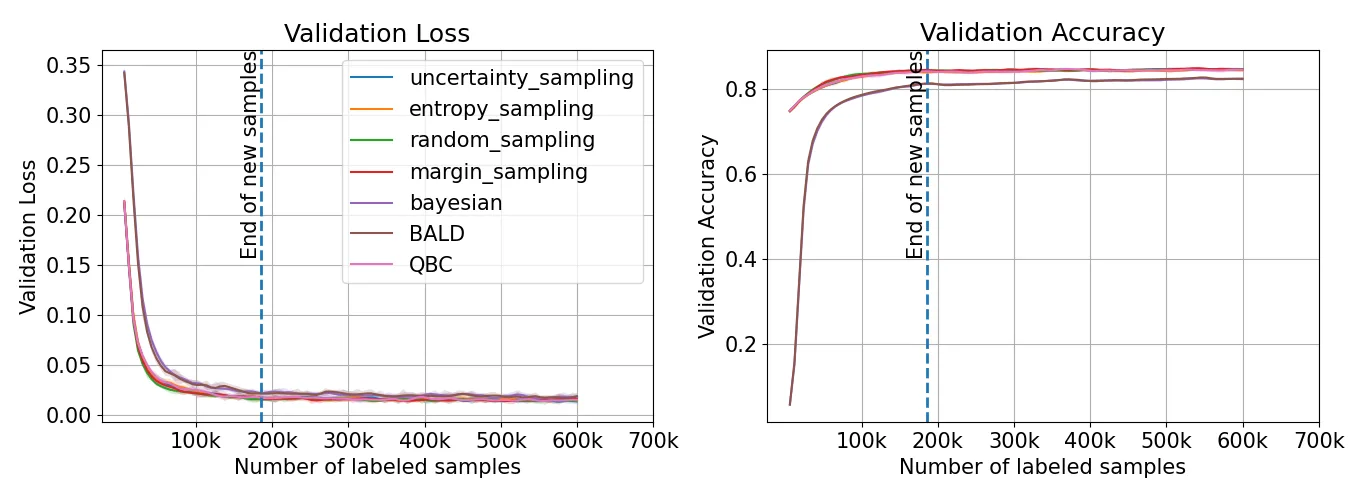
The results were compared with conventional training, where the model is fed all data indiscriminately. Active learning achieved the same prediction accuracy but required fewer model updates, processed less data, and noticeably saved computational resources. For researchers, this means studying protein functions faster and cheaper without sacrificing quality.
This approach is especially important now, as protein sequence databases grow explosively while experimental verification lags behind. Instead of waiting years for each new protein to be studied in the lab, scientists can focus on the most mysterious and promising candidates. It's like searching for diamonds in a pile of sand, sifting not everything but only the spots where a glint is already visible.
The largest protein sequence database contains hundreds of millions of entries, but only a tiny fraction, less than one percent, has been experimentally verified.