An amino acid sequence is the linear order of amino acids in a protein chain, determined by the genetic code. This sequence is the primary structure of a protein and dictates how it folds into its three-dimensional shape, which in turn determines its function. Comparing amino acid sequences across species or among related proteins reveals evolutionary relationships, functional domains, and conserved residues critical for activity. In astrobiology, sequence analysis helps identify potential biosignatures by distinguishing biological patterns from abiotic chemistry.
History
The concept of a linear amino acid sequence was established by Frederick Sanger, who determined the complete sequence of insulin in 1955, proving that proteins have a defined order of amino acids. This earned him the 1958 Nobel Prize in Chemistry.
How it works
Proteins are built from 20 standard amino acids linked by peptide bonds. The sequence is read from the N-terminus to the C-terminus, and each position is one of the 20 letters. During folding, hydrophobic and hydrophilic interactions, hydrogen bonds, and disulfide bridges drive the chain into a specific conformation. Sequence comparison algorithms (e.g., BLAST or multiple sequence alignment) score similarities based on substitution matrices like BLOSUM, which reflect how often one amino acid replaces another in evolutionarily related proteins. High similarity suggests common ancestry or convergent function.
In practice
Amino acid sequences are used in protein engineering, drug design, phylogenetic analysis, and the search for extraterrestrial life, where unusual sequence patterns could indicate biological origin.
Fun fact
The protein titin, found in muscle, has the longest known amino acid sequence, with about 34,350 amino acids, and its full chemical name is over 189,000 letters long.
Stated relations:part of →gene · follows from →mutation
A monkey that lives forty years and its relative that dies at ten read the same book of life, but with different notes in the margins. Those notes, identical in all long-lived species and absent in short-lived ones, are what scientists looked for in the genomes of 126 primate species.
A protein in a cell doesn't hang motionless like a mannequin in a store window. Its atoms are constantly jiggling, stretching, and bending, like a plucked guitar string that keeps vibrating after you strum it. To understand how a protein works, you need to know how tightly each part holds onto its neighbors.
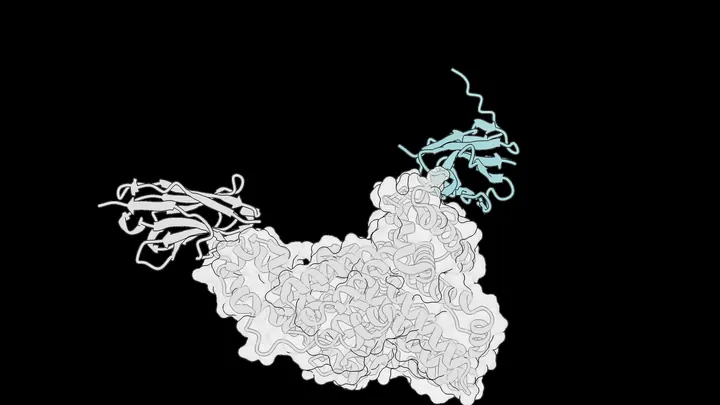
When an antibody meets a virus, it doesn't latch on with a single death grip. Rather, it's like two bunches of grapes tumbling in water, catching each other with dozens of short tendrils. Each tendril is weak on its own, easily torn by the thermal jitter of water molecules, but together they hold tight.
As you slowly turn the tuning knob of an old radio, the sound doesn't fade in gradually from the static: it bursts forth in a sudden jump, the moment the antenna hits resonance with the wave. Genes in a living cell behave much the same way.
A protein chain folds into a working tool in a fraction of a second, and almost never makes a mistake. For a long time, it was thought that evolution specifically polishes amino acid sequences so that a protein not only works but also easily finds its unique shape. New work turns this idea on its head.
A protein slides along the DNA strand like a key along a keyring, searching for its lock. One wrong turn and a gene stays switched off. To know where a protein will grip firmly, you need to measure the strength of that grip — the binding energy.
Imagine a vast library where every book is a precise instruction manual for assembling one protein molecule. AlphaFold2 read millions of such books and learned to instantly produce a ready-made 3D model. But inside this network, in its very 'brain,' something more remained — not just assembly rules, but an entire atlas of possible protein motions, its hidden life.
Think of a massive cookbook: each recipe is a protein, and the finished dish is its job in the cell. To whip up a complex treat, you often need to mix several ingredients and let them 'set' into the right shape. Until now, scientist-chefs could only guess how someone else's recipes would fold.
For a long time, we only saw proteins in their final form — like photographs of dancers frozen in a beautiful pose. Programs like AlphaFold learned to predict that pose from a chain of carbon links. But the real magic is how a protein finds this shape faster than you can blink, performing a swift dance.
Imagine a huge garage with hundreds of parking spots. You're driving a tiny car, a future drug molecule, and you want to find the one free bay where it fits perfectly. But these bays aren't concrete; they're woven from DNA or RNA chains, and no one has posted the parking rules.
A protein is a tiny magnet with a complex shape, and a nanoparticle is a smooth ball. Depending on which side of the protein approaches the ball, the attraction differs. Scientists have built a detailed map of these "landings" to understand how allergen molecules from birch pollen attach to silica nanoparticles.
They used two approaches.
Long protein threads, their tangled entanglements, and random contacts: this is how the birth of cellular droplets was usually explained. These membrane-less organelles, where important reactions take place, resemble oil drops in water: they arise on their own when molecules separate into phases.
The nose is an amazing instrument. A single coffee molecule entering a nostril can awaken a memory of a morning kitchen. Another, nearly identical in shape, smells like rotten eggs.
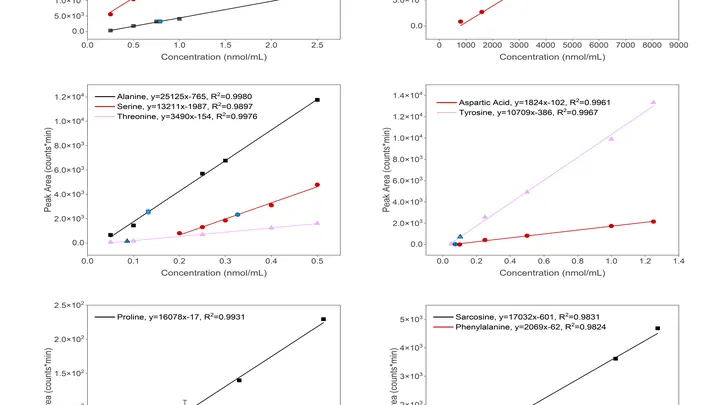
A chemical detective searches for life on other planets. Its tool is a mass spectrometer that identifies molecules by weight (the same device earthly forensic scientists use to analyze clues).
Capsids are protein boxes that viruses use to carry their genetic material. In gene therapy, these boxes serve as couriers: you put a desired gene inside, and the outside retains the ability to enter cells.
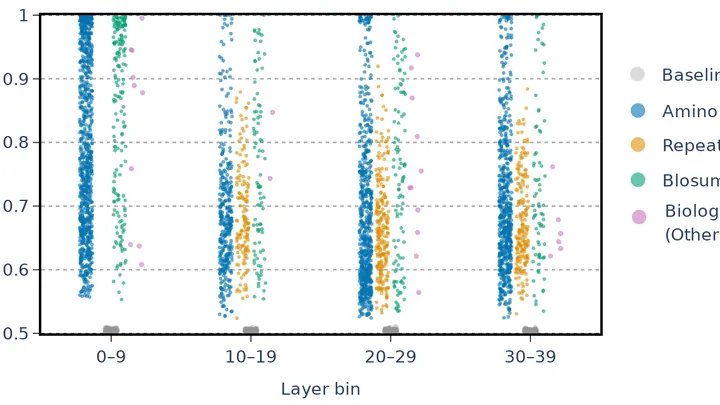
Proteins are chains of amino acids, and they often contain repeated chunks. Sometimes the repeats are exact, like the same phrase said twice. Sometimes they come with typos: a couple of letters swapped, but the meaning is the same. These repeats matter: they help the protein fold into the right shape and do its job.
An antibody is a protein that catches viruses and bacteria. When an enemy enters the body, immune cells start trying out different antibody variants, as if testing different keys against a lock. Beneficial changes are kept, harmful ones are discarded. Over a few weeks, this process yields an antibody that fits its target perfectly.
Proteins are the molecular machines of life. They fold into complex three-dimensional shapes, like a sheet of paper into origami. But if you fold the paper a bit differently, you get a different figure. Likewise, a protein can take on several forms, and that determines how it works.
Usually, scientists compare proteins by their sequences — chains of amino acids.
Searching for a new drug is like matching a key to a lock. The protein in a cell is the lock, and the candidate molecule is the key. You need to know whether the key fits and how snugly it sits. Previously, the computer would examine every atom in the lock and the key to check this. A single lock could take hours or even days. Checking millions of keys was out of the question.
A rubber band is stretched, and suddenly snaps. In the atomic world, a similar picture emerges: the string binding particles can break. In a new study, physicists took a chain of Rydberg atoms and tracked how such a string breaks.
Under weak tension, the string breaks completely, and the system splits into several independent pieces, as if a rubber band shattered into segments.
A protein language model is like a chef who learned from thousands of recipes and now invents new dishes. Sometimes he gets carried away and salts every dish because one good cookbook used a lot of salt. In proteins, such repetition isn't just ugly: identical stretches in the chain make the protein fragile, it can't fold into the right shape, and it doesn't work.
A cell is like a kitchen where thousands of recipes (genes) are collected in one thick book (DNA). The chef-protein Klf4 flips through the pages and decides which recipe to cook today. But how does it find the right line among billions of letters? Previously, researchers thought the protein looked for a short 'password'—a few consecutive letters.
The chemical composition of a sample is like a soundscape. A living forest sounds polyphonic: chirping, rustles, the hum of insects. A barren desert is just the whistle of the wind.