Predictionaccuracy is a fundamental metric in machine learning and statistics, quantifying how often a model's predictions align with actual observed outcomes. It is expressed as a value between 0 and 1, where 1 indicates perfect prediction and 0 indicates complete failure. This metric serves as a cornerstone for evaluating models across diverse fields, from medical diagnostics to weather forecasting and materials science, as highlighted in the corpus titles covering cirrhosis prediction, solar flare forecasting, and quantum calculation verification.
History
The concept of predictionaccuracy has roots in early statistical inference, but its formalization in machine learning emerged in the mid-20th century with the development of pattern recognition and decision theory. No single inventor is credited; it evolved from basic probability and error analysis.
How it works
Predictionaccuracy is typically computed as the ratio of correct predictions to total predictions made. For binary outcomes, this is straightforward: (true positives + true negatives) divided by the total number of cases. In more complex scenarios, such as multi-class classification or regression, accuracy may be adapted or supplemented with other metrics like precision, recall, or confidence intervals, as seen in the solar flare prediction article. The key is that accuracy measures the frequency of agreement between model output and ground truth, providing a simple yet powerful gauge of model performance.
In practice
Predictionaccuracy is used to validate models in healthcare (e.g., predicting cirrhosis), environmental monitoring (e.g., solar flares), and AI-driven design (e.g., aerodynamic shapes), ensuring reliability before deployment.
Fun fact
In some cases, a model with high accuracy can still be misleading, as noted in the article about acoustic AI verification, where accuracy alone fails to capture systematic biases.
A protein engineer is like a chef trying to make a dish that is tasty, healthy, and cheap all at once. Change one ingredient, and you risk ruining another. In the past, computer assistants could only evaluate protein properties one at a time, missing how they are connected.
Two black holes, caught in a dance, spiral closer and closer until they merge into one. This dance is not silent: it shakes spacetime itself, sending gravitational waves rippling across the Universe. To understand what we hear in these waves, we need a precise mathematical model of the dance.
In 1998, mathematician David Boyd noticed something strange. He was studying the Mahler measure of polynomials, a quantity that gauges the "complexity" of their roots, and found that for a family of curves, it always equals a special rational number times the derivative of an L-function.
A hundred thousand stars in the dense core of a globular cluster move like steel balls in a giant pinball machine. Each 'bump' — a gravitational encounter between a binary system and a single star — triggers a cascade of unpredictable events.
In combat, a pilot needs to instantly understand what an object is and what its intentions are. Conventional systems wait for complete radar data — like a goalkeeper who only reacts after the shot. The new algorithm works like an experienced goalkeeper: from the attacker's first moves, it predicts the target's maneuver.
An AI predicting room acoustics is like a student taking an exam with a cheat sheet. If the test points are the same as the training ones, the model simply memorizes the acoustic 'fingerprint' of each position — like a student recognizing a question by the dog-eared corner.
When a radio wave encounters a building in its path, it doesn't just reflect or get absorbed: it bends around it, much like ocean waves flowing around a rock, leaving calm water behind. In radiophysics, this phenomenon creates a radio shadow — a complex pattern of zones where the signal is amplified or attenuated, which scientists call a radio portrait.
At a weather station in Brazos County, Texas, rain is recorded on magnetic tape: every day, four years straight. Nine hundred millimeters in a good season, a hundred in a bad one. Then the tape falls silent. Drought creeps in without a sound — the slow fading of the earth's pulse. The standard SPI-3 index only catches on a month or two later, once the moisture is already gone.
Every carbon atom in a molecule carries a passport — the energy with which its deepest electrons sit in their orbitals. This energy is sensitive to neighbors: add an oxygen nearby or a double bond, and the number in the passport changes. Chemists have long measured such energies with X-rays, but calculating each new molecule takes hours of machine time.
Quantum calculations are a recipe with perfect ingredients, but nature-the-chef cooks in her own way. Machine-learned models of atoms memorize the recipe and predict material properties in seconds instead of weeks.
Training an accurate aerodynamic model is like culinary art: first, a chef masters hundreds of recipes to grasp the general principles, then easily perfects a specific dish. Engineers created AeroTransformer and fed it 30,000 different wing shapes — a whole galaxy of culinary ideas galaxy.
A uranium nucleus is like a tight wallet snapped shut on two halves. To make it burst and release energy (that is, to make the nucleus split) you have to climb over an energy barrier. The height of this threshold determines whether a substance is stable or ready to fall apart at any moment.
When chemists calculate the behavior of molecules on a computer, they use approximate methods because exact calculations are too complex. For light atoms, there are well-established benchmarks, but for heavy atoms, where relativistic effects matter, such benchmarks did not exist. It's like checking a ruler against another ruler rather than against a standard meter.
The atmosphere is a chaotic system, and a detailed global forecast requires monstrous computing power. StretchCast sidesteps this by working like the human eye: it creates 'sharp vision' over a selected region with an ultra-fine grid, while seeing the rest of the world blurry, but sharp enough to capture global connections.
A piece of aluminum alloy is heated, and it quietly tells you about its strength. You just need to listen to that story in how the metal absorbs heat.
The usual way to find out how strong an alloy is — pull it until it breaks. That takes time and destroys the sample.
A film of a shattered cup played backward looks absurd: shards don't spontaneously reassemble. This intuitive sense of irreversibility is tied to the increase of entropy — a measure of disorder in a system. The second law of thermodynamics states that the entropy of an isolated system never decreases, setting time's direction from past to future.
Solar flares — sudden energy releases on the Sun — can knock out satellites and power grids. Previous models often either cried wolf or missed a real blow. The fix: attach a reliability estimate to every prediction.
A solar panel on a roof produces little current in the morning, a lot at noon, and stays silent at night. Wind doesn't blow randomly either: it's often stronger in the morning and evening than during the day. Energy providers need to know in advance how much energy will be available in an hour or three, so they can switch on backup plants or store electricity in batteries in time.
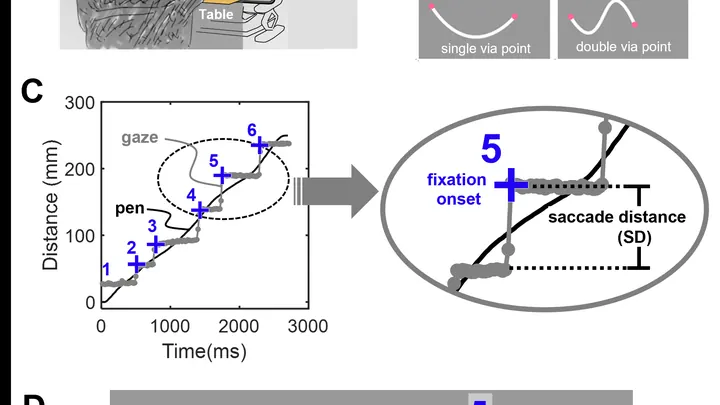
When the hand draws a line, the gaze almost always runs ahead, like a scout peeking around the corner before the column turns. But how far ahead? It turns out that each person has their own distance, and it does not change from attempt to attempt.
In the experiment, professional calligraphers and ordinary people traced a contour on a screen while instruments recorded eye and pen movements.
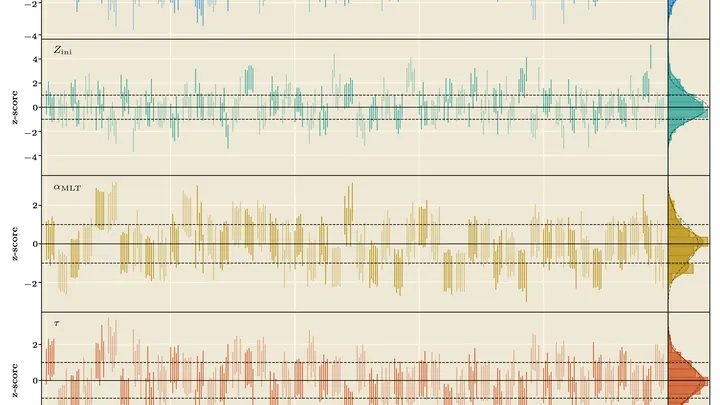
A star trembles like a bell after being struck. These tremors, tiny fluctuations in brightness and surface, can be caught by a telescope. From the frequencies of these 'stellar notes,' astronomers infer what's happening inside: how old the star is, how it's structured.
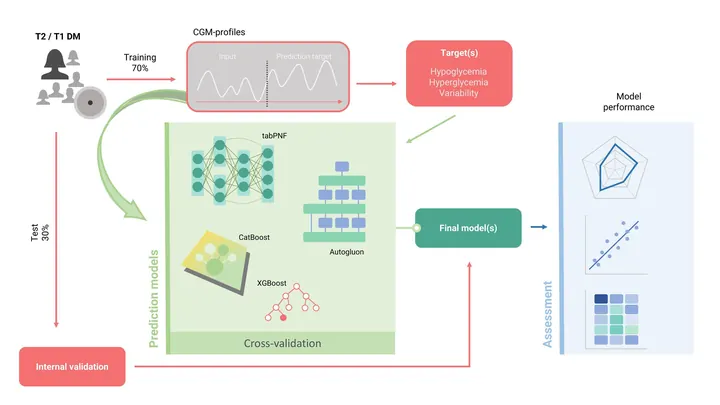
A sensor on the upper arm measures blood sugar around the clock and sends the data to a phone. But by the time the doctor sees it, the event has already happened: sugar dipped overnight, spiked after lunch. What if you could look a week ahead and see what glucose levels will be? That's exactly what the study authors set out to do.
The liver is a quiet workhorse. It processes everything we eat and drink, and rarely complains out loud. By the time the first obvious symptoms of cirrhosis appear, the disease has already destroyed a significant portion of the organ. Doctors have long sought a way to see into the liver's future, and a new study offers an unexpected tool — ordinary hospital records.
In 1992, Hurricane Andrew tore through Florida, leaving insurers with $$15.5 billion in losses. Many companies went bankrupt, and the market devised a way to shift disaster risk onto investors: catastrophe bonds. These securities pay generous coupons as long as a specified disaster does not occur, such as a hurricane of a certain strength or an earthquake in a particular region.
The ice cover of a river looks solid, but beneath it lie cracks that alter the flow. So it is with a time series: behind the smooth surface of numbers hide moments when the rules of the game change. These moments are called change points, and finding them is like tapping the ice to locate weak spots.
The puppet master pulls the strings, and the marionette dances. In forecasting the future from time series, the puppet masters are the few variables that truly control the system. The rest merely echo their movements, creating an illusion of complexity. The challenge is to find these puppet masters and watch only their fingers, not the whole stage.