Light at the Flick of a Switch: How an Infrared Beam Boosts Quantum Sources express
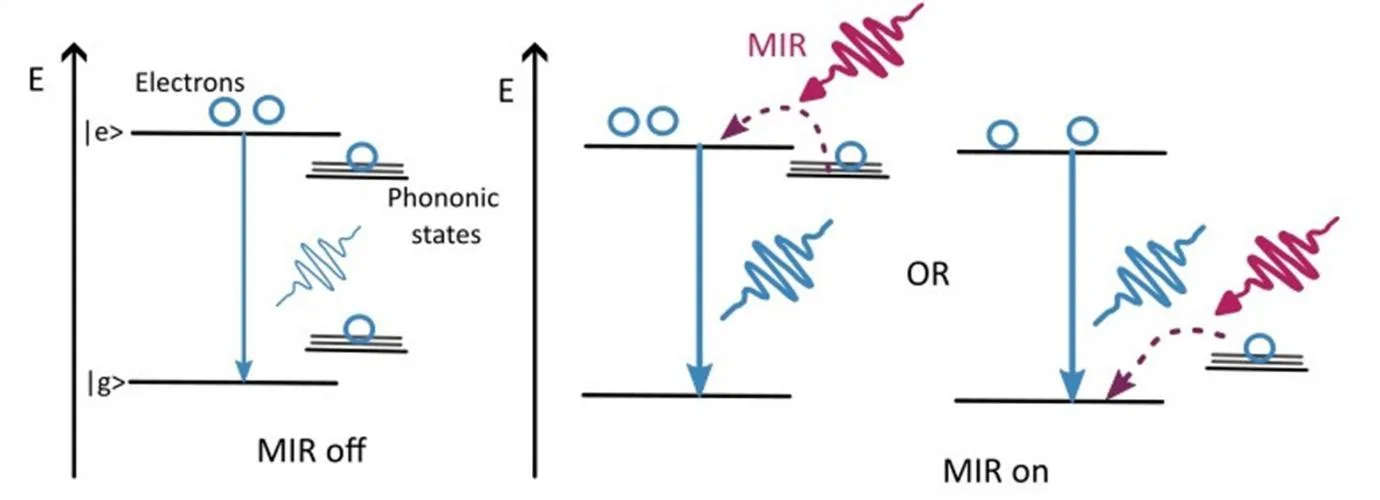
A glowing spot on a crystal is like a firefly that you can wake not only with a flashlight but also with the warmth of your palm. Such spots, single-photon sources, can emit light one particle at a time, which is essential for quantum communication and computing. Usually, they are 'woken up' with visible light, but the details of this awakening have long remained murky.
Now, a second beam has been added to the visible one — invisible, mid-infrared, with a wavelength of about 7.3 micrometers. This beam resonates with atomic vibrations around the defect in hexagonal boron nitride — a material similar to graphite but transparent. The vibrations, like a swing, rock back and forth and help charge carriers recombine faster: that is, come together and emit a photon. As a result, the blue light sources shine brighter.
Such a 'gas pedal' for quantum emitters has never been used before. The method works at room temperature, without complex cryostats. It is a step toward practical devices: single-photon sources could be tuned on the fly, like the volume on a radio.
A wavelength of 7.3 micrometers is about ten times thinner than a human hair, and such light is invisible to the eye but perfectly 'heard' by crystal lattice vibrations.