The process where an incoming photon triggers an excited atom to emit a second identical photon.
12 related articles
Description
Stimulated emission is the process by which a photon passing near an atom that is already in an excited state causes that atom to release its excess energy as a second photon. The crucial detail is that the new photon is a perfect copy of the first: same frequency, same direction, same phase, same polarization. The two photons leave together, and each can go on to trigger further emissions, so a single photon can set off a cascade of identical photons. This is what makes it possible to turn a trickle of light into a bright, orderly beam.
Why it matters is that ordinary light sources — a hot filament, a flame, the Sun — emit light through spontaneous emission, where each atom fires at a random time and in a random direction. The result is a jumble of frequencies and phases. Stimulated emission instead produces light that is coherent: all the waves march in step. That coherence is the defining property of laser light, and it is why lasers can be focused to a tiny spot, carry information through optical fibers, or cut metal with a clean edge.
The concept explains a whole family of effects beyond the laser itself: optical amplification in fiber-optic repeaters, the gain medium inside every laser cavity, and even astrophysical masers in gas clouds around dying stars, where naturally excited molecules amplify radio waves.
History
Albert Einstein predicted the effect in 1917 in a paper on the quantum theory of radiation, where he introduced the A and B coefficients to relate spontaneous and stimulated emission and absorption. The first working device based on it, the maser (microwave amplification), was built by Charles Townes and colleagues in 1954; Theodore Maiman demonstrated the first optical laser, using a ruby rod, in 1960.
How it works
An atom has discrete energy levels. If it sits in an excited level, it will eventually drop to a lower one on its own, emitting a photon — spontaneous emission. But if a photon of exactly the right energy arrives while the atom is still excited, the photon's oscillating electric field nudges the atom's electron, encouraging it to make the downward jump sooner. The energy released by that jump is added to the incoming photon's field rather than going off in a random direction, so the atom emits a second photon into the same mode of the electromagnetic field. The incoming photon is not absorbed; it continues on, now accompanied by its clone.
For this to build up into a useful beam, more atoms must be excited than not — a condition called population inversion. In a laser, an external energy source (a flash lamp, a current, another laser) pumps atoms into the excited state, and mirrors at the ends of the gain medium send photons back and forth so each pass multiplies them. One mirror is partly transparent, letting the amplified beam out.
In practice
It is the gain mechanism in every laser and maser, from barcode scanners and fiber-optic amplifiers to surgical instruments and gravitational-wave interferometers.
Fun fact
Einstein derived stimulated emission purely from thermodynamic consistency, decades before anyone had a way to build a device that used it.
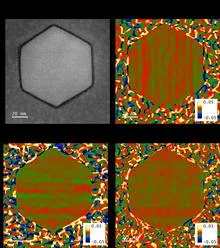
A taut string sounds higher, a slack one lower. In quantum dots, the crystal lattice plays the role of the string: compression or stretching changes the color of the emitted light. The trouble is that during nanowire growth, each dot ends up with its own random strain, so their "strings" sound out of tune.
A courtroom interpreter must relay every word without being distracted by noise in the room. In the quantum world, a superconducting resonator plays that role, losing photons on schedule without straying into spurious effects.
When a laser beam hits a gas, it tears electrons from atoms and accelerates them to nearly the speed of light. As these electrons fly through the plasma, they emit X-rays, like a glowing trail from a fast particle. In the new work, physicists made a single laser pulse create not one but two such trails in succession.
A copper oxide crystal looks like a dark red pebble. But when a short laser pulse hits it, pairs are born inside: an electron and a 'hole'—a place where an electron is missing. Such a pair is called an exciton and behaves almost like a hydrogen atom: the particles circle each other, bound by electric attraction.
Ordinary atomic clocks are like a tuning fork that must be kept in perfect silence and stillness. The slightest movement, and the note goes flat. The same goes for atoms: their thermal motion shifts the frequency of radiation, so ultra-precise clocks require almost complete immobilization of the particles.
Light from a bulb or even a regular laser resembles a crowd at a subway exit: people move haphazardly, sometimes dense, sometimes sparse. Physicists call this behavior shot noise — random fluctuations in the number of particles arriving per second.
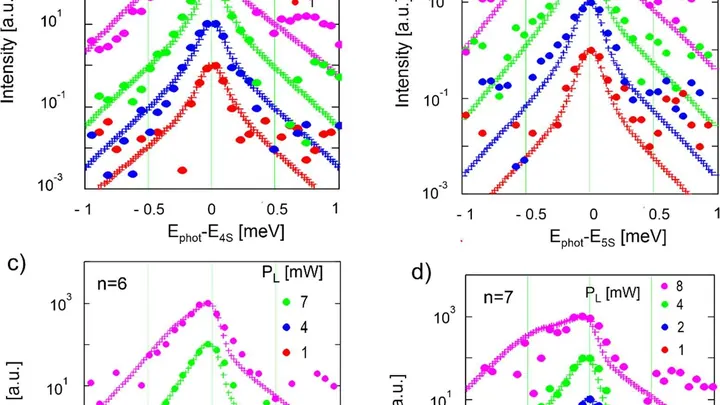
A glowing spot on a crystal is like a firefly that you can wake not only with a flashlight but also with the warmth of your palm. Such spots, single-photon sources, can emit light one particle at a time, which is essential for quantum communication and computing.
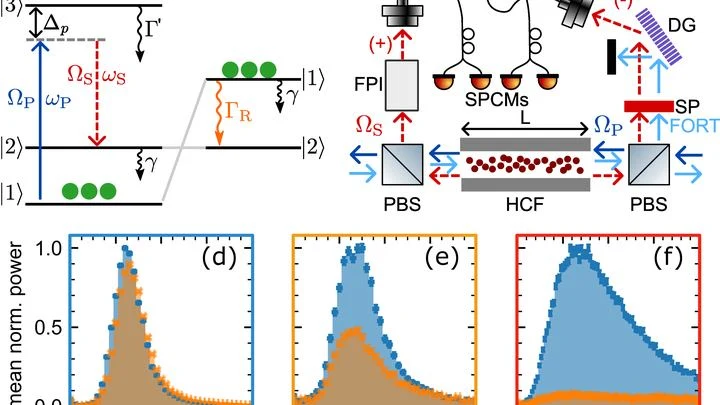
A swarm of fireflies in a night forest flashes randomly: each beetle blinks on its own, and the light scatters equally in all directions. Now imagine the fireflies agreeing to blink so that their combined light goes only north — even though they stay put and none of them turns. That's roughly what physicists did with atoms inside a thin glass tube.
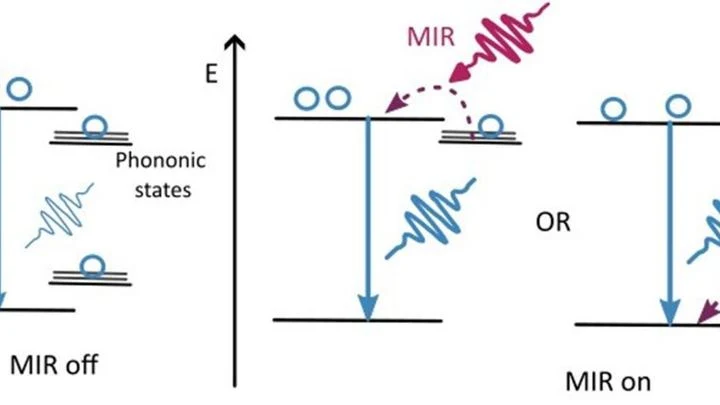
In a silicon crystal, a phosphorus atom holds an extra electron on two very closely spaced orbits. These orbits are like two neighboring floors in a building where the staircase is almost invisible. A short laser pulse in the mid-infrared range pushes the electron from the lower floor to the upper one, and it starts swinging between them like a pendulum.
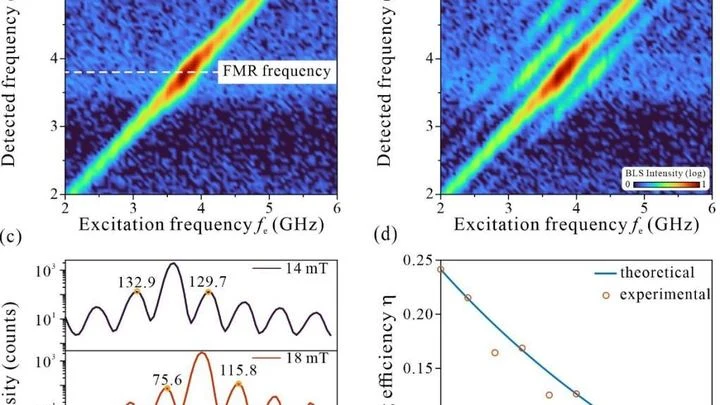
Waves in magnets resemble the vibrations of a string: if you pluck a string, it sounds a single note, but with a strong pluck, overtones appear — sounds at multiple frequencies.
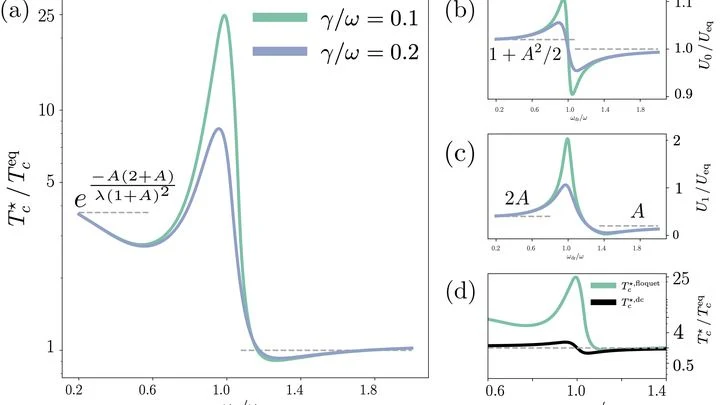
An ordinary superconductor works only in nature's freezer — at temperatures below minus one hundred degrees. The carbon-ball material K₃C₆₀ is no exception: without cold, it resists current like a crowd in a narrow corridor. But physicists noticed something strange: if you shine a laser on it, it starts conducting without loss even in warmth.
When a molecule absorbs light, it doesn't just heat up: it transitions into a special, excited state. Its electrons rearrange, like musicians who, after a loud chord, start playing a new melody.