Freeze to See the Quantum World express
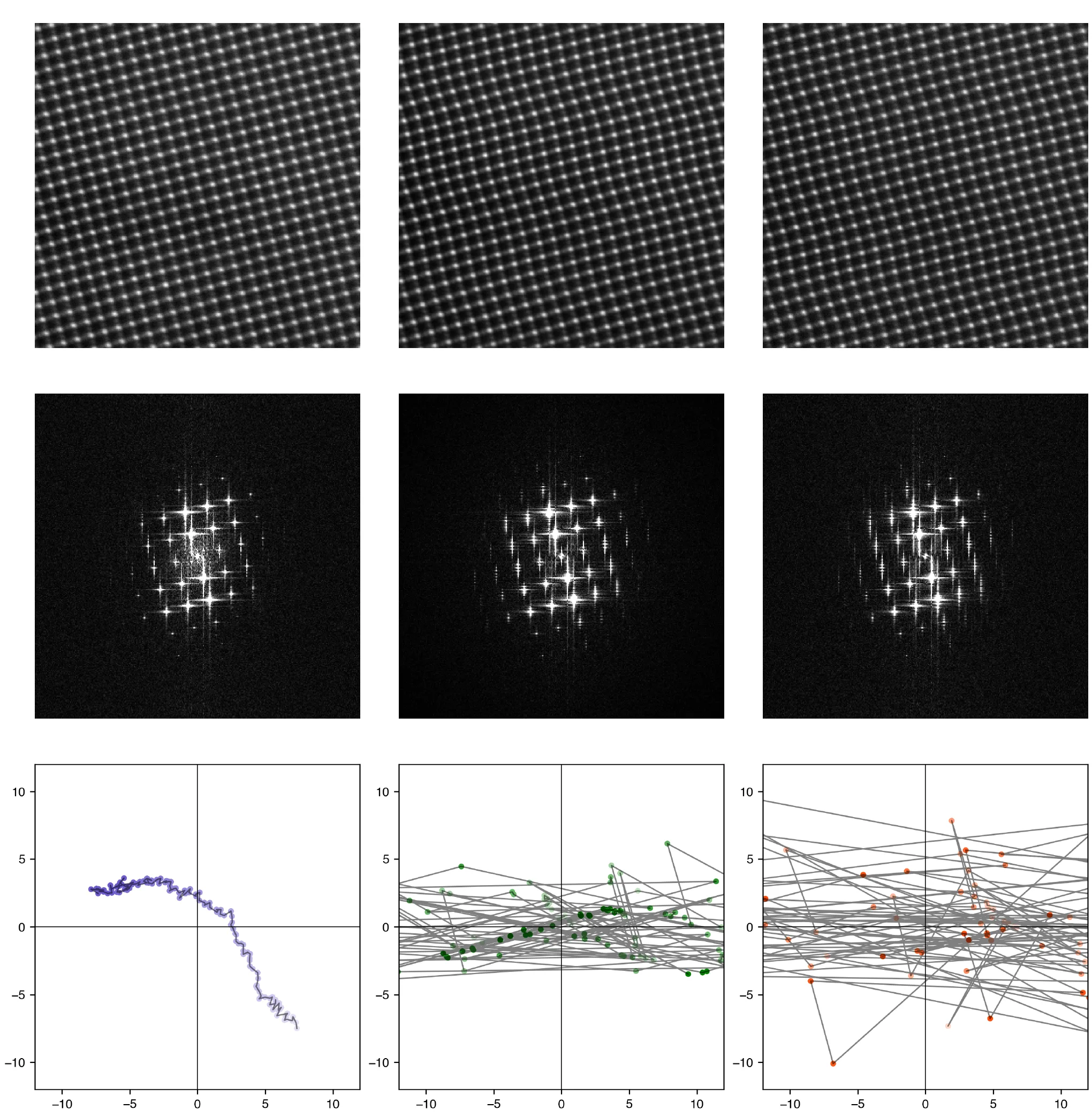
Quantum materials are like finicky flowers: they only bloom in the cold. At room temperature, they hide their unusual properties, but when deeply cooled, they become superconductors or change their magnetic behavior. To understand how they work, you need to examine their atoms in the very cold where these properties reside.
A conventional electron microscope is not up to the task: the liquid helium used to cool the sample shakes and vibrates. Even tiny jolts blur the picture, like a shaky hand with a camera on a long exposure. The authors got around this problem by scanning the sample with rapid movements and then stitching the frames together, aligning each image by the positions of the atoms.
They also accounted for the fact that the microscope's lens itself distorts slightly in the cold, and they corrected these distortions mathematically. The result was clear images of the atomic lattice at minus 253 degrees Celsius. Now you can literally see how atoms arrange themselves into the state needed for quantum technologies.
This opens the door to unraveling the structure of materials that could one day form the basis of quantum computers and ultrasensitive sensors.
Original abstract
as written by the authors arXiv:2603.10892
Much of the exotic functionality of prime interest in quantum materials emerges from structural and electronic ground states that can only be accessed at cryogenic temperatures. Understanding device operation therefore requires structural characterization under the same low-temperature conditions at which these functional phases exist, as room-temperature measurements often probe a different structural state. Achieving atomic-resolution in scanning transmission electron microscopy imaging and particularly 4D-STEM electron ptychography at liquid helium temperature has remained extremely challenging because even small amounts of drift, vibration, and thermal instability associated with the cryogen can disrupt the stringent stability requirements of atomic-resolution STEM. In this work we demonstrate atomic-resolution STEM and multislice electron ptychography at temperatures as low as 20 K using a commercial helium cooled holder. We find that rapid scans and a multi-stage registration workflow are critical to reducing artifacts associated with cryogenic instability for atomic-resolution imaging, while for ptychography scan position correction including compensation for coupling between probe aberrations and position refinement is necessary for successful reconstructions. Together these results establish a pathway for reliable atomic-resolution STEM and ptychography at low temperature, enabling direct visualization of structural ground states relevant to quantum technology.
A temperature of 20 kelvin is colder than the surface of Pluto, where the average is minus 223 degrees Celsius.