Geometric confinement involves trapping quantum particles, such as atoms, ions, or photons, in specific geometric structures to control their quantum states for computation and simulation. By confining particles in engineered potentials, researchers can create well-defined quantum systems with tunable interactions, which are essential for building quantum processors and simulating other quantum systems. This approach is fundamental to many quantum technologies, including trapped-ion quantum computers and optical lattices.
History
The idea of trapping particles with light was proposed by Arthur Ashkin in the 1970s, leading to the development of optical tweezers. Ion traps were developed in the 1980s by Wolfgang Paul and Hans Dehmelt, who shared the Nobel Prize in 1989. Optical lattices were introduced in the 1990s, and they have since become a standard tool for quantum simulation.
How it works
Confinement is achieved using electromagnetic fields, such as optical tweezers, ion traps, or magnetic traps, which create potential wells that hold particles in place. The geometry of these wells determines the energy levels and interactions of the confined particles. For example, in an optical lattice, a periodic potential is created by interfering laser beams, and atoms can be placed at the lattice sites, mimicking the behavior of electrons in a crystal. By adjusting the lattice geometry and depth, researchers can control tunneling, interactions, and even simulate complex condensed-matter phenomena.
In practice
Geometric confinement is used in trapped-ion quantum computers, where ions are confined in linear or 2D arrays, and in neutral-atom quantum simulators, where atoms are arranged in optical lattices to study quantum magnetism and superconductivity.
Fun fact
In a 2D optical lattice, atoms can be arranged in a honeycomb pattern, which mimics the structure of graphene and allows researchers to study exotic electronic properties in a controlled environment.
A ship in a bottle is assembled from the inside, not the outside: masts and sails are pulled through the narrow neck, and once inside the glass they settle into the right pose on their own. Chemists have done something similar with a single cobaltocene molecule, which they pulled into the gap between layers of a two-dimensional crystal.
Quantum systems made of many particles are the basis of future computers and secure networks. But the more particles there are, the harder it is to understand how they are arranged: the number of possible states grows like an avalanche. The usual approach, measuring everything, takes an incredibly long time.
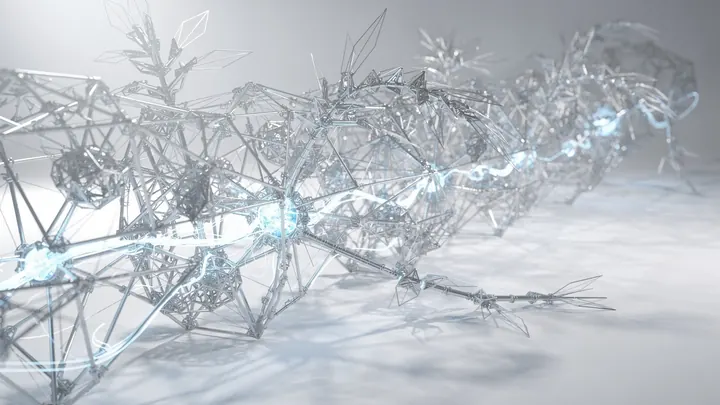
A stellarator fusion reactor resembles an intricately twisted magnetic cocoon. Its job is to confine superheated plasma so that hydrogen nuclei fuse and release energy. But the cocoon's three-dimensional shape creates gaps: some particles escape, especially the fastest ones, which carry most of the heat.
The proton is not a solid ball but a tiny prison. Inside it, three quarks are locked up, and the gluon field keeps them from escaping — something like invisible threads that only grow stronger if the quarks try to move apart.
Imagine a quantum phase transition as an intricate dance. Electrons whirl in strict order, each step representing their spatial arrangement, and the rhythm their dynamics. For decades, physicists could only see a blur of motion, unable to tell if the figures were changing or the music speeding up.
A translator who translates not words but the very structure of a conversation runs into trouble when the chat moves beyond a quiet room. In a familiar simulation on a spatial lattice, everything follows a strict script. But the moment the interlocutors find themselves in a noisy square, where sound is distorted by echoes and the crowd keeps changing direction, the script falls apart.
A magnetic field holds a tiny particle in mid-air, like an invisible dance partner. A special tuning of the field creates a trap with two "positions." In the ordinary world, a dancer occupies only one, but in the quantum world — both at once. Physicists have learned to achieve this for dust grains weighing trillionths of a gram.
The number −0.000459 is no random guest in the Blasius equation. It's the coefficient of η⁵, defining the boundary layer on a flat plate — a thin whisper of air friction against metal. Standard numerical methods like Runge–Kutta yield only an approximate curve. Physics-informed neural networks (PINNs) try to guess the entire solution. Often — unsuccessfully.
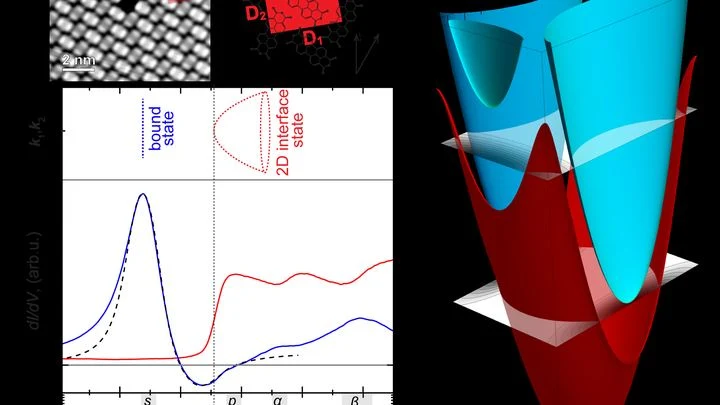
Light or sound can be confined in a tiny region of a crystal, like a pearl in a shell. Usually, two methods are used. The first is like a heavy ball in a pit: a particle with large mass simply cannot roll out. The second is a perfect cage of mirrors, where waves cancel each other everywhere except in the trap itself.
On a sound mixing console, there are hundreds of volume knobs, and each one affects its neighbors. Turn one, and the whole picture changes, but you can only check the result by listening to the entire chord, which takes hours. Designing a laser pulse for inertial confinement fusion is much the same.
A quantum computer is like an orchestra: each musician plays their own part, but the slightest noise from the audience can throw off the whole ensemble. The particles that store information easily lose their coherence from thermal jolts or stray magnetic fields.
Energy transfer in photosynthesis is like a children's slide: it bends under the weight of one, reshaping the path for the next. That's what happens in a leaf: an excited molecule instantly reshapes the 'landscape' of its neighbors.
Physicists reproduce this effect using ions suspended in a vacuum trap.
Dip your finger into water once, and from that single sensation, try to guess its temperature. In the quantum world, such one-shot measurements happen all the time, except you have to guess invisible parameters: say, the squeezing strength of a laser beam.
A person hunting for keys mentally runs through places where they might be. A bird that tucked hundreds of seeds into crevices in autumn retrieves them flawlessly in winter. How can a brain hold so many addresses when all birds have roughly the same number of neurons? The answer lies in geometry.
A quantum computer is like an orchestra where each musician is an electron spin: its tiny magnetic moment. For the orchestra to play in harmony, the conductor must hear each musician individually.
A wafer-thin film of organic molecules was grown on a silicon substrate. In this film, as if on a sheet of graph paper, tiny "pens"—artificial atoms — were laid out with the tip of a scanning tunneling microscope.
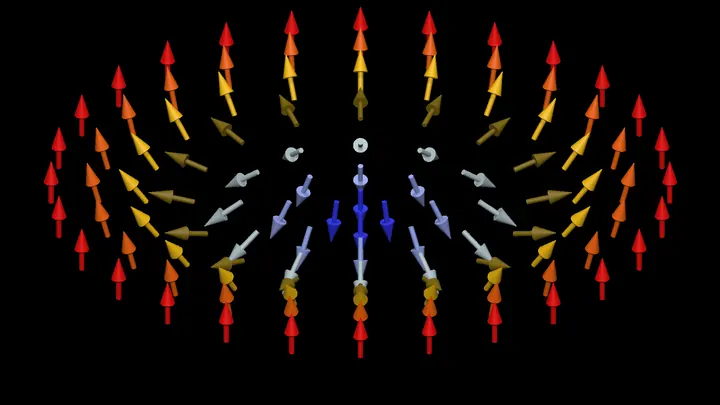
In a field trap, scientists assembled a crystal — 150 ions at ultra-low temperature. Each ion behaves like a tiny magnet, capable of rotating in any direction. By controlling forces that depend on this rotation, physicists made all the magnets swirl into a common vortex called a skyrmion.
Conventional photolithography, used to make chips, hits a fundamental limit: light cannot draw features smaller than its wavelength. Here, they took a different route. First, they made sparse vertical ridges of oxide, then deposited layers of aluminum oxide, each one atom thick, onto them.
Two tiny dust grains hover at the crossing of laser beams. Each is held by its own 'tweezer'—a focused beam that keeps the particle from falling. Inside a mirrored cavity, light bounces between the walls, and its oscillations are coupled to the trembling of the grains.
Water in a cup cools down in minutes. Gas in a room spreads evenly in seconds. But if you trap atoms in a tube as thin as a laser beam and give them a good kick, they will take several seconds to "cool" toward equilibrium — an eternity by atomic standards.
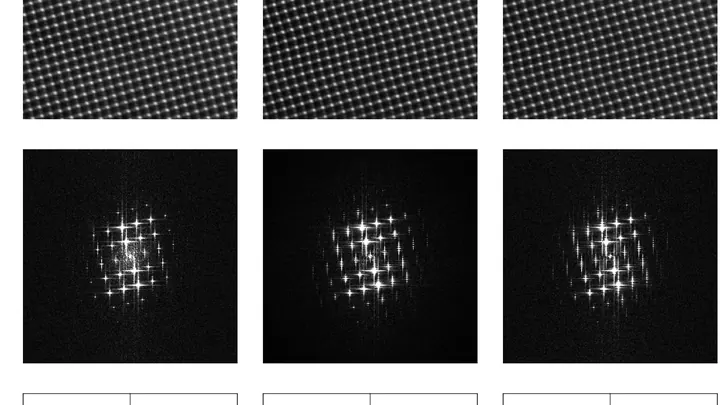
A gold particle a few nanometers across looks like a tiny faceted diamond, but with five faces instead of the usual ones. Inside it hides a defect, like a crack in glass that can either heal or shatter the whole object. Scientists set out to discover what makes this defect move and disappear.
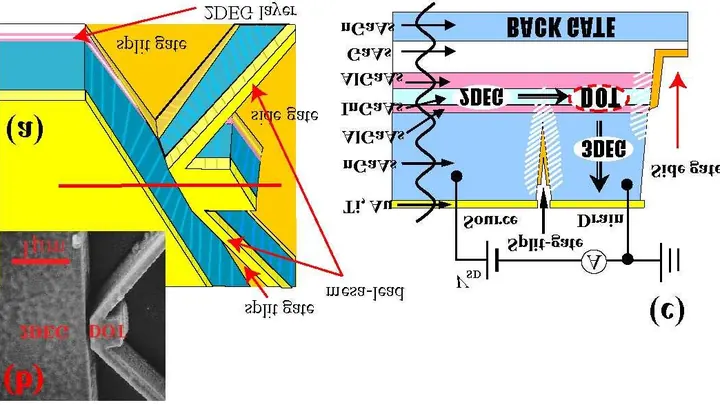
A quantum dot is like a tiny island where one or a few electrons can settle. In this new work, such an island was connected to two 'seas' of electrons: one flat like a pancake, the other bulky like an ocean. Electrons can hop from the island to the seas and back, and this hop depends on the shape of the electron's wave on the island.
Quantum materials are like finicky flowers: they only bloom in the cold. At room temperature, they hide their unusual properties, but when deeply cooled, they become superconductors or change their magnetic behavior. To understand how they work, you need to examine their atoms in the very cold where these properties reside.
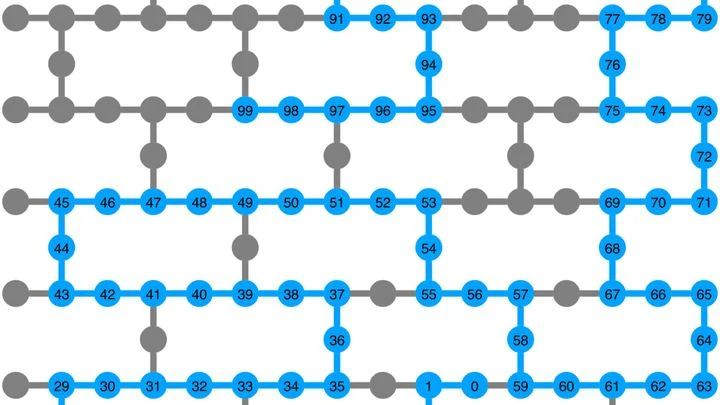
An ion quantum computer is like a chandelier with a dozen pendants: pull one, and they all start swinging. Each ion is a qubit, but when there are many, their collective vibrations crowd the stage. Any operation on one pair disturbs the neighbors, and the computation goes awry.
A rope braided from a hundred short strands can be twisted to the right or to the left. Each strand individually doesn't know which way the whole rope is twisted, but try to unravel it, and the difference immediately shows. That's roughly how the states physicists call symmetry-protected are arranged: locally they are indistinguishable, but globally they are different.
A single antiproton, trapped and cooled to near absolute zero, behaves like a tuning fork that needs a very precise strike to produce a clean note. Catching that 'note' directly is nearly impossible — the signal is too weak.
There is always noise in the microworld. Even in absolute emptiness, something trembles, and these quantum fluctuations interfere with precise measurements. But noise can be "squeezed," like a balloon: if you squeeze it from the sides, one part gets thinner while the other bulges.
A good chef tastes the soup and adds a pinch of salt. Ordinary scales won't notice that pinch, but sensitive ones will. In the quantum world, pairs of entangled particles play the role of such scales. It was previously thought that the entanglement had to be as strong as possible, otherwise precision wouldn't improve.
Each qubit has its own little ring, freely sliding on the doughnut. All quantum logic boils down to smooth movements: shift, flip, connect. Entanglement, for example, is when two doughnuts stick together, and the rings on them begin to spin synchronously, like figure skaters in pairs skating.
The key insight: the geometry of the surface dictates the rules of the game.
A quantum computer weaves a kind of thread from qubits, where each node is a particle and the connection between them is an entanglement. When a physicist measures a qubit, the thread changes: it breaks somewhere, gets sewn together somewhere else, and sometimes a twist appears on it.
River water flows smoothly until it hits a narrow spot. There the current speeds up, and around a bend it may swirl into a vortex. Similar funnels, but just molecule-sized, can gather particles in one place all by themselves — no pump or motor needed.
Three charged ytterbium atoms are arranged in a triangle inside an electromagnetic trap. Normally, they all communicate with each other, like three people at a table constantly exchanging remarks. But if one of them steps into the next room, the conversation continues between the remaining two.
Light races through a maze of mirrors and beam splitters, but at the end of its journey, it doesn't just flash on a detector: it transforms itself. In the new photonic computer, nonlinear modules have been added to the familiar linear circuits, and now light can perform any quantum operation, not just a subset.
A vortex in a superfluid gas is like a whirlpool in a sink: the fluid swirls around an empty core. If you spin such a vortex three times harder than usual, it won't hold: it breaks into three separate whirlpools, much like a thick stream of water splits into droplets.
A quantum computer made of trapped ions played the role of a tiny universe. In it, particles didn't just move; they wove into knots that change their properties when swapped. Such knots are called Fibonacci anyons: they aren't ordinary particles but rather vortices in the fabric of space.
Imagine two synthetic diamonds, each acting as a high-precision tuning fork. Inside the crystal lattice of each diamond sits a carbon-13 atom: this is a quantum bit, or qubit, the minimal unit of quantum information.
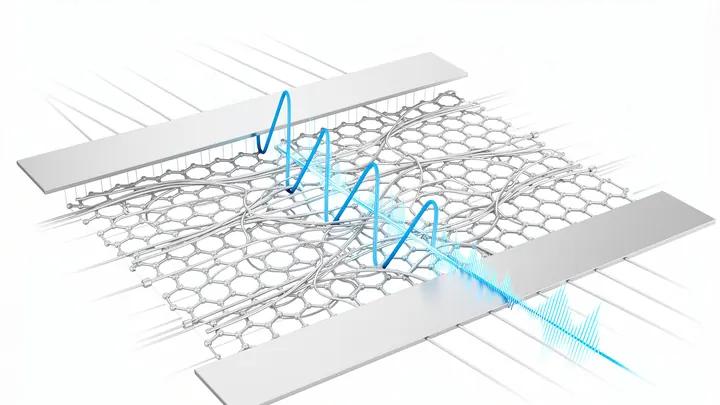
In a narrow slit between two plates, ions don't behave like free particles but like a crowd in a packed bus: pressed tightly together, they form dense clusters. This very property, the ability of ions to bunch up in extremely confined spaces, underpins a new mechanism for controlling ion transport.
Researchers studied ion behavior in two-dimensional nanochannels just a few atoms wide.
A massive refrigerator the size of a wardrobe hums, maintaining an interior colder than outer space. At its heart lies a silicon chip with tiny superconducting loops — qubits. But to make the chip work, dozens of thick copper cables snake from room temperature down to it.
In the quantum world, particles can walk through walls: this is quantum tunneling. If you place a detector right in the path of such a 'ghostly' passage, the moment of detection acts like a starting pistol: the particle gets a sharp kick and flies out of the barrier with excess energy, turning into a tiny engine.