A Beam That Spares Healthy Cells express
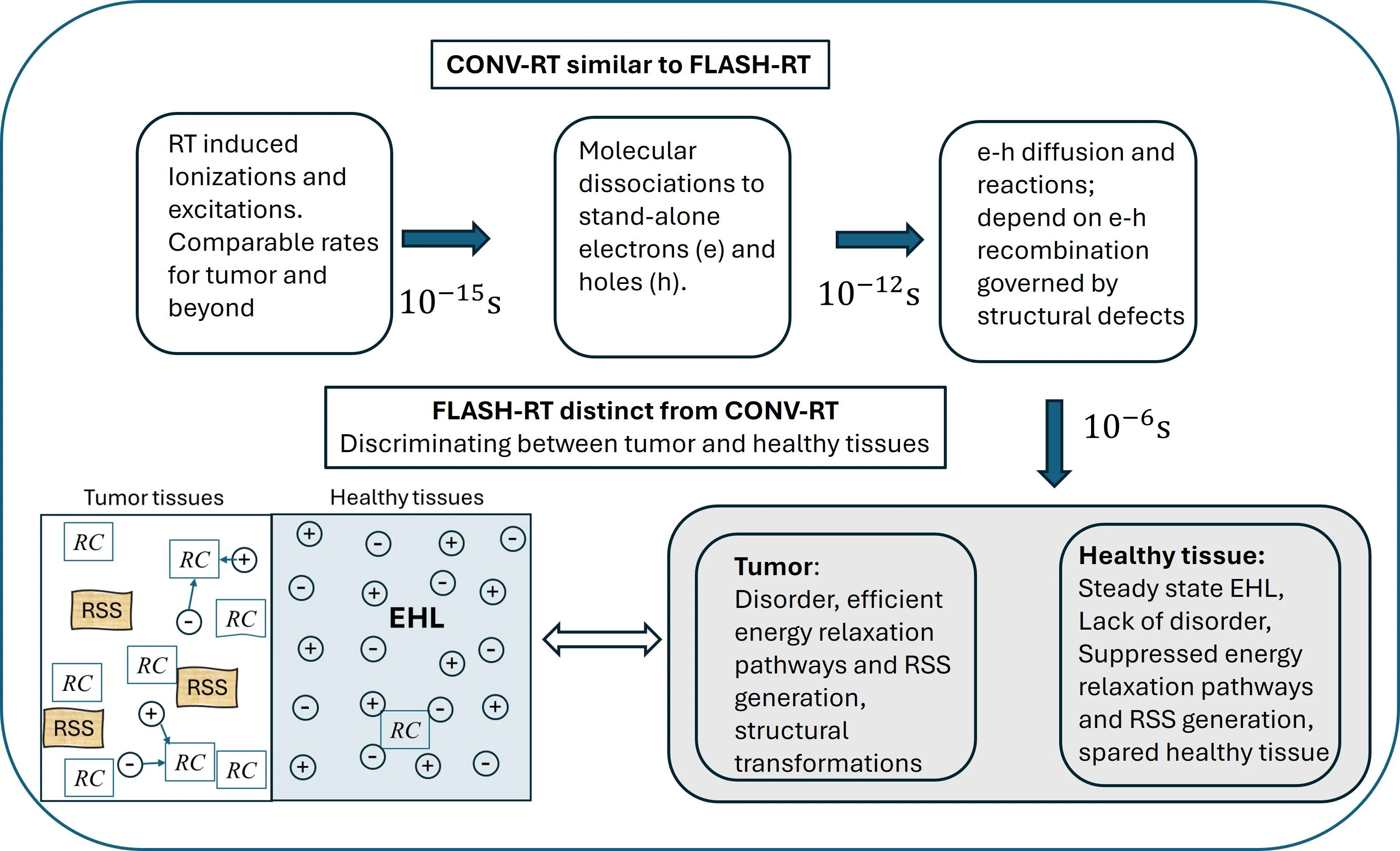
Two cities: one with neat, straight streets, the other with a tangle of alleys. If you send a powerful flood of water through both, in the first the water quickly drains away through channels, while in the second it swamps everything. That's roughly how tissues behave under ultrafast radiation therapy, known as FLASH.
In healthy tissue, cells are arranged in an orderly fashion, like houses along regular streets. When radiation hits, charged particles are created that quickly find each other and form a dense 'electron-hole liquid.' This liquid is viscous and prevents the energy from spreading — harmful chemical reactions are slowed, and the tissue stays intact.
In a tumor, however, cells are jumbled, like shanties in an old city. There, charges don't merge into a calm liquid; instead, they immediately trigger a chain of reactions, producing free radicals — aggressive molecules that destroy cancer cells. So the tumor dies, while healthy tissue survives.
Now it's clear why very high doses and dose rates are needed to protect healthy tissue. If you irradiate too slowly, harmful radicals accumulate in healthy tissue, and then it suffers too. But with ultrafast irradiation, the liquid in healthy tissue manages to 'lock up' the energy, preventing it from doing damage.
Original abstract
as written by the authors arXiv:2603.15913
We consider physics behind the FLASH modality of cancer radiation treatment where extremely short treatment times are achieved with ultra high dose rates maintaining the conventional antitumor effectiveness and yet substantially reducing damage to normal tissues (sparing effect). The difference in responses between normal and tumor tissues is attributed here to different recombination rates related to their structure morphologies: ordered in normal vs disordered in the tumor tissues. Correspondingly different are their charge densities under ionizing radiation. In normal tissues it is high enough to form electron-hole liquid (EHL). Because of low EHL diffusivities, the chemical reaction and generation of free radicals are suppressed; hence, sparing effect. To the contrary, a disordered tumor tissue renders efficient energy relaxation channels forming antitumor free radicals. We describe the FLASH thresholds for doses and dose rates.
Free radicals aren't always bad: they're exactly what kills cancer cells in FLASH therapy, while in healthy tissue their production is suppressed.