The Ocean Hints at Winter: A Simple Neural Network Reads Water Temperature ✛
The ocean holds memories of heat and cold longer than the air does. If the water off the coast of Peru is warmer than usual, a couple of months later winter in Europe might be milder or, conversely, harsher. Scientists long struggled to grasp this connection because it is not straightforward: the same warm patch can sometimes bring frost and sometimes a thaw.
The researchers took 80 years of sea surface temperature records and trained a neural network. It looks at three "snapshots" of the ocean: one, two, and three months before winter begins. Then it issues a forecast: what the winter will be like. The network was compared with a simple linear model that does the same thing but lacks the ability to find complex patterns. The neural network proved more accurate, especially when El Niño was raging in the Pacific, when the ocean "speaks" louder.
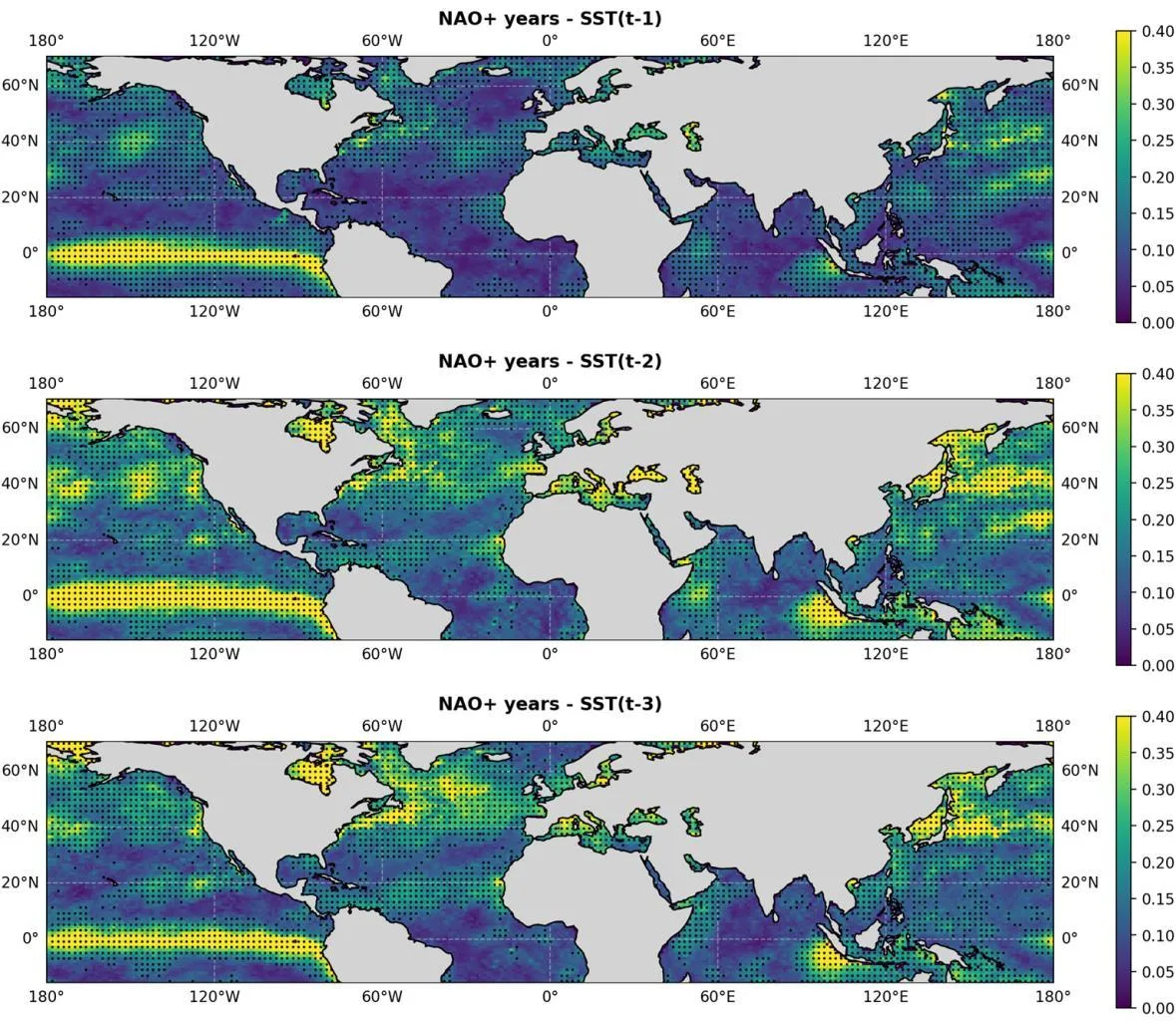
Previously, it was unclear which parts of the ocean matter for the forecast. Now the network has shown that it relies on the tropical Pacific, the North Atlantic, and a region of the Indian Ocean. This is somewhat like an experienced fisherman reading the faint ripple on the water to tell where the wind will come from. The practical benefit is straightforward: if such a forecast becomes reliable, energy companies and farmers could prepare better for winter.
The neural network, with 262,225 trainable parameters, matches the accuracy of seasonal forecasts that use supercomputer models of the atmosphere and ocean. Yet it was trained on just 250 independent 'pictures' of the ocean.
The idea of reading the future from ocean temperature evokes Frank Herbert's 'Dune', where navigators use complex calculations to foresee their path. Here, the convolutional network plays the navigator, and the path is Europe's winter weather.