The Ocean Whispers Early: Neural Network Hears the Atlantic Winter Three Months Ahead ✛
The ocean does not shout about its intentions. It whispers: a warm patch off the coast of Peru, a cold tongue near Hudson Bay, a barely perceptible shift in a current. The atmosphere does not respond immediately, and by winter Europe may get either mild slush or Siberian frosts. Scientists have long known that a connection exists between ocean temperature and winter weather, but it is nonlinear and weak, so climate models often get it wrong.
The researchers trained a convolutional neural network on ERA5 reanalysis data from 1940 to 2023. The inputs were three maps of sea surface temperature anomalies: one, two, and three months before winter began. The architecture consisted of three convolutional blocks with circular convolution along longitude, making the ocean 'seamless' like a globe. For comparison, they built a linear model with the same structure but without nonlinear activations. This allowed them to test whether the neural network truly captures nonlinear relationships or simply averages the data.
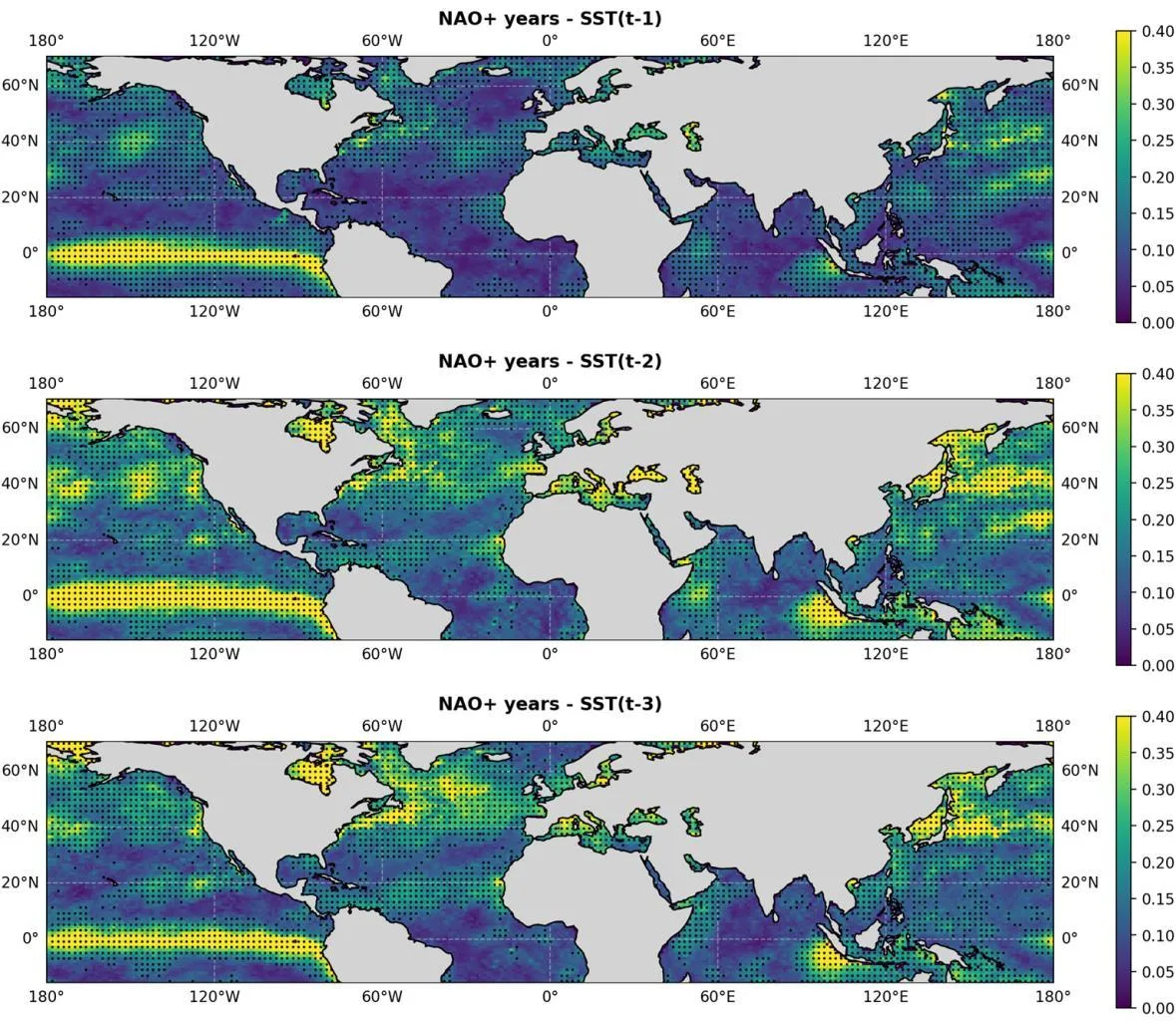
The neural network proved more accurate: its correlation with the real oscillation index was 0.50, versus 0.44 for the linear model. In years of moderate and strong El Niño, the gap widened: 0.57 versus 0.47. This means the network is better at hearing the 'loud' signal from the tropical Pacific. Sensitivity analysis revealed which ocean regions it relies on: the equatorial Pacific, the North Atlantic near the North Atlantic Current and Hudson Bay, and the Indian Ocean near the Mentawai Islands.
It was known before that the ocean influences the atmosphere, but exactly how remained a puzzle because the relationship is nonlinear. Now we see that deep learning can extract signals from water temperature that traditional approaches miss. This is not a replacement for physical models, but rather a hearing aid that amplifies the ocean's whisper. The practical benefit is medium-range forecasting of winter weather in Europe, important for energy and agriculture.
The ocean's whisper has become more audible. The neural network does not explain why the water warms the way it does, but it can recognize the pattern and warn us: the winter will be harsh or mild. Perhaps in a few years, such networks will be part of routine weather services, and we will know in advance whether to stock up on warm coats.
The neural network, with 262,225 trainable parameters, matches the accuracy of seasonal forecasts that use supercomputer models of the atmosphere and ocean. Yet it was trained on just 250 independent 'pictures' of the ocean.
The idea of reading the future from ocean temperature evokes Frank Herbert's 'Dune', where navigators use complex calculations to foresee their path. Here, the convolutional network plays the navigator, and the path is Europe's winter weather.