Virus evolution versus quarantine express
An epidemic is like a fire in a dry forest: a spark flares up, the flames leap from tree to tree, and within a week the whole area is burning. A hundred years ago, scientists devised a simple mathematical model for such a fire: they divided people into those who had not yet fallen ill, those who were ill, and those who had already recovered. The model predicted well how a disease spreads through cities.
But a real virus has a property that fire lacks: it changes. Each time it replicates inside a human body, the virus may make a mistake when copying its genes, and a slightly different variant emerges. Most such mistakes change nothing, but occasionally a variant arises that attaches to cells better or survives longer in the air. Such a variant finds new hosts faster.
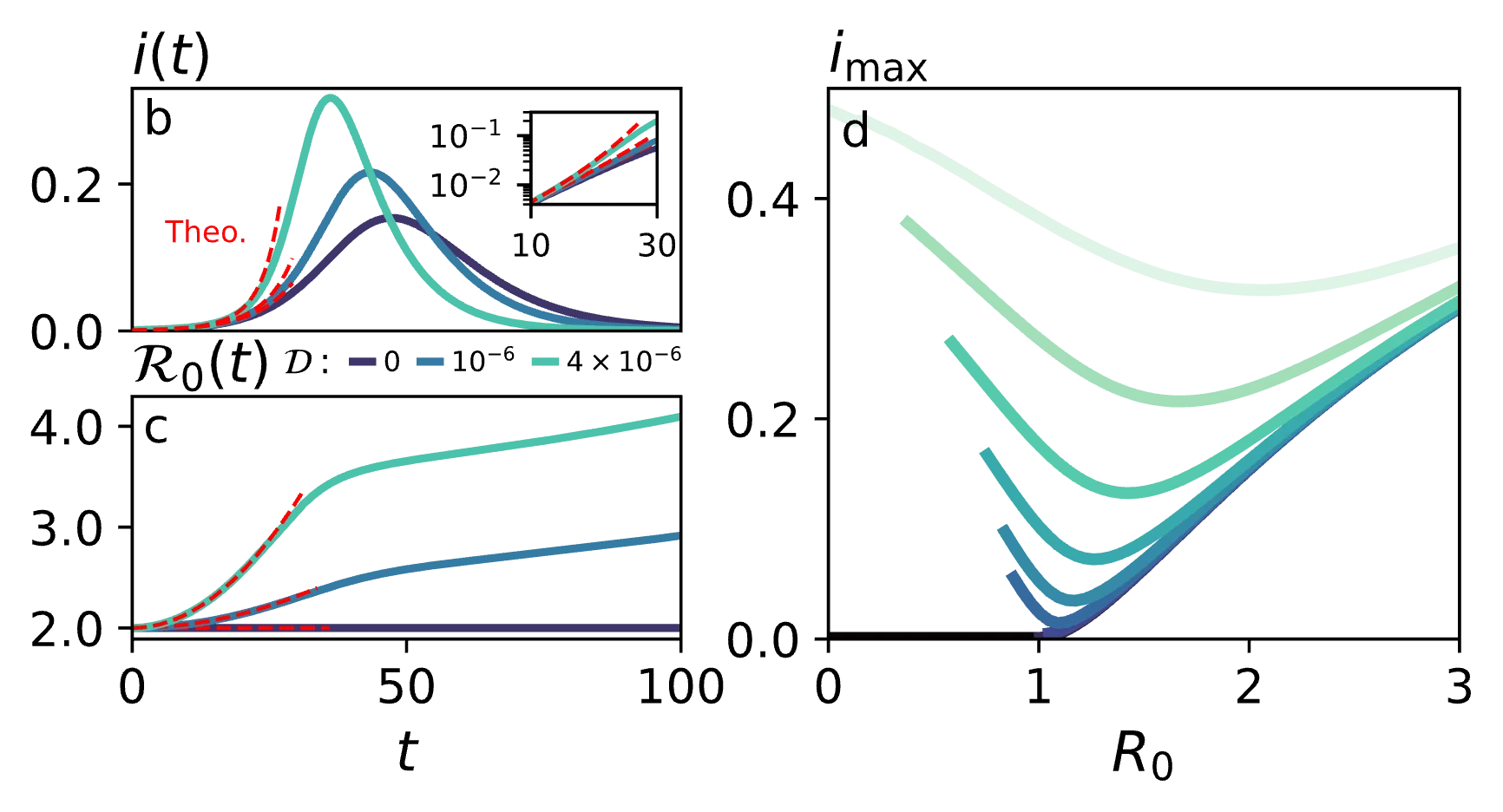
The authors of the new study took the classic epidemic model and allowed the virus to evolve: that is, to change its infectivity. It turned out that this changes the picture radically. An outbreak can grow not just quickly, but superfast: each new patient infects more and more people, and the case curve shoots upward like a rocket. The transition from a calm situation to an epidemic becomes abrupt, almost instantaneous.
The scientists derived formulas showing at what mutation rate and at what timing of lifting restrictions the epidemic spirals out of control. There is also an unexpected conclusion: different measures affect evolution differently. If you shorten the period during which a person is infectious, the virus simply does not have time to transmit further, but the virus itself continues to change inside the infected host. If you reduce infectivity (for example, with masks and distancing), both the number of cases and the speed of evolution decrease: the less often the virus passes to a new host, the fewer chances it has to accumulate beneficial mutations.
A forest fire is fought with water and by cutting firebreaks. With a virus it is more complicated: it does not just burn, it adapts. The model with evolution shows that fighting an epidemic is a race where it is important not only to put out the current flames, but also to prevent sparks from igniting a new, even hotter fire.
Superfast growth in the model means that over the same time interval, the number of new cases increases not by a constant factor, but faster and faster, like a snowball rolling down a mountain and gaining mass.
In the film Contagion (2011), the virus mutates too quickly for a vaccine to be developed — a plot that became closer to reality after the COVID-19 pandemic.