Hamilton's rule is a principle in evolutionary biology stating that altruistic behavior evolves when the benefit to the recipient multiplied by relatedness exceeds the cost to the actor.
In 1964, British biologist William Hamilton proposed an elegant explanation for altruism. His rule is expressed as an inequality: rB > C, where r is the degree of genetic relatedness, B is the benefit to the recipient, and C is the cost to the helper. If relatedness is high (e.g., between siblings r=0.5), even costly help can be justified. This overturned views on natural selection: it turned out that selection acts not for the good of the species or individual, but at the gene level. A gene that encourages helping carriers of its copies will spread, even if individual organisms suffer. Thus, the concept of the 'selfish gene' emerged.
History
William Donald Hamilton, a British evolutionary biologist, formulated the rule in 1964 in two papers, 'The Genetical Evolution of Social Behaviour'. His ideas initially met resistance but were later recognized as a cornerstone of modern evolutionary biology. John Maynard Smith popularized the term 'kin selection'. Richard Dawkins developed the concept in the book 'The Selfish Gene' (1976).
How it works
The rule is applied to explain social behavior in animals: from ant colonies to human societies. It predicts that altruism is proportional to relatedness. Limitations: the rule does not account for reciprocal altruism (mutual aid among unrelated individuals) and group selection effects. It also assumes additivity of effects, which does not always hold.
In practice
The rule explains why worker bees sacrifice themselves for the queen. In agriculture, it helps predict the behavior of social insect pests.
Fun fact
Hamilton's rule predicts that in harems, where offspring are from a single male, relatedness among siblings is higher, and altruism should be stronger. This is confirmed in some wasps: workers more readily help full sisters than half-sisters.
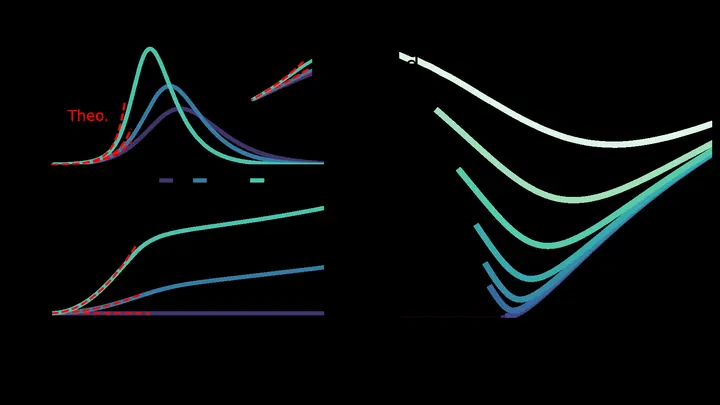
Two daughter cells receiving equal shares from the mother: that's the familiar picture of division. But what if one gets almost everything and the other just crumbs? Stochastic modeling shows that sometimes unequal division is more advantageous.
Each cell stores a protective reserve that helps it weather hardships. During division, this reserve is distributed between daughters.
When an antibody meets a virus, it doesn't latch on with a single death grip. Rather, it's like two bunches of grapes tumbling in water, catching each other with dozens of short tendrils. Each tendril is weak on its own, easily torn by the thermal jitter of water molecules, but together they hold tight.
A mountain pass connects two valleys. In one, the protein is folded; in the other, it is unfolded. To get from one to the other, you must cross the saddle — the highest point on the path. In protein science, this point is called the transition state, and the coordinate that shows the distance to it is the committor.
A mosquito swarm resembles a living cloud — hundreds of bodies circle together, but no one lines up or mimics a neighbor's movements like starlings or fish. For a long time, it was unclear what held such unity together. The authors of a new study suggested that the insects communicate by sound.
Two gardeners haggle over water from a magical well. One proposes how many buckets to take, the other can agree or refuse. If the deal goes through, the water decreases; if not, the well gradually refills. This haggling repeats hundreds of times, and the gardeners' habits sometimes change randomly, as if they're trying new tactics.
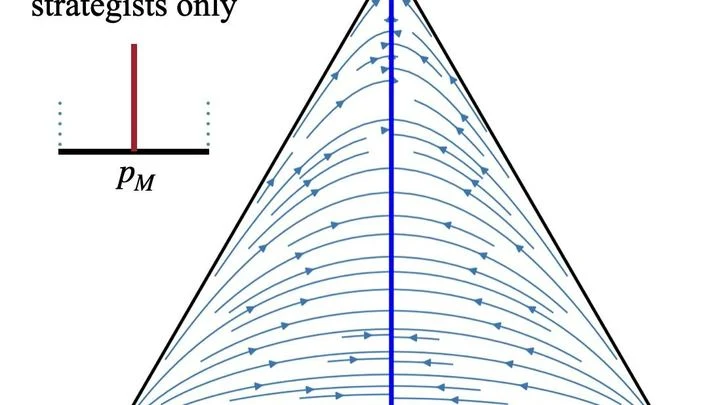
For a long time, biologists argued: if a herd of animals stably maintains a mix of aggressive and peaceful individuals, does each one alternately change behavior, or do some always fight while others always yield? In classical equations, these options are indistinguishable.
Ecosystems are not chaos but a complex dance where every species plays its part. Scientists modeled such a dance: two prey compete for carbon and water (the building blocks of cells), while a predator eats both. Sixteen scenarios emerged — from predator extinction to a steady rhythm for all three species.
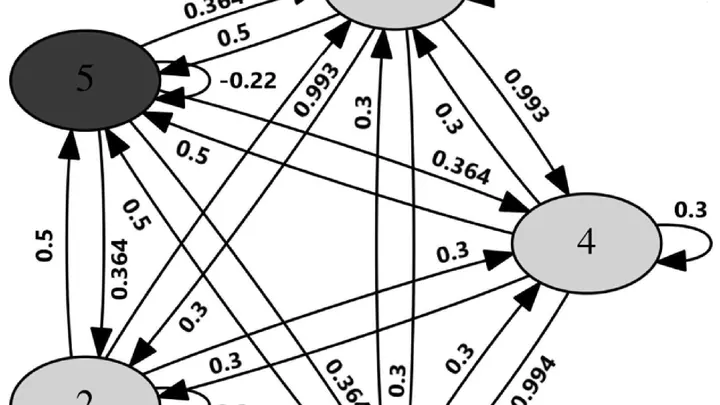
Molecules float in a pot of broth. Some copy themselves, others help their neighbors, and still others just get in the way. This isn't soup: it's a model of early life: a replicator system. Usually, we assume the rules of the game are fixed once and for all: whoever reproduces fastest wins. But the authors of this study proposed something different — the rules can change too, just very slowly.
We're used to thinking that noticing only confirmations of our guesses is a mistake. But recent calculations, inspired by wave behavior, flip that view. It turns out that the habit of seeking the familiar is the best way to reduce information noise (scientists call it entropy).
A person reaches out to a stranger across town. That stranger will never return the favor: they'll never meet. So why help? Biologists call this indirect reciprocity: kindness comes back not from the person you helped, but from someone else, down the line.
In a new study, two variants of this idea were pitted against each other.
The immune system is like a tireless editor, revising antibody drafts to make them stickier to viruses and bacteria. This process is called antibody maturation: random typos (mutations) arise in the genes, and natural selection keeps those that improve target capture.
You can think of a political system as a vast galaxy — a gravitationally bound system of stars, gas, and dust. In this analogy, parties are the stars, radiating the light of public activity, while their supporters are dark matter, the invisible substance that emits no electromagnetic radiation but whose mass holds the whole structure…
Engineers improving neural networks act like breeders: they try a variant, check the result, and keep the best. They collected 935 such trials from 161 papers and measured how often a code tweak turns out beneficial, harmful, or neutral. The picture is familiar to any biologist: 68% of changes degrade performance, 19% do nothing, and only 13% yield a gain.
In urban planning, Braess's paradox is well known: adding a new road to a transport network can worsen traffic rather than ease it. For a long time, it was explained by the selfish behavior of drivers, each seeking personal gain. However, ant colonies, acting as a single coordinated superorganism without personal interests, exhibit the same trap.
In everyday life, time flows on its own, like a river past its banks. But in quantum gravity, things are different: time does not flow; it emerges from relations between objects, like a pattern in a carpet that is only visible when viewed from a certain spot.
An epidemic is like a fire in a dry forest: a spark flares up, the flames leap from tree to tree, and within a week the whole area is burning. A hundred years ago, scientists devised a simple mathematical model for such a fire: they divided people into those who had not yet fallen ill, those who were ill, and those who had already recovered.
A branching network, like a river delta or a tree crown, is built on the principle of economy. The classic law, derived back in 1926, stated that the cube of the parent vessel's diameter equals the sum of the cubes of the daughter diameters. This rule worked beautifully for ideal tubes, but real arteries stubbornly gave a different exponent — around 2.7 instead of 3.
The authors of the new study found the reason.
An ecosystem is like a swing that someone is subtly pushing. Previously, it was thought that the main concern was that the swing wouldn't swing too wildly. But the authors of this work showed that the greater danger is when the equilibrium point itself slides toward a place where the swing can no longer return.
Two species of bacteria share a single Petri dish. Both eat the same food, and by all rules, one should outcompete the other. But in reality, they often live together for years. The secret lies in knowing when to leave.
Bacteria don't stay put. When a stranger appears nearby, they start moving faster.
An infection is spreading through a city, and residents are watching each other: some have already been vaccinated, others are hesitant. Every day, they update their decisions — whether to imitate neighbors or friends who support vaccination.