Heavy Quarks Reveal Secrets of the Early Universe express
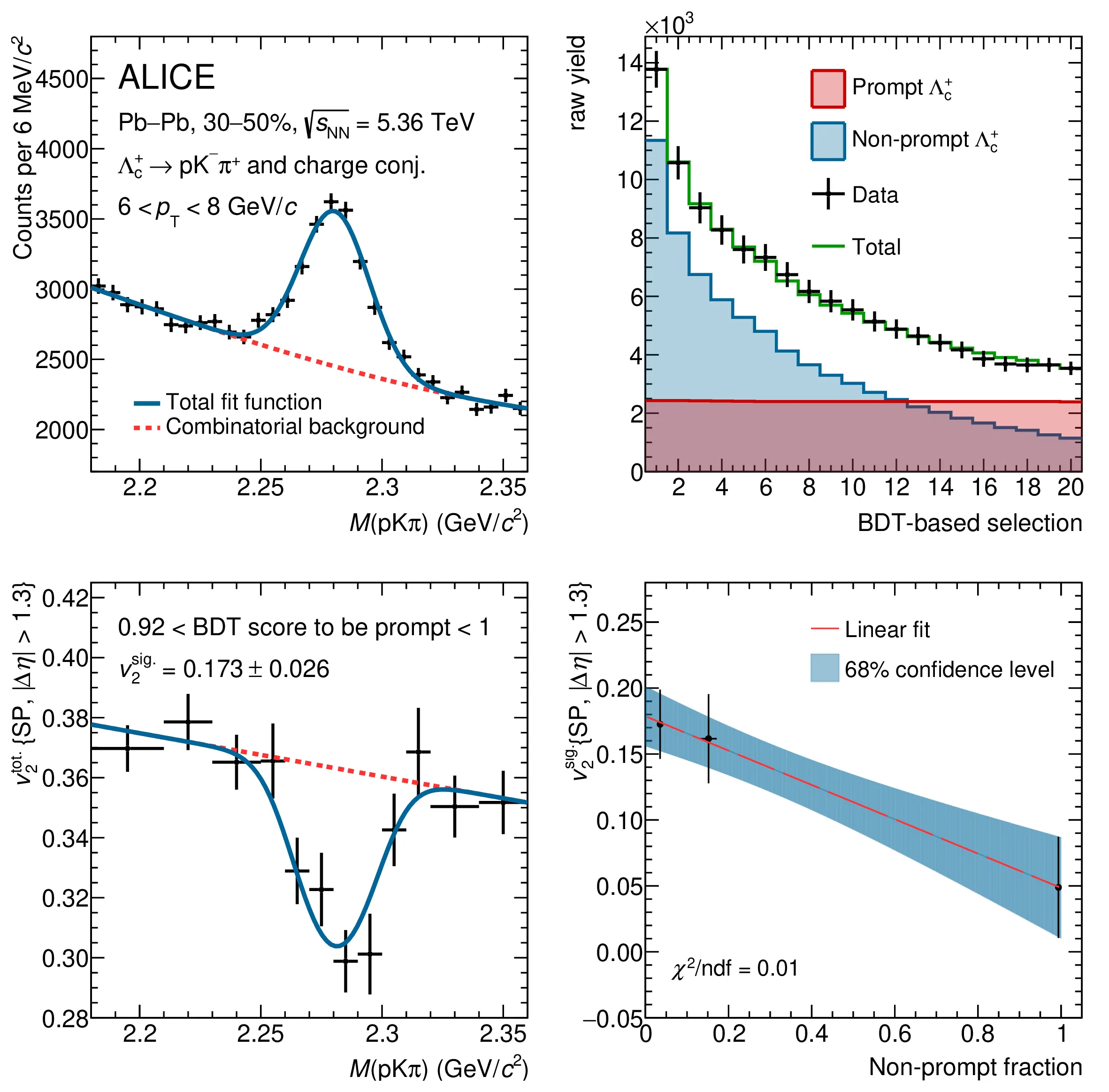
In 2010, physicists at the Large Hadron Collider first produced a quark-gluon plasma — a state of matter where quarks and gluons are as free as water in steam, not locked inside protons and neutrons. Now the ALICE collaboration has studied how charmed particles, those containing a heavy c-quark, move in such a medium. The Standard Model predicts that c-quarks should be born in the first instants of the collision and then interact with the plasma like a spoon in honey.
The scientists collided lead nuclei at an energy of 5.36 TeV per nucleon pair and reconstructed the trajectories of D mesons and lambda baryons from their decays. It turned out that lambda baryons, made of three quarks, are more strongly 'aligned' with the direction of the collision plane than D mesons, which consist of two quarks. The difference is 3.7 sigma, like in a traffic flow where trucks hug the shoulder more often than cars.
This behavior is explained by the mechanism of quark coalescence: light quarks from the plasma 'stick' to the heavy c-quark, forming a baryon. It's as if in a crowd of runners, one heavy runner gathers companions around them, and the whole group moves more coherently. If particles formed independently, there would be no difference. So charmed particles indeed feel the collective flow of the plasma.
This result is another brick in understanding how matter behaved in the first microseconds after the Big Bang. Back then, the Universe was filled with the same quark-gluon plasma, and it was from this that protons and neutrons later assembled, followed by atoms, stars, and planets.
The quark-gluon plasma was first produced at the RHIC collider in 2005, and at the Large Hadron Collider it has been studied since 2010. The temperature of this plasma reaches 5.5 trillion degrees—100,000 times hotter than the Sun's core.
In Isaac Asimov's novel 'The Gods Themselves', a civilization learns to extract energy from quark interactions — an idea that echoes the study of the quark-gluon plasma as an energy source of the early Universe.