When a proton slams into a lead nucleus at the Large Hadron Collider, a swarm of particles is born. They fly off in all directions, but not entirely randomly: their motion resembles ripples on water from a thrown stone.
Deep inside the Large Hadron Collider, lead nuclei are accelerated to nearly the speed of light and smashed together. In such collisions, a multitude of particles are born, including kaons, particles containing a strange quark, and deuterons, the nuclei of heavy hydrogen.
Deep inside the Large Hadron Collider, lead nuclei collide with such force that, for an instant, matter hotter than the Sun is born. This is the quark-gluon plasma — a soup of the tiniest building blocks of matter that existed only in the first microseconds after the Big Bang.
At the Large Hadron Collider, protons are smashed into lead nuclei. At the moment of impact, hundreds of new particles are born, and some of them fly out in narrow beams — jets. Inside such a jet, like in a dense stream, protons and neutrons can stick together to form larger nuclei, for example a deuteron — the nucleus of heavy hydrogen.
In the first moments after two lead nuclei collide at the Large Hadron Collider, a tiny fireball is born — a quark soup where particles move freely. If a very strong magnetic field arises at that moment, it can separate positive and negative charges, much like a comb parts hair into strands.
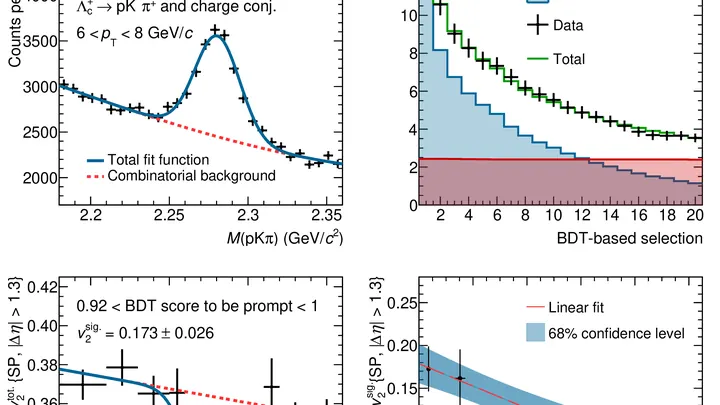
In 2010, physicists at the Large Hadron Collider first produced a quark-gluon plasma — a state of matter where quarks and gluons are as free as water in steam, not locked inside protons and neutrons. Now the ALICE collaboration has studied how charmed particles, those containing a heavy c-quark, move in such a medium.
If an atomic nucleus is a family, then in an ordinary helium house live two protons and two neutrons, holding hands tightly. Now imagine that one family member is an oddball who loves to wander far from home.