A Magnetic Mosaic: How Atoms Divide Roles express
A woven bamboo basket is not just a household item: it's an exact blueprint for how atoms are arranged in the crystal YMn₆Sn₆. Six manganese atoms form hexagons that assemble into a pattern reminiscent of the Japanese kagome. In such a lattice, electrons usually behave uniformly, like passengers in a crowded subway car. But in this material, they unexpectedly separate into two groups, as if in one car some passengers ride calmly to the end of the line while others jostle by the doors.
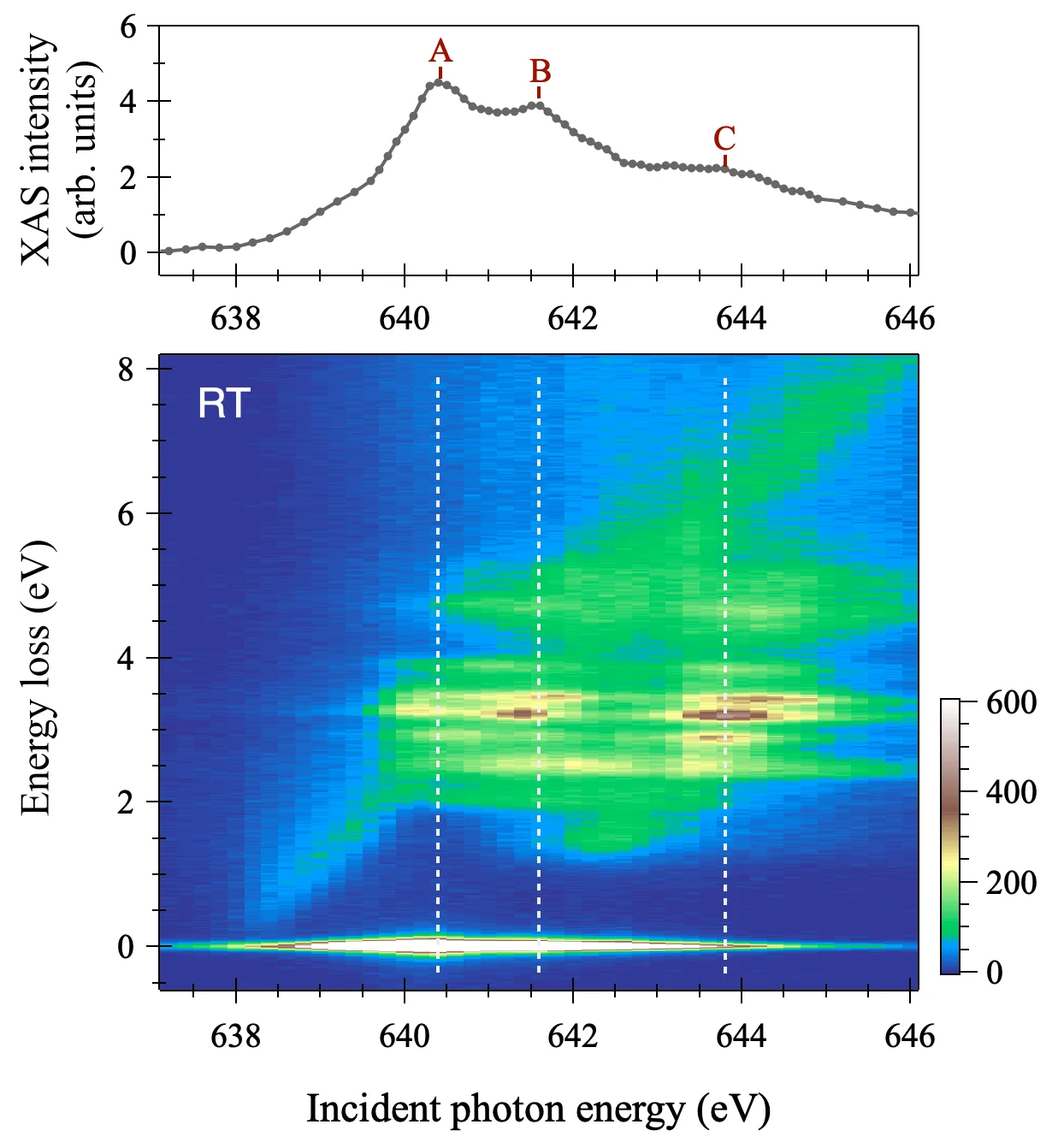
Using X-rays that make electrons jump between energy levels, scientists peered inside the manganese atoms. They found that electrons in orbitals aligned along the bonds between manganese atoms move freely through the crystal, like water through pipes. Meanwhile, electrons in orbitals pointing toward the tin atoms become heavy and sluggish, like thick honey that barely flows. This separation happens spontaneously, without any external push, and is maintained by a special magnetic interaction within the atom that suppresses electrons from switching roles.
This division of roles explains why the manganese layers in this crystal are magnetized in the same direction, even though adjacent layers in similar structures usually oppose each other. The material becomes a natural laboratory for studying how lattice geometry and internal atomic forces jointly create new quantum states — unlike either insulators or ordinary metals.
Original abstract
as written by the authors arXiv:2603.21203
The kagome lattice naturally hosts flat bands, Dirac fermions, and van Hove singularities, yet whether its geometry can stabilize orbital-selective phases - a hallmark of Hund's physics in multi-orbital correlated systems - has remained an open question. Here, we combine resonant inelastic X-ray scattering with density functional theory and dynamical mean-field theory to demonstrate that YMn$$_6$$Sn$$_6$$ exhibits a spontaneous orbital differentiation into coexisting itinerant and localized electrons within the same Mn $$3d$$ manifold. Orbitals directed along Mn-Mn bonds provide coherent quasiparticles and metallic bands, while those pointing toward ligands become strongly correlated and display non-Fermi-liquid behavior. Hund's intra-atomic exchange suppresses orbital fluctuations, stabilizing this dichotomy and providing a natural double-exchange-like mechanism for the observed ferromagnetic bilayer coupling. Our work establishes YMn$$_6$$Sn$$_6$$ as a kagome platform where orbital selectivity, flat-band topology, and Hund's metallicity converge - revealing that geometric frustration and correlation-driven orbital differentiation can cooperatively design exotic quantum phases beyond the canonical paradigms of Mott physics or band topology alone.
The kagome pattern was first described by Japanese basket weavers: hexagons with triangular holes. Now this pattern is repeated in crystals, and electrons within it behave like balls in a maze — some roll freely, others get stuck in corners.