A. Singh

8 articles · 30 co-authors · latest: 2026-09-07
15,077 citations · h-index 42 · 95 papersData: Semantic Scholar

We have retold 8 papers by this author. 1 of them with a full read. most often about: critical point, superconductivity, Phase transition. 30 co-authors across our retellings.

Links in the knowledge graph
Strongly Correlated2026-02-112 minarXiv:2602.11011express
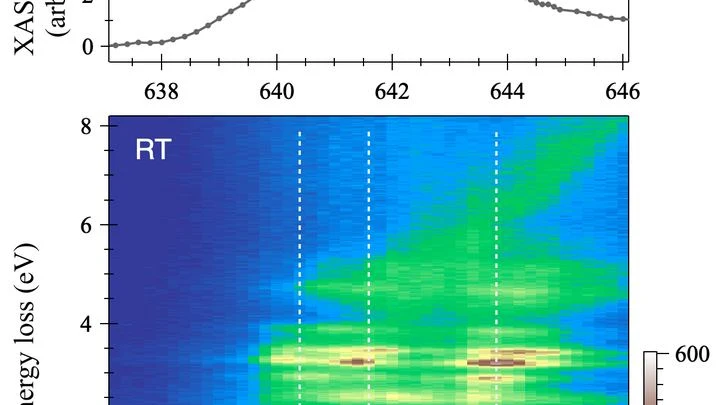
A Quantum Crossroads Inside a Superconductor
Inside some materials, electric current flows with zero resistance. These are superconductors, and they only work when it's very cold. Copper oxides are special: they stay superconducting at somewhat higher temperatures, but why has been a puzzle for forty years.
Optics2026-02-261 minarXiv:2602.23476express
The Light That Shakes Mirrors
You can squeeze light between two mirrors like a spring in a vise. It bounces back and forth, growing denser: that's how you get ultra-bright beams. But there's a limit: at too high a brightness, the mirrors start to shake. The light rocks them the way wind rocks a swing, and some energy leaks into that jitter.
Strongly Correlated2026-03-222 minarXiv:2603.21203express
A Magnetic Mosaic: How Atoms Divide Roles
A woven bamboo basket is not just a household item: it's an exact blueprint for how atoms are arranged in the crystal YMn₆Sn₆. Six manganese atoms form hexagons that assemble into a pattern reminiscent of the Japanese kagome. In such a lattice, electrons usually behave uniformly, like passengers in a crowded subway car.
General Relativity2026-05-261 minarXiv:2605.27225express
Cosmology2026-05-262 minarXiv:2605.27227express
Gravitational waves measure the expansion rate of the universe
Imagine a giant inflatable balloon with galaxies painted on it. As it inflates, the pattern stretches and neighboring dots move apart. The rate of that stretching is the Hubble constant. Astronomers usually catch light from distant stars and see how much it has reddened due to the stretching of space.
General Relativity2026-07-212 minarXiv:2607.19293express
Gravity Passes Another Test: 168 Mergers Confirm Einstein
A huge bowl of water. Drop a stone into it — ripples spread across the surface. The fabric of spacetime works much the same way: when two massive stars merge, they create ripples — gravitational waves. These waves travel to Earth and are picked up by giant detectors like LIGO and Virgo.
Instrumentation2026-08-122 minarXiv:2608.11673express
Gravitational Hearing: How to Catch the Whisper of Merging Black Holes
Gravitational-wave detectors are like extremely sensitive ears: they pick up the trembling of space when black holes or neutron stars collide somewhere in the universe. But even the most sophisticated "ears" cannot hear everything. The new LIGO A# project is like replacing the eardrum with a thinner, more sensitive membrane.
Stellar2026-09-072 minarXiv:2609.07931
The supernova that forged too much sulfur
In the cosmic forge, stars do not melt iron but atomic nuclei. An ordinary furnace can do that, but sometimes the heat becomes so intense that the furnace blows itself apart. That seems to be exactly what happened with supernova SN 2024afyu. Its spectrum shows sulfur and silicon lines that leave no doubt: several solar masses of these elements were forged inside.