Heart MRI in a minute: how Gaussian blobs speed up scanning express
An MRI scanner is like a camera that photographs your insides, but very slowly. The patient has to lie still for several minutes while the heart keeps beating. If the person moves or the rhythm goes off, the image blurs. Doctors then have to repeat the scan, wasting time and nerves.
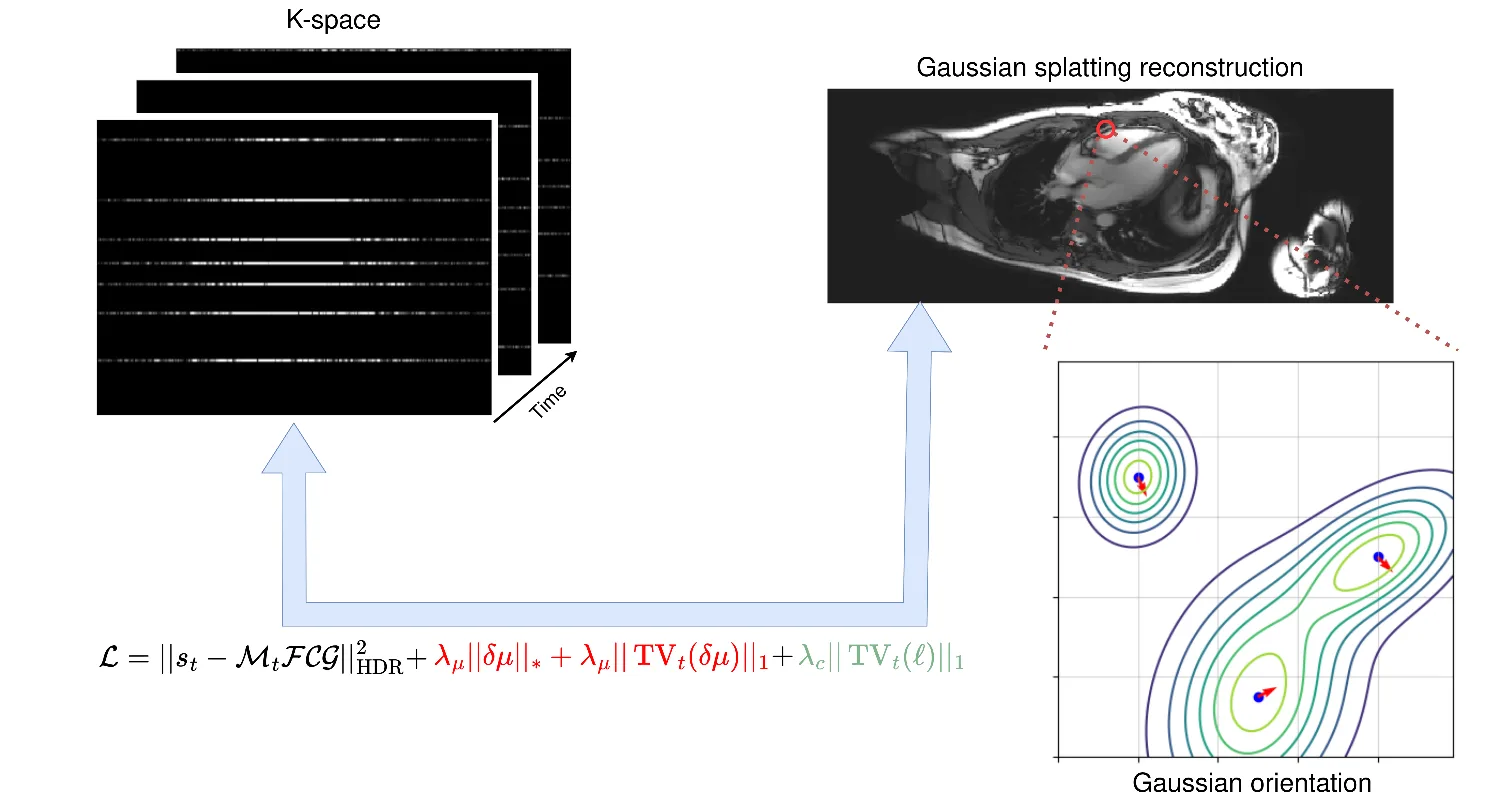
The new method tackles this problem in an unusual way. Instead of building the image from individual pixels, the authors propose to think of the heart as a mosaic of many blurred blobs — Gaussian splats. Each blob is a tiny piece of tissue that can change its brightness, size, and position. As the heart contracts, the blobs move with it, like puzzle pieces forming a living picture.
Thanks to this, MRI can be done 16 times faster than usual. The patient no longer needs to hold their breath or lie still for minutes, just a few seconds. The doctor gets a clear video of the beating heart, showing how the walls contract and the valves move. Moreover, the parameters of the Gaussian blobs directly reflect physiology: the size of a blob relates to muscle thickness, and its motion to contraction. This means the model doesn't just draw a pretty picture: it "understands" how the heart works.
The method has been tested on real data from cardiac patients. The results show that even with strong acceleration, image quality remains high. In the future, this approach could be applied not only to the heart but also to other moving organs — lungs, joints, a fetus in the womb. MRI will become faster, more comfortable, and more accessible.
Original abstract
as written by the authors arXiv:2603.21980
Motivation: Quickly obtaining high-quality MRI from accelerated acquisitions is important to mitigate motion artifacts, maintain patient comfort, and improve clinical efficiency. Goals: To obtain high-quality dynamic MRI using efficient, personalized models. Approach: We propose a novel explicit representation learning approach using Gaussian splatting. Multiple Gaussian primitives are trained to represent the underlying tissue. We extend the Gaussian splatting framework to model anatomical motion, enabling learning an efficient, explicit representation of dynamic MRI. Results: Gaussian splats can be trained in 60s with 0.5ms/dynamic inference time. High-quality cardiac MRI is obtained at R=16. We show that the properties of the Gaussians directly encode physiological properties.
Gaussian blobs are named after the mathematician Carl Friedrich Gauss, who described the bell shape — the very normal distribution curve we see in statistics of human heights or measurement errors.