Dust in the Spiral Galaxy M33: Ultraviolet Surprises express
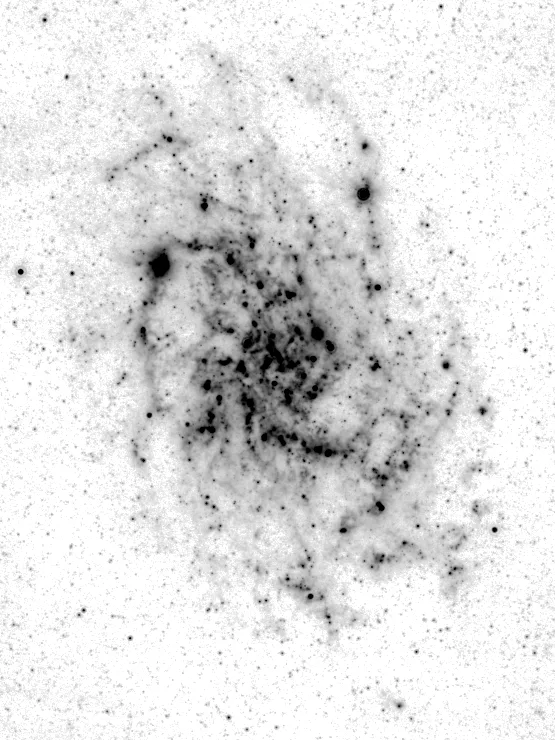
Light from distant stars, as it travels through cosmic dust, loses some of its energy. Dust grains absorb and scatter light, and the way they do so at different wavelengths reveals their composition and size. Astronomers call this the dust extinction curve. For the galaxy M33, such curves in the ultraviolet have been obtained for the first time — previously they had only been measured in four other Local Group galaxies.
New data from the Hubble Space Telescope show that dust in M33 behaves differently than in the Milky Way. Along the four studied lines of sight, the extinction curves differ greatly in shape, and the famous ultraviolet bump at 2175 angstroms is sometimes prominent and sometimes nearly absent. On average, dust in M33 absorbs ultraviolet light more weakly than in other Local Group galaxies, and its behavior does not fit the familiar dependence on the parameter R(V), which describes the overall reddening of light.
Interestingly, the variations in the extinction curves in M33 correlate better with the gas-to-dust ratio than with the galaxy's overall metallicity. This reinforces the idea that dust properties are more strongly influenced by local conditions (radiation density, shock waves from supernova explosions) rather than by global galaxy characteristics like heavy-element abundance. Dust turns out to be a sensitive indicator of local cosmic weather.
Such a spread in extinction curves reminds us that cosmic dust is not uniform: its composition and grain sizes depend on where it formed and what has happened to it since. By studying dust in different galaxies, astronomers are learning to read the history of star formation and chemical evolution across the universe.
Original abstract
as written by the authors arXiv:2603.23662
Dust extinction curves provide one of the main avenues to understanding the detailed nature of dust grains and accounting for the effects of dust on observations of many astrophysical objects. For the first time, spectroscopic ultraviolet (UV) extinction curves are measured in M33 expanding the sample of Local Group galaxies with such measurements to five. These curves are based on Hubble Space Telescope/Space Telescope Imaging Spectrograph spectra and literature photometry from the UV to the near-infrared. The four measured curves show large variations in their UV shapes including their 2175 A bump and UV slope strengths. The average extinction of these four sightlines is lower than the averages for other Local Group Galaxies and does not follow the Milky Way R(V) dependent relationship. The variations between UV extinction shape parameters and gas-to-dust ratios for the M33 sightlines fall within the variations seen in the combined sample of UV extinction curves in the Milky Way, Large and Small Magellanic Clouds, and M31. The correlation with gas-to-dust ratio is much stronger than the correlation with global metallicity. This strengthens the picture that local conditions like radiation field density and shocks dominate over global galaxy properties like metallicity in determining the wavelength dependence of dust extinction.
The famous absorption bump at 2175 angstroms was first discovered in the 1960s, but its exact nature is still debated. Some think it is produced by graphite grains, others by complex organic molecules similar to components of terrestrial soot.