Extinction is the permanent end of a species or other taxonomic group, meaning no individuals of that group remain alive anywhere on Earth. It is a natural part of evolution, but the fossil record shows that extinction rates have not been constant. There have been at least five major mass extinction events, where a large fraction of all species disappeared in a relatively short geological time, often linked to catastrophic events like asteroid impacts, massive volcanic eruptions, or rapid climate change.
History
The concept of extinction was first scientifically established by Georges Cuvier in the late 18th century, who showed that fossils of mammoths and other animals had no living counterparts. The idea of mass extinctions was popularized later, especially with the discovery of the Cretaceous-Paleogene (K-Pg) extinction event and the impacthypothesis by Luis and Walter Alvarez in 1980.
How it works
Extinction occurs when a species' environment changes faster than the species can adapt, or when it faces a direct catastrophic threat. This can be due to habitat loss, introduction of predators or competitors, changes in climate, or a sudden event like an impact. When the death rate exceeds the birth rate for a sustained period, the population declines to zero. In mass extinctions, the cause is usually a global stressor that disrupts ecosystems worldwide, such as a bolide impact causing a 'nuclear winter' or massive volcanic outgassing altering the atmosphere.
In practice
Understanding extinction is vital for conservation biology, helping to assess the current biodiversity crisis and predict which species are at risk, as well as for geology and paleontology to interpret Earth's history.
Fun fact
The current rate of species extinction is estimated to be 100 to 1,000 times higher than the natural background rate, leading many scientists to argue we are in the sixth mass extinction, caused primarily by human activity.
Every one of us has wondered at least once how many years we'll live. In 1996, nearly two and a half thousand Japanese people over sixty answered that question in a national survey. Their answers became a kind of mirror reflecting hopes, fears, and habits of thought. Twenty-eight years later, researchers compared those forecasts with actual dates of death and found that the mirror was warped, but not useless.
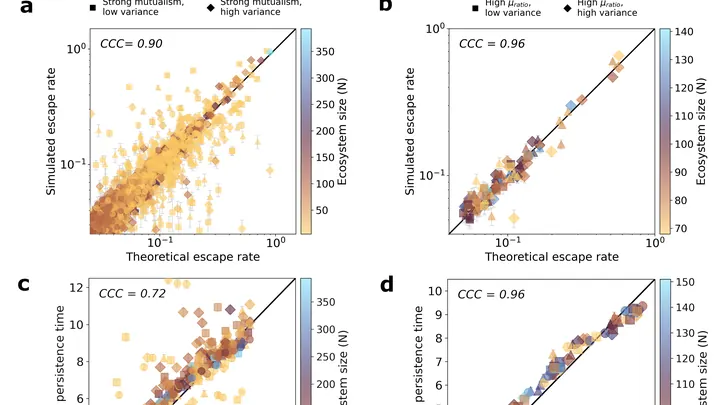
Rare species in a large community are like thin branches on a tree: a random gust can easily snap them. Even if conditions are stable, a small population simply lacks enough individuals to survive a bad season. In a new study, scientists added this factor to an ecosystem model and watched the community clean itself out.
In the web of life, predators and prey exchange carbon and water, and each act of eating slightly increases the universe's disorder. But the intrusion of disease turns this system into a giant seesaw. When a mid-level predator gets sick, its hunting abilities decline, and it becomes easy prey.
A runner loses on both a smooth track and sticky sand. Seems hopeless. But if the surface underfoot starts changing every few seconds (track, then sand) the runner suddenly stops falling behind. He doesn't get faster; the environment just doesn't get a chance to 'crush' his weakness.
That's exactly what the authors found when studying a simple predator–prey model.
In 5 billion years, the Sun, having exhausted its fuel, will start to swell, turning into a red giant. Like a balloon losing air, the star will weaken its gravitational grip, and Earth — a grain of sand on an invisible thread — will drift to a more distant orbit.
On the periphery of the Solar System lurk thousands of objects comparable in size to an exoplanet — a body of planetary mass not bound to our star. Their orbits are chaotic, and from time to time the trajectory of such a wanderer crosses Earth's path.
Our Solar System isn't an island in the void: it's a sensitive web stretched in a dark cosmic corner. Planets circle their orbits like dewdrops on threads, and we are the spider sensing the faintest tremor. That tremor betrays the approach of the catastrophe astronomers call the Big Rip.
Drylands are like skin cracking from dehydration. When rainfall decreases, plants don't vanish overnight: they rearrange, leaving bare patches of soil between them. These patterns are visible even from space.
Scientists compared satellite images of eight arid regions, from the Sahel in Africa to Australian deserts.
A landscape cut by roads or rivers into isolated patches resembles a shared apartment after partitions are installed: residents no longer bump into each other in the common hallway. Species that once competed for the same food or space now live apart. Competition weakens, and those that would have lost to pushier neighbors in a continuous landscape now survive.
When two heavy bodies collide, they don't always stay put. Merging black holes get a powerful kick, like the recoil of a gun, but instead of gunpowder, it's the curvature of spacetime doing the work. This kick can send the new hole flying out of a galaxy's center or even beyond its outskirts.
A rock knocked off one planet by an asteroid impact hurtles through space and lands on another. If microbial spores are hiding inside, they might survive the cold, the radiation, and the rough landing. That's panspermia — the idea that life travels between worlds. But imagining such a journey is one thing; calculating every step is quite another.
Light from distant stars, as it travels through cosmic dust, loses some of its energy. Dust grains absorb and scatter light, and the way they do so at different wavelengths reveals their composition and size. Astronomers call this the dust extinction curve.
When a massive star explodes, its remnants fly apart like fragments of fireworks. But how do we know how far away such an explosion occurred? Astronomers have found a way: they look at the gas clouds that these remnants collide with.
The idea is simple. Supernova remnants are often surrounded by clouds of cold molecular gas.
Quantum entanglement works like a leash: it ties particles together, but the length of this tether is strictly limited. In a chain of particles, heat plays the role of an impatient dog tugging at the leash — the hotter it gets, the shorter the distance over which the connection holds.
An ecosystem is like a swing that someone is subtly pushing. Previously, it was thought that the main concern was that the swing wouldn't swing too wildly. But the authors of this work showed that the greater danger is when the equilibrium point itself slides toward a place where the swing can no longer return.