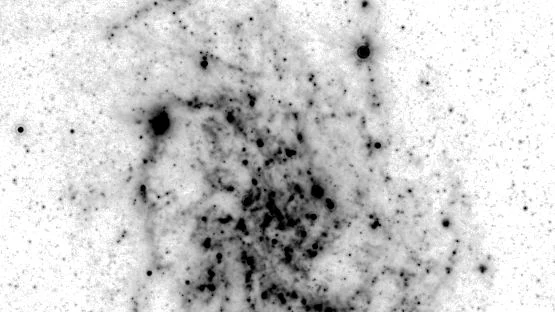
Dust extinction is the process by which interstellar dust absorbs and scatters light from distant objects, making them appear dimmer and redder than they truly are. This effect is a major challenge in astronomy because it distorts our measurements of brightness, color, and distance. Dust grains, composed of silicates, carbon, and other materials, are concentrated in the disks of galaxies and along the line of sight to many celestial sources.
History
The existence of interstellar dust was inferred in the early 20th century from the reddening of starlight, with Robert Trumpler providing strong evidence in 1930 by showing that distant star clusters appear dimmer and redder than expected. The detailed study of extinction curves became a cornerstone of interstellar medium research.
How it works
When light passes through a cloud of dust, photons are either absorbed by the grains or scattered out of the line of sight. The amount of extinction depends on the wavelength: shorter wavelengths (blue light) are scattered and absorbed more strongly than longer wavelengths (red light). This wavelength dependence causes the light from a distant source to appear redder, a phenomenon known as reddening. By measuring the extinction curve — the amount of dimming as a function of wavelength — astronomers can correct their observations and infer the intrinsic properties of the source.
In practice
Correcting for dust extinction is essential for measuring accurate distances to supernovae, studying star formation in dusty galaxies, and interpreting observations of the early universe, where dust can hide the true nature of distant objects.
Fun fact
Dust extinction is so strong in some directions that it can hide entire galaxies in visible light, making them visible only in infrared or radio wavelengths.
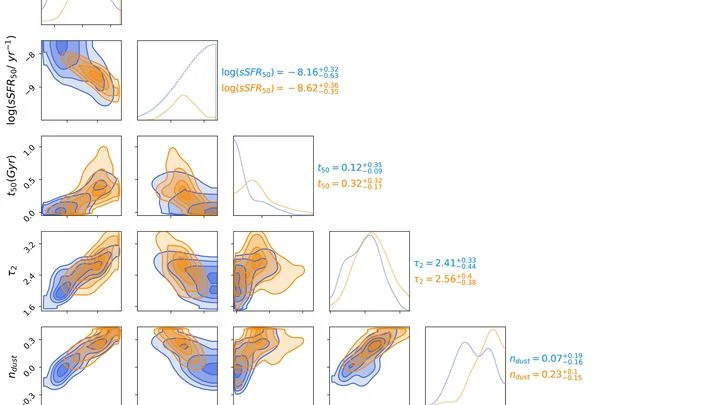
Light from a distant galaxy reaches us through its own dust. This dust is not a smooth haze but ragged clouds, like wisps of cotton. Old models treated it as a uniform mist, and then the galaxy didn't add up energetically: too much light disappeared in the ultraviolet and too little came back in the infrared.
Astronomers did what a cook does when they dice a potato instead of tossing it in whole.
Every morning, a janitor sweeps leaves into a pile. The Sun, as it travels through the galaxy, does something similar: its gravity gathers diffuse interstellar gas into an invisible cone — a giant funnel.
When stars are born in a galaxy, they make hydrogen glow, like a neon sign, but on a cosmic scale. This light could tell us a lot about how many stars are forming, but on its way to us, it passes through cosmic dust. Dust is like a fogged-up window: it dims the glow and alters its color.
In the galaxy NGC 1052 DF2, stars move at only 8 kilometers per second, as if there were no invisible mass around. For comparison: in our Milky Way, outlying stars accelerate to 200 kilometers per second, held by a massive dark matter halo.
Two cities endure a series of fires. In one, the wind carries ash far beyond the outskirts, leaving the sky clear. In the other, ash settles as a dense veil, painting sunsets crimson. Roughly the same thing, just on a galactic scale, happens with supernova explosions, the final flares of massive stars.
Ten billion years ago, the universe was speckled with strange crimson sparks. The JWST spotted them in images at distant redshifts — compact sources blazing like entire galaxies yet no larger than a tiny central region. Astronomers nicknamed them “little red dots.” Their nature long defied explanation.
Massive gas outflows from active galactic nuclei are a key regulator of galactic evolution. They sweep out the interstellar medium, quench star formation, and dictate the growth of supermassive black holes.
The universe is like a vast warehouse where a strict inventory was taken long ago. The cosmic microwave background is an ancient record of everything in stock 380,000 years after the big bang. According to it, the fraction of matter in the cosmic 'budget' (the parameter Omega_m) is known with high precision.
At the center of the Milky Way, like a matryoshka doll within a matryoshka doll, lies a supermassive black hole, surrounded by a swarm of stars and an invisible shell of dark matter. This shell, or "spike," is expected to be extremely dense right at the horizon.
Civilizations in the Universe are separated not just by distance, but by the vast gulf of time. Hunting for their traces is like archaeology: instead of palace ruins, we find clouds of cosmic dust.
Type Ia supernovae are the final, blinding chords in the symphony of stellar evolution: when a white dwarf crosses the limit predicted by Chandrasekhar, it explodes so brightly that for a moment it outshines an entire galaxy.
Using the James Webb telescope, astronomers peered into an ancient quasar — the dazzling heart of a galaxy where a giant black hole sucks in matter. It turns out it doesn't just destroy, but also creates: its powerful outflows and shock waves act like a true cosmic mill.
The first two billion years after the Big Bang were an era when the universe resembled a boiling construction pit. Dark matter clumped the gas together, igniting the first stars. It seemed there simply wasn't enough time to assemble massive elliptical galaxies—'dormant' stellar metropolises — from this raw material.
Images from the James Webb Space Telescope have revealed unexpectedly intense light from the first galaxies — colossal star systems that formed shortly after the Big Bang. Imagine a toaster browning a slice of bread in a minute, while an oven takes an hour to bake a loaf — the result is essentially the same.
A distant galaxy always looks redder than it really is. That's the work of cosmic dust — tiny solid particles that scatter blue light more than red, like haze at sunset. Astronomers measured this effect for tens of thousands of galaxies using two powerful instruments.
Edwin Hubble and Georges Lemaître discovered the expansion of the Universe nearly a century ago. One way to test it is the surface brightness test: in an expanding cosmos, the light of a distant galaxy should fade like a pattern on a stretching film.
A neutron star is the dead core of a massive star, crushed to the size of a city. A teaspoon of its material weighs as much as a mountain. Dark matter particles fly through such a dense medium almost unimpeded, but occasionally they do hit neutrons and get stuck, like bullets bogging down in deep sand.
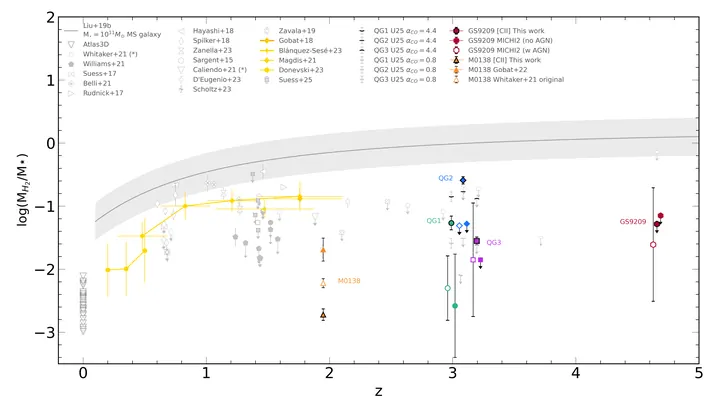
Five galaxies that long ago stopped igniting new stars look like houses with darkened windows. But the ALMA radio telescope and the James Webb Space Telescope peered inside and saw that in these 'sleeping' houses, a fire still smolders.
Dark matter is an invisible substance that keeps galaxies from flying apart. If its particles occasionally decay near the Sun, they shoot out streams of fast particles, like invisible hammers striking light. Each impact turns a particle of sunlight into a gamma ray — a super-powerful flash that telescopes can spot.
Light from distant stars, as it travels through cosmic dust, loses some of its energy. Dust grains absorb and scatter light, and the way they do so at different wavelengths reveals their composition and size. Astronomers call this the dust extinction curve.
When a massive star explodes, its remnants fly apart like fragments of fireworks. But how do we know how far away such an explosion occurred? Astronomers have found a way: they look at the gas clouds that these remnants collide with.
The idea is simple. Supernova remnants are often surrounded by clouds of cold molecular gas.
A galaxy is like a house with drawn curtains: bright ultraviolet light is born inside, but from outside you only see what manages to sneak through dust and gas. Astronomers need to know how much of this light escapes into intergalactic space, because it ionizes hydrogen in the early Universe and makes it transparent.
Around the star Epsilon Indi, visible to the naked eye from the Southern Hemisphere, orbits a planet the size of Jupiter. The temperature there is like a good freezer: minus 200 degrees Celsius. The James Webb Space Telescope has for the first time directly imaged it and measured the light the planet emits in the thermal range.
In the mid-20th century, astronomer Vera Rubin discovered that stars on the outskirts of galaxies were moving too fast — held by an invisible mass. Thus the mystery of dark matter was born. It doesn’t emit light but reveals itself through gravity. The big question: why is there exactly as much as we see?
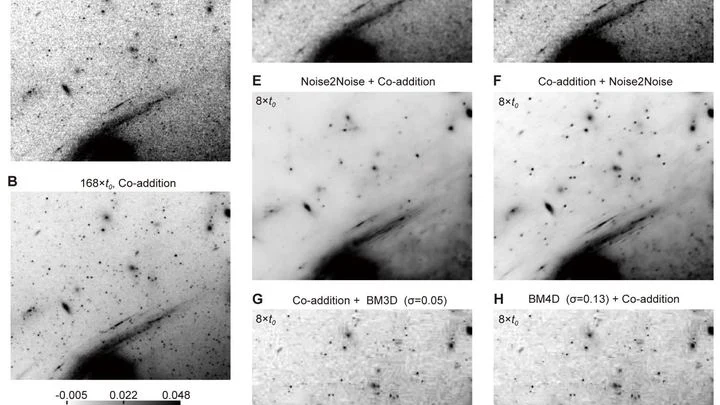
The night sky in a telescope image looks like a photo taken through a fogged-up window: bright stars are visible, but everything faint drowns in a murky haze. That haze is noise — random interference from electronics, heat, and the atmosphere itself.
A distant red object usually means one thing: we're seeing a dust veil over a scorching disk falling into a black hole. But when the James Webb split its light into shades, a shadow appeared inside — just like steam from boiling water intercepts rays.
The James Webb telescope peered into the early universe and saw a multitude of mysterious red dots. Their glow didn't resemble familiar galaxies or stars. The answer was unexpected: these are growing black holes, born without a stellar stage.
Astronomers pointed the James Webb at three galaxies whose light traveled 12 billion years. Early data pointed to incredibly fast growth — like an infant reaching adult height in just a year, clashing with the expansion of the Universe.
Light from distant galaxies carries a hidden recipe — a color barcode revealing the elements inside. For decades, astronomers used familiar tricks to decode it, but the James Webb Space Telescope shows these tricks fail for the earliest galaxies.
Some stars fizzle out like a dud firework: instead of a bright blast, just a cloud of smoke. Usually, a massive star ends with a supernova explosion, leaving a black hole. But sometimes there's no bang: the star collapses straight into a black hole, almost unnoticed.
At the center of the supernova remnant SN 1987A, 168,000 light-years from Earth, hides an object that astronomers have been seeking for 37 years. This is the closest supernova to have exploded in front of modern telescopes, and the only one where the compact remnant has yet to be seen directly.