A variable star is any star whose brightness changes over time, as seen from Earth. This variability can be caused by intrinsic processes, such as pulsations or eruptions, or by extrinsic factors, like a companion star eclipsing it or dust clouds passing in front. Variable stars are natural laboratories for studying stellar structure, evolution, and the dynamics of binary systems.
History
The first recognized variable star was Mira (Omicron Ceti), identified as changing in brightness by David Fabricius in 1596. The systematic study of variable stars began in earnest in the 19th century with the work of astronomers like John Goodricke, who correctly explained the variability of Algol as an eclipse.
How it works
Intrinsic variables, like Cepheids, physically expand and contract, changing their surface area and temperature, which alters their luminosity. Extrinsic variables, like eclipsing binaries, change brightness simply because a companion star periodically blocks their light. The period and amplitude of the brightness variation reveal physical properties such as the star's mass, radius, and internal structure.
In practice
Cepheid variable stars are standard candles: their pulsation period is directly related to their intrinsic luminosity, allowing astronomers to measure distances to galaxies and map the expansion of the universe.
Fun fact
The Sun is a variable star, but its brightness changes by only about 0.1% over its 11-year sunspot cycle, making it a very quiet variable.
In a binary star system, one star pulls matter from its companion. Over centuries, this material settles onto the surface of a neutron star — the ultra-dense remnant of a dead star. This process, called accretion, usually proceeds smoothly. Gravity behaves as general relativity predicts, without surprises.
A planet in the habitable zone is no guarantee of life. Like a conductor leading an orchestra, a star dictates the tempo and character of planetary atmosphere evolution over billions of years.
Five thousand robotic fingers of the DESI spectroscopy reach toward the telescope's focus. In a single night, they record one hundred thousand light signatures. Hidden among these records are binary star systems with white dwarfs — cataclysmic variables.
A candle flame in a draft dances: now it flares up, now it almost goes out. Quasars behave much the same way — supermassive black holes in the centers of distant galaxies, surrounded by a scorching disk of infalling matter. Only they flicker not over seconds, but over months and years.
A pendulum swings with such precision that, had it been counting seconds since the Big Bang, it would have drifted by only half a second by today. That is the stability of the new portable ultraviolet laser — the heart of aluminum atomic clocks.
A glowing cloud in a telescope looks like a wisp of fog about to dissipate. Planetary nebulae are gas shells cast off by dying stars. Young nebulae are bright and compact, but as they age, they expand, cool, and become increasingly transparent until they vanish into the interstellar medium.
A lighthouse blinks every few seconds, but then begins to slowly brighten and dim over the course of a year. That is exactly what about a third of red giants do — huge stars in the late stages of life. Their normal pulsations take days or weeks, but on top of that, long secondary periods are visible: months and years.
The Sun is not a perfectly steady lightbulb. Its brightness quivers slightly: it dims a bit, then brightens. For Earth's climate, even slow variations stretched over thousands and millions of years matter. They could have left their mark in the geological record of the last 540 million years.
Astronomer [scientist:A. M.
Light from distant stars, as it travels through cosmic dust, loses some of its energy. Dust grains absorb and scatter light, and the way they do so at different wavelengths reveals their composition and size. Astronomers call this the dust extinction curve.
Double stars lose speed like a figure skater who slows their spin by extending their arms. In a close pair, one star transfers mass onto a white dwarf. The magnetic field of the donor star, consisting mostly of hydrogen, entangles the outflowing gas and flings it away, as if the skater's arms were pulling the spin outward.
Around certain close binary stars, where a white dwarf siphons matter from its companion, astronomers have seen a glowing arc. They took it for a shock wave — the place where a fast stellar wind slams into interstellar gas. But new observations show: there's more than one arc.
Eclipses in binary stars are like clockwork: a white dwarf (the dense remnant of a star) regularly passes in front of its companion, and the light briefly dims. But for most such pairs, the clock runs fast or slow by seconds over years. Astronomers measured these glitches in 43 systems and found a pattern.
The solar wind and ultraviolet constantly peel a thin layer of gases off Earth, like wind carrying away steam over a hot pot. This process is slow, taking billions of years. But for planets near red dwarfs, it's harsher: they bask right next to the star, and X-ray fluxes sandblast their atmospheres like an abrasive blaster.
A young star is surrounded by a flat, rotating disk of gas and dust — the construction site for future planets. The disk lives its own life: gas flows toward the star, dust clumps together, and from outside, harsh ultraviolet light from neighboring hot stars presses down on it all, like wind blowing leaves off a path.
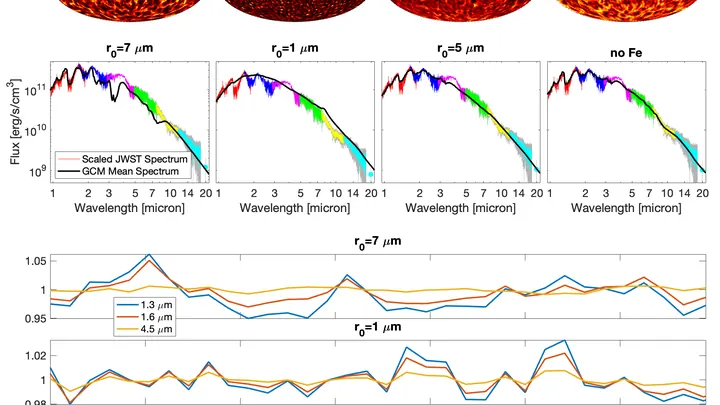
Far beyond the Solar System, a world called VHS 1256B wanders — a giant planet without a star. For a long time, astronomers couldn’t figure out why its brightness jumped by nearly 40% in just a few days. The answer came with the James Webb telescope: it turns out, colossal storms of silicate dust engulf the entire planet.
The Solar System takes 210 million years to complete one orbit around the center of the Milky Way. The last time we were on this same side of the Galaxy, early dinosaurs were roaming the Earth. That number, 243.72 km/s, has now been refined thanks to rare stars that streak through the Galaxy like cannonballs.