The Galaxy's Halo: How to Weigh the Invisible express
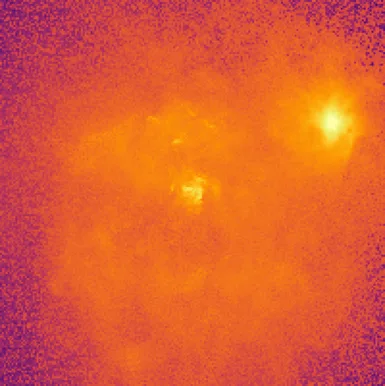
Every galaxy is wrapped in an invisible shell of hot gas, like steam rising from a pot of boiling water. This gas barely glows in X-rays, making it notoriously difficult to measure. Yet it holds the memory of stellar explosions and the galaxy's growth.
The new method uses light from a galaxy's bright center. As X-rays pass through the outer layers of gas, some scatter off oxygen atoms, like a flashlight beam in fog. By comparing the brightness of the center and the light scattered by the fog, you can count how much oxygen is in the halo, and from that, the total gas mass.
The method was tested on the TNG50 galaxy simulation. It turns out that for most galaxies, it yields an error of just 10%—as if you weighed a sack of potatoes and were off by only one spud. Even when galaxies are lopsided or their gas is in motion, the method holds up, except for the most unusual cases.
Thus the invisible becomes measurable: light reflected from gas tells the story of what lies hidden from view.
Original abstract
as written by the authors arXiv:2603.25600
The circumgalactic medium (CGM) regulates galaxy growth and retains the imprint of feedback from supernovae and supermassive black holes. However, the bulk of the hot CGM produces little X-ray emission and is challenging to study with X-ray telescopes. We propose a novel method for evaluating the CGM mass using resonant scattering of the helium-like oxygen (\ovii) resonant line at $$E=574$$ eV. In a spherically symmetric and static CGM halo with a sharp central X-ray peak, the number of \ovii\ ions within an outer radial shell can be calculated from the ratio of the two directly observable quantities: the \ovii\ flux from the bright inner region and the scattered \ovii\ flux from the shell (where the scattered flux can be much higher than the intrinsic emission). To evaluate the accuracy of this geometric estimate for realistic galaxies -- with satellites, asymmetries, and gas velocities -- we use a sample of galaxies from the TNG50 cosmological simulation. We find that, when the most irregular systems are excluded based on their X-ray observables, we accurately predict the \ovii\ mass in the outer halo (e.g., in an $$r=R_{\rm 500c}-R_{\rm 200c}$$ shell) from the ratio of the fluxes in the corresponding annulus and the central peak region ($$r<0.2R_{\rm 500c}$$), with only a 10\% bias and an rms scatter of $$\sim 0.2$$ dex. As \ovii\ mass strongly correlates with the total oxygen and gas mass, this direct \ovii-counting method enables indirect estimates of those quantities by future X-ray microcalorimeter missions, such as {\em NewAthena}\/ and {\em HUBS}.
A galaxy's outer halo can contain more ordinary matter than the galaxy itself, like an invisible pantry we only discover by the light it reflects.