A Snow Avalanche Under the Microscope express
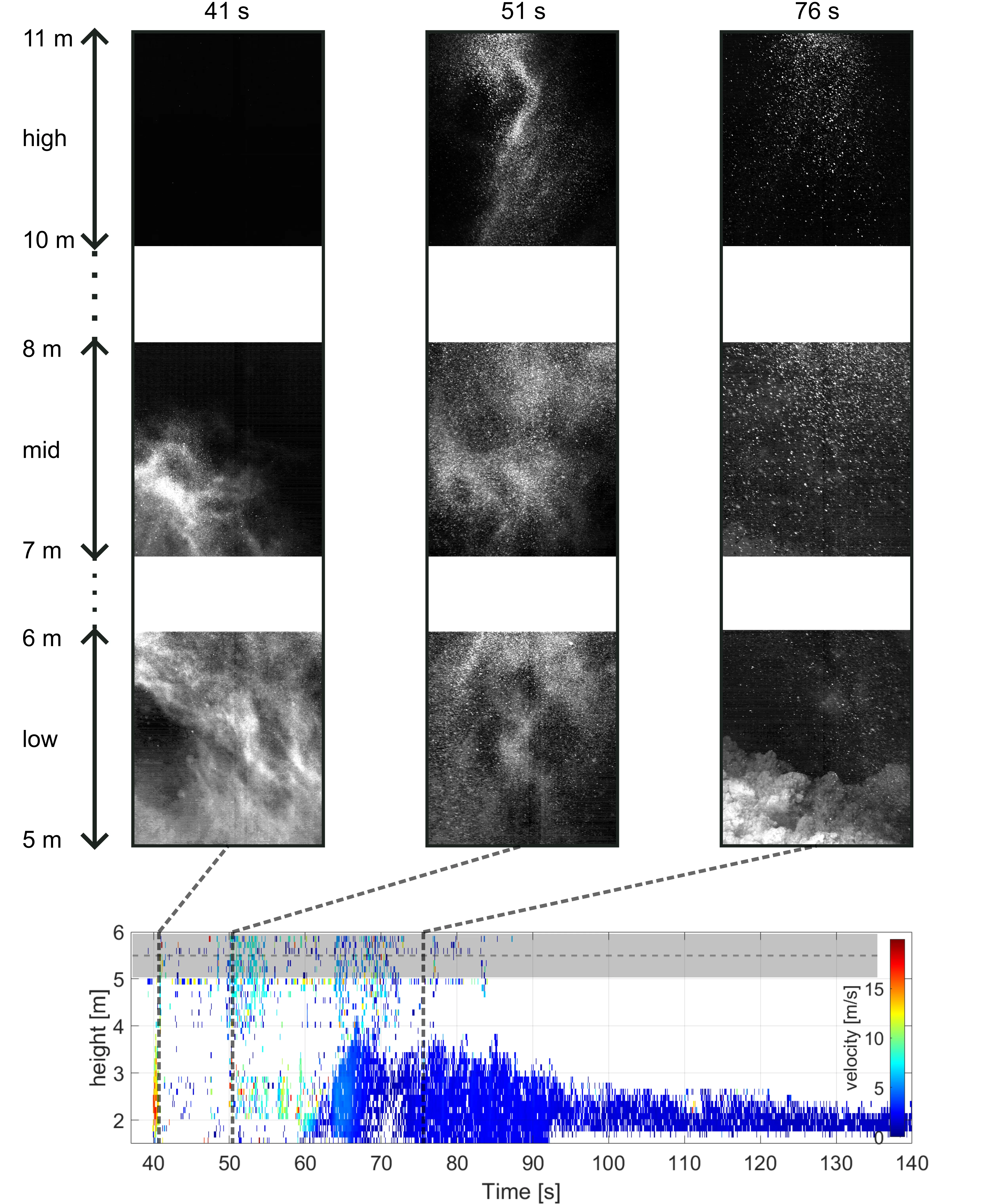
A powder avalanche isn't just a pile of snow sliding down a mountain. It's a cloud racing downhill at car speed. Inside, snow doesn't lie still: it flies: thousands of tiny particles are caught up in air vortices. Until now, no one had seen what actually happens to each snowflake in this chaos. Now scientists have the first footage.
The researchers set up a high-speed camera in the path of a real avalanche in the Alps. It recorded at 1000 frames per second — faster than the blink of an eye. The footage shows the flow splitting into three parts. First, a short burst, like a first exhale. Then a long phase where snow and air are mixed into a churning suspension. Finally, a tail where particles simply settle, like dust in a room after a draft.
The key discovery is how turbulence is born. At the boundary between fast air and slow snow, waves arise similar to those that wind creates on water. These waves grow and overturn, mixing the layers. For the first time, scientists have measured their size and speed in a real avalanche. Previously, such data could only be obtained in the lab with an artificial flow.
These measurements aren't just curiosity. They're needed for computer models that predict where an avalanche will strike and with what force. Current models rely on guesses rather than direct observations. Now they have a foundation of real data. The next avalanche might be predicted more accurately, and that could save homes or lives.
A powder avalanche can outrun the skier who triggered it: the air cloud can reach speeds of 100 km/h.