Intermittency refers to the irregular, sporadic occurrence of events or properties in a system, often characterized by sudden, unpredictable jumps. In the context of matter density, it describes how turbulentflows exhibit patches of extreme density fluctuations amidst a more quiescent background. This phenomenon is observed in interstellar gas clouds, where density variations influence star formation, and in laboratory plasmas, where it affects confinement.
History
The concept was introduced in the context of turbulence by Andrey Kolmogorov in the 1960s, who proposed a refined similarity hypothesis to account for the observed intermittency in velocityfluctuations. Later work extended these ideas to density and other scalar fields.
How it works
Intermittency arises from the nonlinear nature of turbulence, where energy cascades from large to small scales in a highly non-uniform manner. Instead of a smooth distribution, the energy dissipation and density fluctuations become concentrated in small, intense regions. This leads to probability distributions with heavy tails, meaning extreme events are more likely than a Gaussian distribution would predict.
In practice
Intermittency is important in modeling turbulent combustion, predicting extreme weather events, and understanding star formation in molecular clouds. It also affects the design of fusion reactors, where intermittent plasma bursts can damage reactor walls.
Fun fact
Intermittency in solar windturbulence is so pronounced that the magnetic field fluctuations follow a multifractal distribution, meaning the statistical properties change with scale in a complex, self-similar way.
In the intricate dance of active turbulence, where invisible engines spawn chaos, a soft droplet takes on the role of a detective. Its shape is not merely an outline but a sensitive cipher: it reads the hidden signals of its environment.
A string sounds perfectly pure until a draft touches it. That's roughly how a superradiant laser works: a beam of atoms, pre-charged with energy, flies through a room made of two mirrors — an optical resonator (a trap where light bounces back and forth).
A swarm of fireflies rarely collides, yet they synchronously change color by exchanging signals. This is how neutrinos behave in dense streams from collapsing stars: they collectively transform from one type to another, even though individually they interact extremely weakly.
Mountain river water doesn't flow smoothly: it churns, swirls into eddies, and suddenly accelerates. This chaotic motion is called turbulence. But even within it, there are hidden rhythms — rare and intense bursts that briefly alter the entire flow pattern.
A distant lighthouse flashes for an instant brighter than an entire galaxy. This is a fast radio burst — a mysterious signal from deep space. Some repeat, and astronomers have noticed a peculiarity: these bursts show rapid changes in polarization — a property indicating how the radio wave is twisted in space.
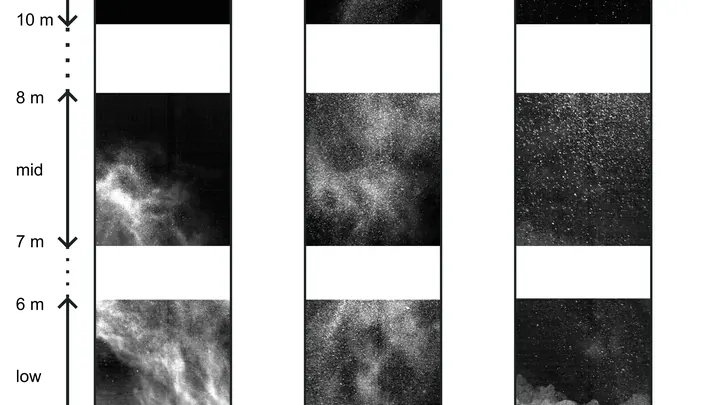
A powder avalanche isn't just a pile of snow sliding down a mountain. It's a cloud racing downhill at car speed. Inside, snow doesn't lie still: it flies: thousands of tiny particles are caught up in air vortices. Until now, no one had seen what actually happens to each snowflake in this chaos. Now scientists have the first footage.
A black hole can torment a star for years, rather than rip it apart immediately. Tidal forces are when the hole's gravity stretches the star: the near side is pulled harder than the far side. Usually, getting too close rips the star apart instantly — that's a tidal disruption event.
In turbulent air, droplets don't fly in straight lines: they get tossed around like dust motes in a beam of light. Physicists have built a setup that tracks each droplet, which is about a tenth of the thickness of a human hair. A camera captures their motion, and a computer reconstructs their trajectories.
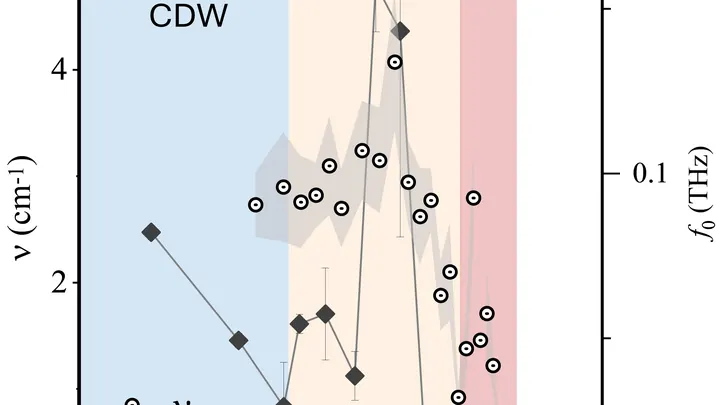
A cooled layered crystal resembles a stack of thin sheets, with electrons wandering between them. At around 17 K, tiny regions appear where electrons line up into a wave, like ripples on water frozen in place. These regions are called charge puddles, and they were previously thought to be static.
Ahead of the bow shock that Earth creates in the solar wind, giant bubbles of rarefied gas sometimes appear. Inside them, particle density drops by factors, and electric fields start to tremble like a plucked string.
Toss a handful of peas into a pot of semolina porridge — the peas quickly sink, pushing the grains aside. But if you make the porridge very thick and sticky, the peas get stuck. That's roughly how light lithium atoms behaved in a cloud of heavy potassium atoms at temperatures just a few millionths of a degree above absolute zero.
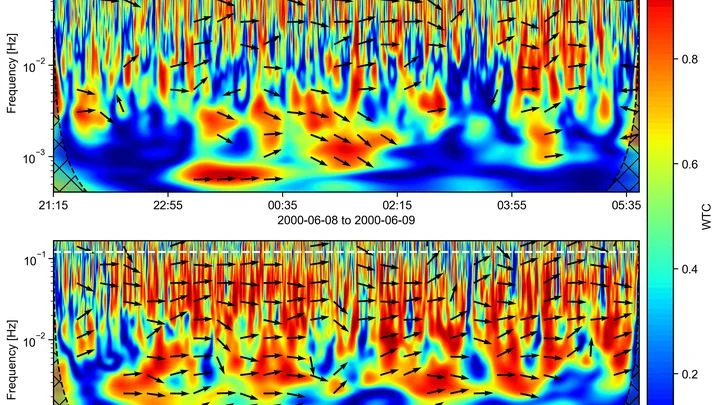
The Sun constantly emits a stream of charged particles, mostly hydrogen — the solar wind. Sometimes the Sun ejects dense blobs of magnetized gas, inside which calm usually reigns. But in 2000, scientists noticed two regions inside one such cloud where the gas was churning.
The wind blows steadily, but suddenly a gust hits, and leaves swirl up in a vortex. Inside such a gust, the air speed changes not smoothly but in jumps — sometimes sharply forward, sometimes sideways. These rare and strong bursts are called intermittency, and they are the main mystery of turbulence.
Quantum particles in a strongly disordered environment behave like dancers executing steps in sync: each knows its own move and never collides with others. This kind of coordinated, frictionless flow, superfluidity, unexpectedly emerged in an experiment on a superconducting quantum chip.
Every few years, the Pacific Ocean off the coast of Peru warms up, and then fields dry out in Australia while deserts in Chile get drenched. This phenomenon is called El Niño.