Water's phase behavior is famously anomalous: unlike most substances, its solid form (ice) is less dense than its liquid form, and its density peaks at 4°C rather than at the freezing point. These anomalies arise from the unique hydrogen-bonding network that water molecules form, which can arrange into open, crystalline structures when freezing. Under different pressures and temperatures, water exhibits at least 18 known crystalline phases and several amorphous forms, each with distinct properties.
History
The anomalous expansion of water was first documented by the French physicist Jacques Alexandre César Charles in 1787, and the phase diagram of ice has been studied extensively since the early 20th century, with new phases still being discovered.
How it works
Water molecules are polar, with a partial positive charge on hydrogen atoms and a partial negative charge on oxygen. This allows each molecule to form up to four hydrogen bonds with neighbors, creating a dynamic, tetrahedral network. When cooled, the molecules arrange into a more open hexagonal lattice (ice Ih), which takes up more volume than the liquid. Pressure can force water into denser ice phases, while extreme cold can create amorphous glasses with no long-range order.
In practice
Understanding water's phase behavior is critical for climate modeling, cryopreservation of biological tissues, and designing materials that resist ice formation, such as aircraft de-icing systems.
Fun fact
Water can remain liquid down to -48°C if cooled carefully without impurities, a phenomenon called supercooling, and it can even form a glassy state at very low temperatures without crystallizing.
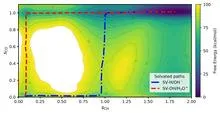
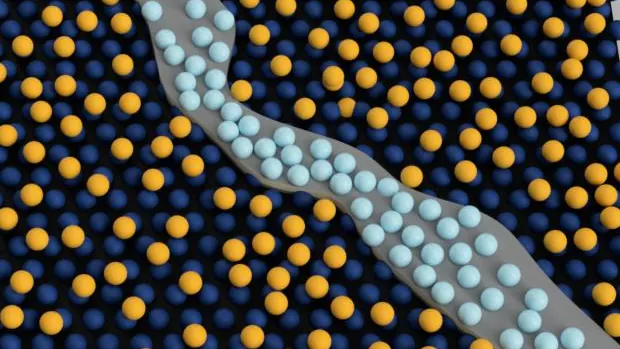
Picture a tiny hole in a sheet of graphene: a single missing carbon atom. It used to be thought that a water molecule splits apart at this defect only on its own, in dry gas. But if liquid water is sloshing all around, everything changes.
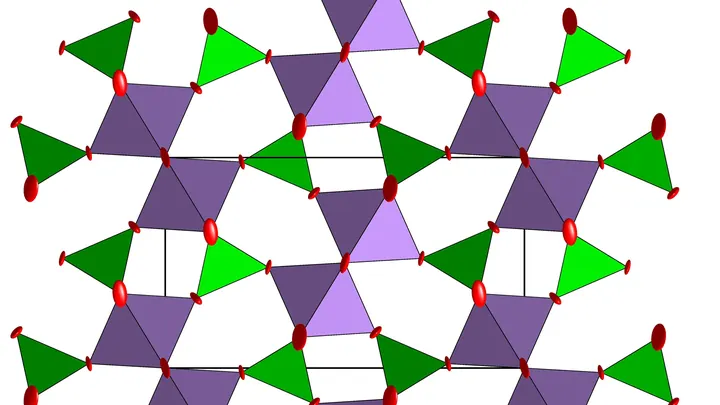
A lake in a drought doesn't dry up all at once. First, islands of dry land appear on the water's surface, they expand and merge, and only then does the water recede from the exposed bed. A mirabilite crystal behaves similarly when it loses water: round patches of anhydrous salt appear on its surface, growing outward and then beginning to deepen.
In a thin layer of liquid crystal, molecules usually lie like matches in a box — aligned in one direction but randomly oriented: some point up, others down. To make all the matches point the same way, you need a special molecular architecture. Scientists have found a chemical trick that does this almost automatically.
A drop of saltwater dries on a table. The salt doesn't settle just anywhere: crystals first appear at the rim, forming a ring, like coffee grounds at the bottom of a cup. Everyone who has seen the stain left by a dried droplet knows this behavior. But what if the droplet contains swimming bacteria?
At a concert, moving through a dense crowd is tough — the tighter the pack, the less you want to move. That's how active matter usually behaves: swarms of bacteria or robot flocks freeze in tight quarters. But one research group found the opposite effect.
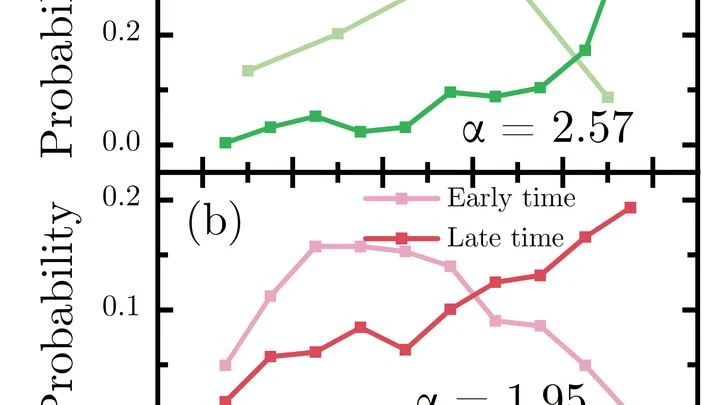
Water is not just a wet substance. On a picosecond scale, it resembles a dance floor where molecules continuously break and form bonds with each other. Usually, this dance is described by one main movement — collective relaxation, as if the whole crowd simultaneously slows down after the music stops.
In the intricate dance of active turbulence, where invisible engines spawn chaos, a soft droplet takes on the role of a detective. Its shape is not merely an outline but a sensitive cipher: it reads the hidden signals of its environment.
In water cooled to –40°C, a paradoxical pause sets in: perfect hexagonal ice is in no hurry to form. Instead, a disordered structure with interspersed cubic layers emerges — a real cradle for future symmetry, brimming with disorder yet already charged with hidden architecture.
In the new model, each active particle has an internal rhythm: it spins either left or right. Chirality is key: some twirl clockwise, others counterclockwise. But when such a particle bumps into an obstacle or a neighbor, it flips its spin, like a figure skater who, after touching the board, explodes into a reverse pirouette.
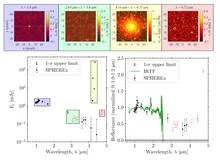
Using the JWST space telescope, astronomers conducted a chemical analysis of the centaur Chiron, an icy body from the fringes of the Solar System. It turns out its gas activity resembles a layered cake. Carbon dioxide evaporates from the surface, forming a top crust.
Plutonium is a metal with attitude. One form shrinks when cooled, another swells. But at room temperature, the alloy behaves strangely: the ruler says one thing, X-rays say another. The ruler shows the sample barely grows, while X-rays see atoms in the crystal lattice moving further apart.
A cell about to divide first marks its waist. Beneath its membrane, in a thin gel of protein filaments, movement begins. The filaments flow like a slow river, and a belt forms in the middle of the cell. This belt tightens more and more until the cell is pinched in half.
Scientists built a computer model of this process.
A stream of electrons enters plasma like a jet of water hitting a calm pond. The jet disturbs the surface, giving rise to waves that grow quickly and mix the water. In plasma, this process is called the Buneman instability: the electron beam excites oscillations that then scatter its energy.
Nitrogen, the very gas we breathe, behaves like a finicky metal under a million atmospheres of pressure. In a diamond anvil cell, it is squeezed to 78–98 gigapascals and heated with a laser to 1800–2500 kelvin. Under these conditions, N₂ molecules rearrange into crystals that can store energy more densely than explosives.
In a dense cloud of gas and dust where giant stars are born, the ALMA telescope has spotted something familiar. Four thin gas jets shoot out from the same region, each leaving behind a chain of bright knots, like a dashed line.
At the Large Hadron Collider, not only nuclei but also individual protons collide. Even in such small systems, collective behavior resembling the flow of a liquid is observed. But the proton is a quantum object; its state is described by a wave function, not by temperature and pressure.
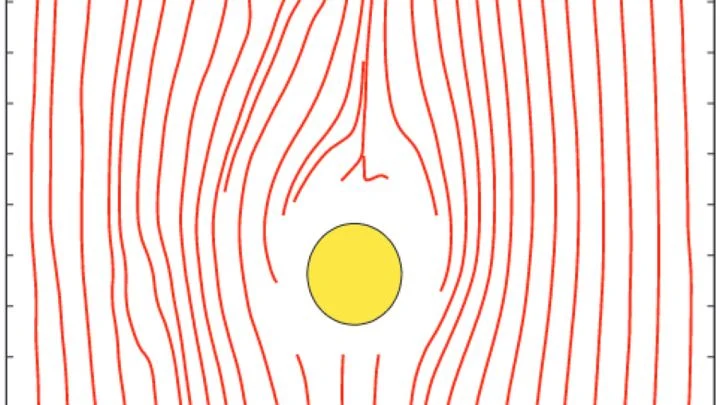
In porous materials (soil, rocks, filters) fluids move through tiny, winding channels. When two immiscible fluids, such as water and air, are present simultaneously, their interface constantly shifts: air bubbles push water out of some pores and open paths through others.
In a narrow gap between two plates, water from humid air collects on its own: this is capillary condensation. If the gap is only a few nanometers wide, water no longer behaves like a continuous liquid: every molecule counts.
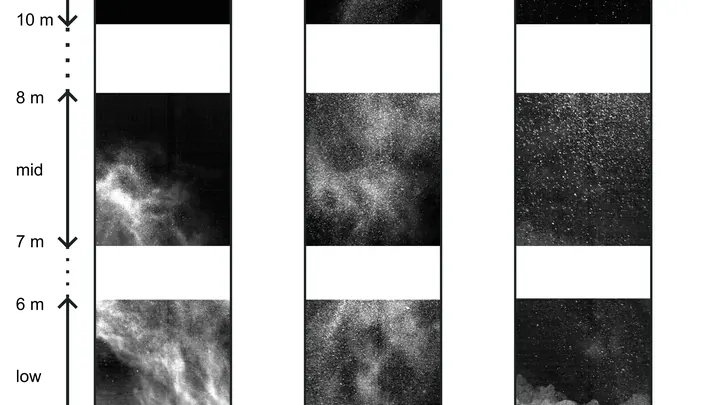
A powder avalanche isn't just a pile of snow sliding down a mountain. It's a cloud racing downhill at car speed. Inside, snow doesn't lie still: it flies: thousands of tiny particles are caught up in air vortices. Until now, no one had seen what actually happens to each snowflake in this chaos. Now scientists have the first footage.
Water is the only common liquid that doesn't immediately contract when cooled. Ice melts, and water becomes denser, but only up to 4 degrees Celsius. Beyond that, with further cooling, it expands again. This quirk explains why fish survive in freezing ponds: the densest water sinks to the bottom, while a lighter cold layer stays on top and turns into ice.
Ordinary window glass may seem frozen forever, but inside, atoms never stay still. In amorphous germanium telluride (GeTe)—a material used in rewritable discs and non-volatile memory — physicists have for the first time directly tracked how atomic bonds stretch and bend in trillionths of a second.
Water deep within the Earth is compressed more than a thousandfold compared to the surface. Even there, it continues to flow, but its internal structure changes. Researchers measured how water resists flow and compression as pressure rises from zero to 1.6 gigapascals — equivalent to placing a 16-ton weight on every square centimeter.
A drop of water with tiny particles dries on a table. The water evaporates, leaving the particles behind, and they arrange into a pattern, like sand after the tide. But if the particles are soft, the pattern turns out quite different. Researchers studied this process under a microscope, varying only one property of the particles: their elasticity.
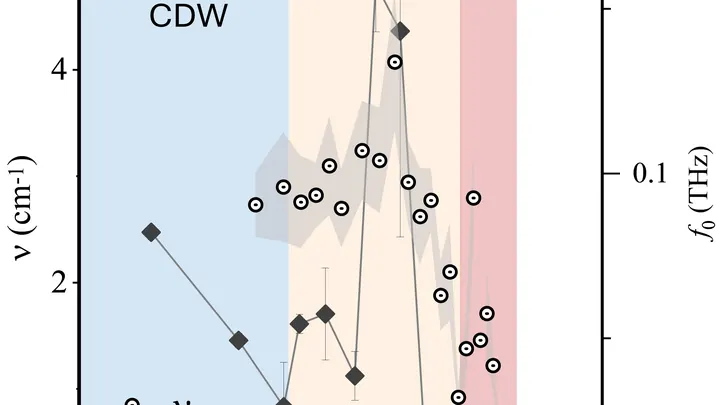
A cooled layered crystal resembles a stack of thin sheets, with electrons wandering between them. At around 17 K, tiny regions appear where electrons line up into a wave, like ripples on water frozen in place. These regions are called charge puddles, and they were previously thought to be static.
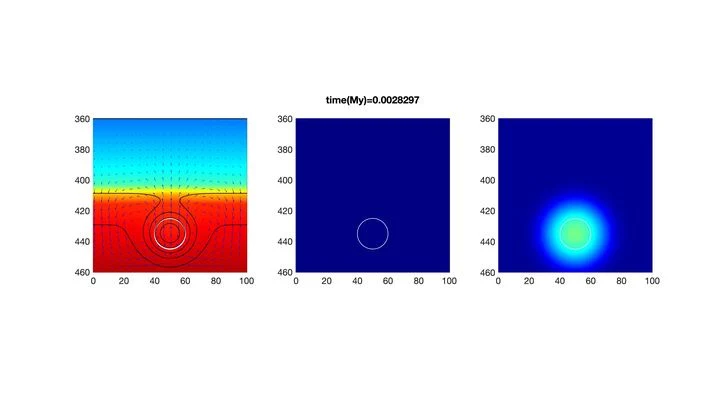
Deep beneath us, hundreds of kilometers down, lies a layer that can absorb water like a sponge. The minerals there, wadsleyite and ringwoodite, can hold up to 1–2% water by weight within their crystal lattices.
Liquid helium cooled to near absolute zero behaves like two fluids at once: a normal viscous part and a superfluid part that flows without friction. When such a flow hits a cylinder, vortices are born behind it. But sometimes vortices appear in front of the cylinder — where classical laws say they shouldn't be.
In a superconductor, electric current flows without loss, like water through a perfectly smooth pipe. But if you place such a material in a magnetic field, vortices appear inside — tiny whirlpools where superconductivity is destroyed. As long as these whirlpools stay put, current flows freely.
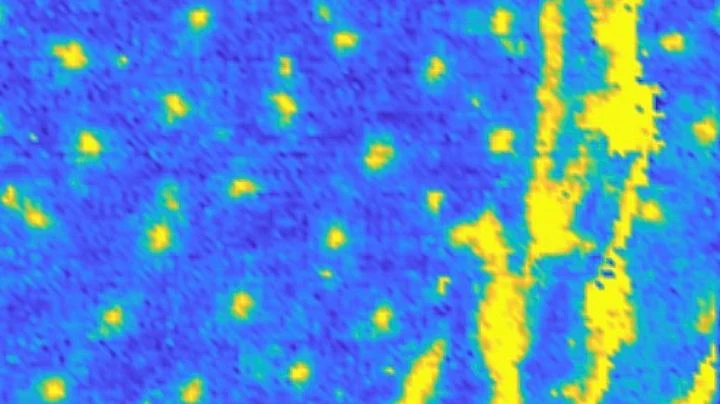
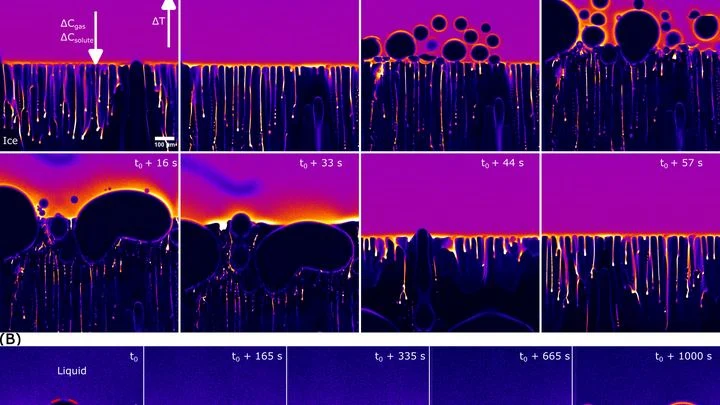
In a glass of soda, bubbles merrily rise to the top. But if you freeze the water, some bubbles end up trapped in the ice. How do they get there? After all, ice grows, pushing gas aside, but it doesn't always manage to.
In the tungsten bronze family, one material was considered the quiet one. When cooled, its siblings rearrange their electrons into wave-like patterns, but it did not, or so it was thought until recently.
Now it turns out that this material also undergoes rearrangement.
A thin stream of water flows down a cold inclined board and, before your eyes, turns into an ice ridge. At first, the water paves itself a straight icy path, as if reinforcing its own banks. Then the trickle starts to meander, and the ice quickly spreads sideways. Finally, the ridge stops growing outward and begins to thicken, smoothing out irregularities.
Deep inside a molecular cloud, where temperatures drop to 10–20 kelvin and gas densities reach a million particles per cubic centimeter, a frozen shadow prevails. There, far from starlight, water, carbon dioxide, and other molecules freeze onto dust grains.