A Quantum Nose for the Hospital express
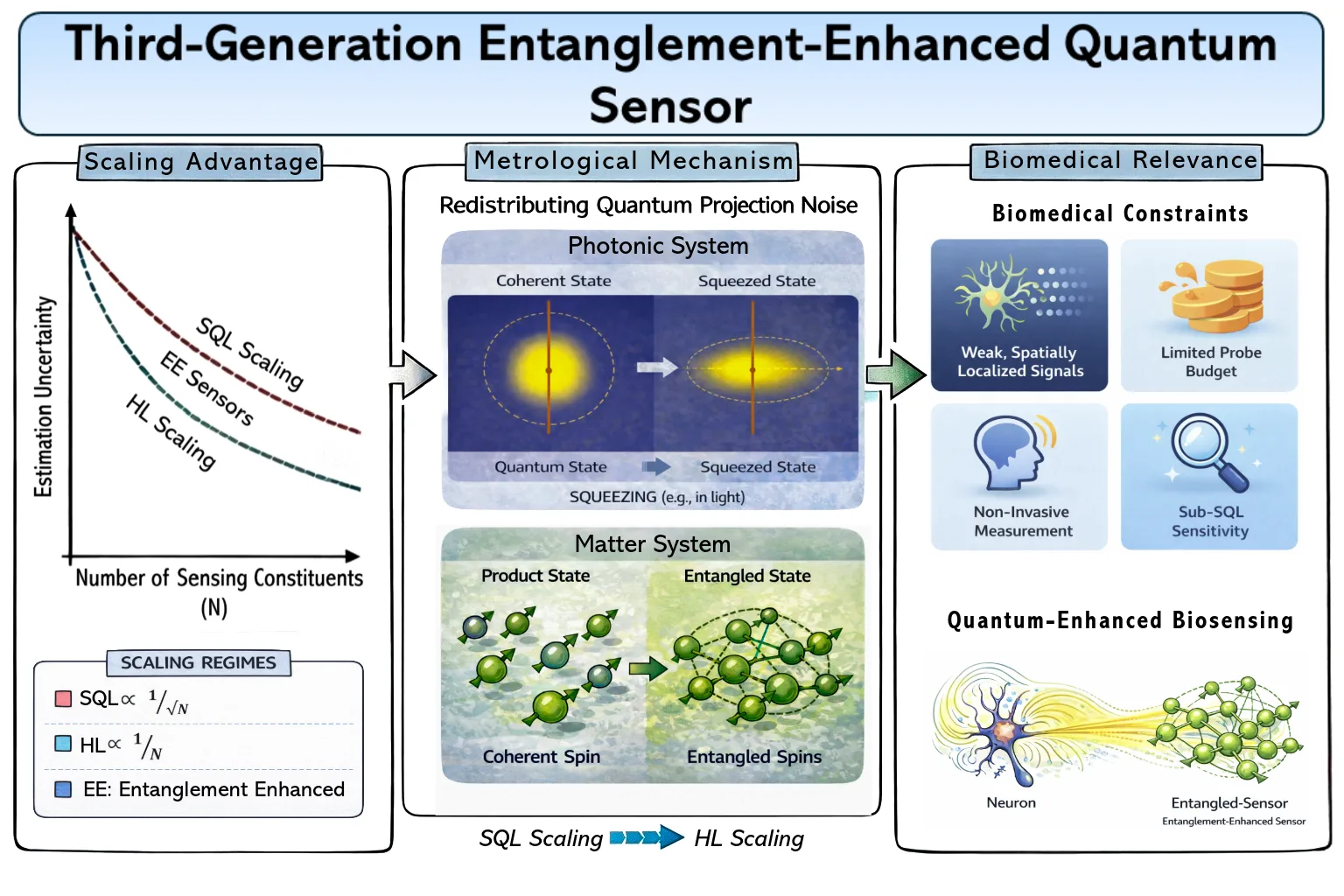
A modern hospital sensor is like a sensitive microphone in a noisy hall. It picks up a weak signal from the heart or brain, but along with it comes the hum of machines, footsteps, the breathing of neighbors. Separating the desired sound from the interference is a science in itself. Quantum sensors promise to hear what ordinary ones can't, but they too are still drowning in noise.
The authors arrange such sensors on a staircase. The first step is a device that simply uses special states of matter to turn a signal into electricity. It's more sensitive than a regular one, but the noise still grows along with the signal. The second step is a device that keeps its particles in a special agreement (called coherence) and thus reaches the limit once thought to be the ceiling for any measurement. The third step is a device where particles are linked so that an error in one is immediately corrected by another. Such a sensor approaches the strictest limit nature allows.
Right now, the main obstacle is not sensitivity itself, but that the sensor sits far from the affected area. The signal fades like the smell from the kitchen by the time it reaches the hallway. So the authors propose a roadmap: first, learn to tune the sensor to the right signal frequency; then, bring it closer to the body; and finally, trust it to extract meaning from the noise on its own. Then the device would stop being just a scale and become a sniffer that can tell the scents of disease apart.
The limit that the best quantum sensors strive for is called the Heisenberg limit. It says: the more particles work together, the more precisely you can measure, but only if they are linked in a special way. Ordinary instruments can't reach this limit.
In the series "Star Trek," the medical tricorder makes a diagnosis in a couple of seconds, just by waving it over the body. The fourth generation of quantum sensors is the first step toward such a device: it not only measures but also understands what it has measured.