In 1973, Soviet mathematician Alexander Holevo from the Steklov Mathematical Institute proved his famous theorem. It states that the amount of classical information accessible to an observer about a quantum state does not exceed the von Neumann entropy of that state (a measure of its uncertainty) minus the average entropy of the states composing the ensemble. This work became a cornerstone of quantum information theory.
History
Formulated and proven by Alexander Holevo in 1973. The idea was independently discussed in Western literature later, but priority belongs to Holevo. The theorem became the starting point for the development of quantum channel capacity theory: Benjamin Schumacher and Richard Jozsa later introduced the term 'qubit' and studied quantum information compression. Also important are the works of Charles Bennett and Stephen Wiesner.
How it works
The Holevo bound is used in designing quantum communication protocols and evaluating their efficiency. It is also important in quantum cryptography — it determines the upper bound on information leakage to an eavesdropper. Limitations: it assumes that the sender and receiver do not use entanglement (they transmit prepared states). For quantum channels with entanglement, there are more general bounds — the Holevo-Schumacher-Westmoreland capacity, which go beyond this theorem.
The Holevo bound explains why quantum computers cannot simply 'download' all answers from parallel universes: only a limited amount of ordinary data can be extracted from a quantum state.
In 1996, physicists asked: how much noise can a quantum channel withstand before it stops transmitting information? A phone call where every third word is replaced by random noise is still understandable. Up to what level of interference can the listener still grasp the meaning?
Alice prepares a quantum particle in one of several states and sends it to Bob. The channel the particle travels through isn't perfect: it's noisy, scatters, interacts with the environment. Bob receives the signal and tries to figure out what Alice actually sent. This is the classic "prepare-send-measure" scheme, and there's always a risk of losing something along the way.
A quantum particle moves in a circle, passing through several stations. At each station, something happens to it — for example, its properties change slightly. After completing a full circle, the particle returns, but its state is no longer exactly what it was at the start.
A quantum computer is like a fragile snowflake resting on a warm palm. The slightest breath of heat or a gentle vibration, and it turns into a droplet. To keep the snowflake alive, you constantly adjust it, restoring its original shape. That's quantum error correction.
An electrical grid stuffed with power electronics resembles a huge orchestra without a conductor. Each converter, each line adds its own note, and sometimes the instruments start playing out of tune.
A laser beam in a multi-kilometer tunnel trembles as a gravitational wave passes, but the tremor is barely perceptible, on the scale of fractions of a proton's diameter. To hear this cosmic whisper, physicists squeeze every last bit of performance out of light.
Once Richard Feynman saw in quantum systems a challenge for classical computers. Now we face the inverse problem: understanding what exactly the quantum processor has simulated. Among the states it births are veritable 'black boxes'—topological phases of matter.
Training a large neural network across hundreds of compute nodes is like making soup as a team: each 'chef' tastes the dish and tells the others what to adjust.
Atomic nuclei are rarely perfect spheres. More often, they resemble a slightly squashed ball — the electric charge inside is unevenly distributed, and protons may shift a bit, creating a tiny 'pear-shaped' bulge.
A light beam approaches a black hole not head-on, but at a glancing angle. If the angle is just right, the light neither falls in nor escapes: it starts looping around, like a figure skater circling the rim of a funnel. This narrow track is the photon ring. It acts like a lens, repeatedly reflecting the image of everything that falls into the hole.
Two simultaneous interpreters sit in the same booth. The first translates from English into Russian but swallows half the words. The second goes from Russian into French, and also loses half. If you put them together, you'd expect a mess: the losses would add up, and only a quarter of the meaning would reach the listener. But what if they start correcting each other?
In the kitchen, the sequence of actions is strictly dictated by the recipe: first chop, then fry, and nothing else. In quantum physics, the role of the recipe is played by causality — one event causes another, and they cannot be swapped. But in recent years, theorists have devised clever scenarios where the order of events seems to 'hang' in uncertainty.
A drop of ink falls into a glass of water, and within a minute you can't tell where it landed. In the quantum world, it's even more dramatic: information about a local event spreads across the entire system so quickly that any point-like sensor soon stops feeling anything. This is called delocalization, and for quantum sensors, it sounds like a death sentence.
In a vast dark hall, someone invisible plucks the strings. The cosmic gas, the tenuous hydrogen that filled the young universe, resembles stretched strings that can resonate at a radio wavelength of 21 centimeters. This is hydrogen whispering about its temperature.
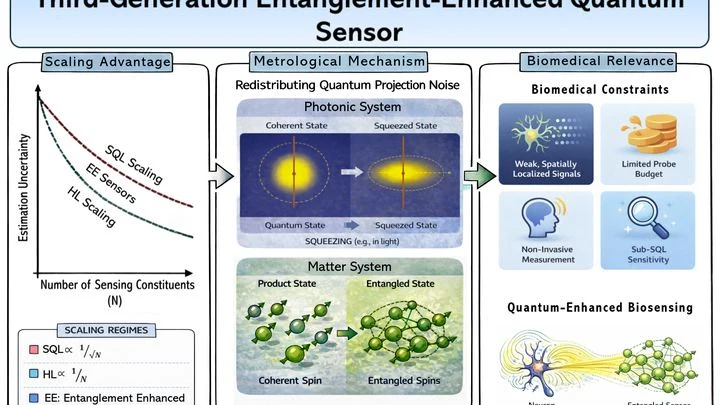
A modern hospital sensor is like a sensitive microphone in a noisy hall. It picks up a weak signal from the heart or brain, but along with it comes the hum of machines, footsteps, the breathing of neighbors. Separating the desired sound from the interference is a science in itself.
An ion channel in a cell membrane is a gate just a few atoms wide. Every second, millions of charged particles, sodium and potassium ions, pass through it. Classical physics said that to get through, an ion must jump over an energy barrier, like a traveler crossing a high mountain pass.
IBM's Heron R3 quantum computer handled a task that made a classical method back down. The challenge was finding the ground state, the lowest energy level, of a system of 49 quantum bits.
For a long time, physicists were certain: quantum entanglement requires direct quantum contact. A new study refutes this. Two microscopic magnetic particles, connected only by a classical spring, successfully become entangled.
A quantum sensor is like a telegraph line transmitting a hypersensitive message. The slightest disturbance distorts the signal. It used to be thought that accurate measurement required an error-free 'telegraphist' — a perfect error-correction system. But in practice, all elements are noisy. The new approach allows for errors at every step: in sending, verification, and reception.
The calm вода of a lake: the slightest ripple blurs the depth. In quantum sensors, noise — random jitters — generates энтропию (disorder) and kills precision. Physicists found a solution: scramble the order of events.
We are used to thinking that events have causes, objects exist independently, and signals cannot outpace the speed of light. Quantum mechanics, which describes the Standard Model of particles, challenges all these assumptions at once — as if a recipe couldn't use all seven ingredients.
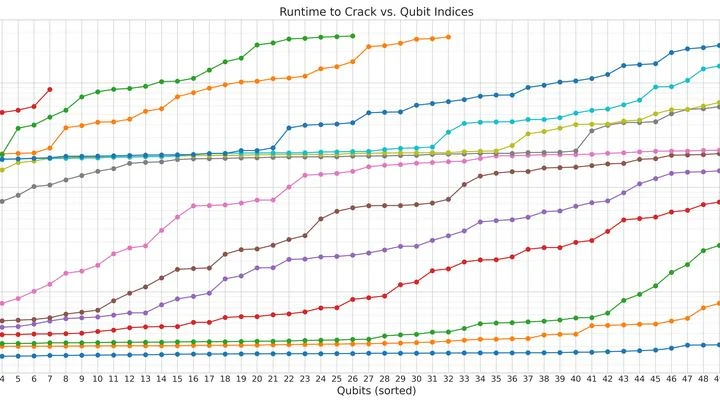
The task resembles a giant maze with a single exit among billions of dead ends. A conventional computer checks each corridor step by step — taking centuries. A quantum processor launches a wave that seeps through all paths at once. The correct route echoes back, amplifying, and the answer is found in hours. That’s exactly how the “peak” circuits worked in the new experiment.
Deep inside a superconductor, electrons pair up into Cooper pairs and glide without resistance. But if a vortex appears in this perfect order, a tiny region where superconductivity vanishes, special excitations emerge there: Bogoliubov quasiparticles.