Witness Particles of Quantum Vortices express
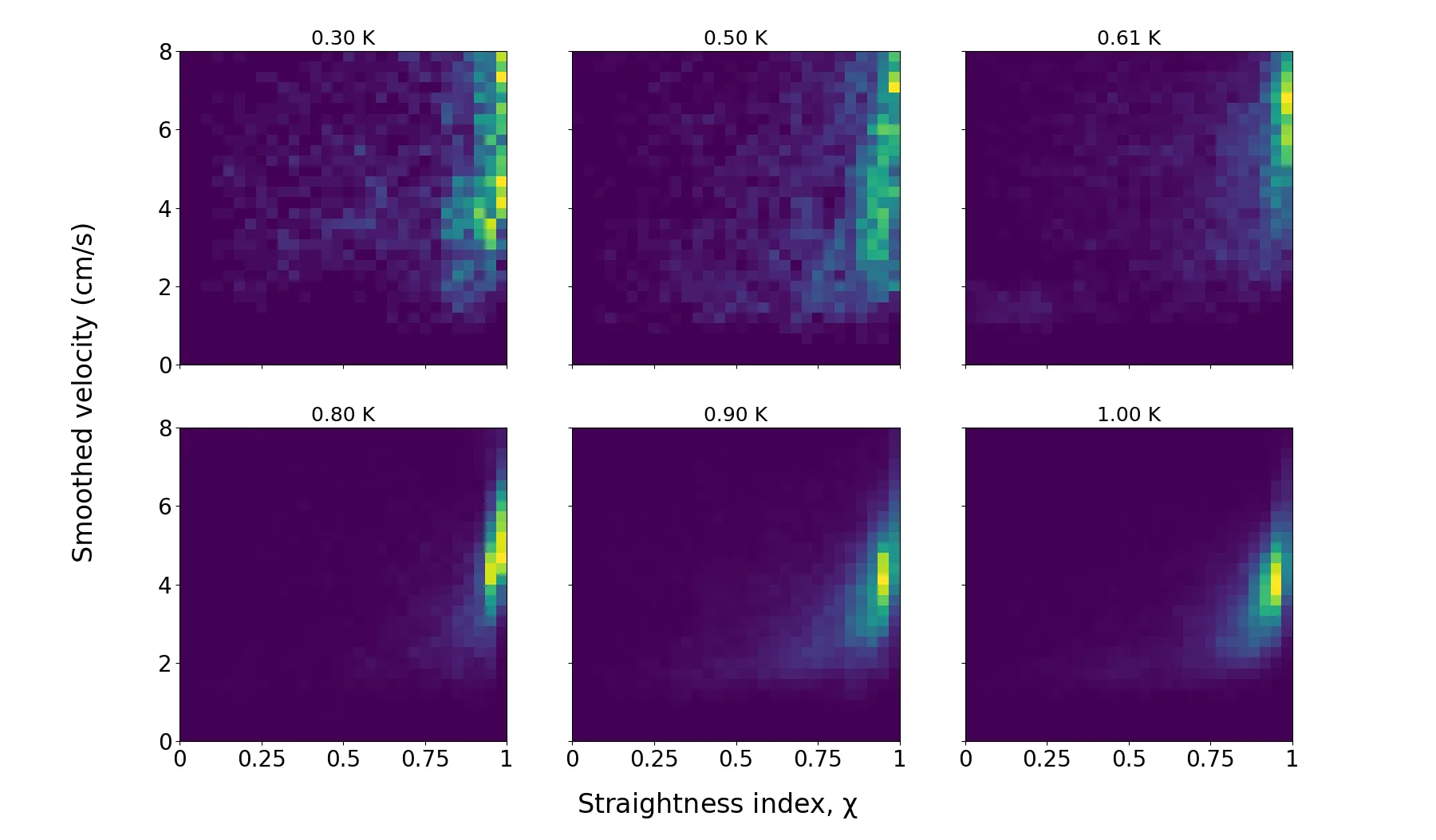
In helium cooled to near absolute zero, the liquid stops rubbing against itself and begins to flow without any resistance. Physicists launched tiny polymer spheres (from one to six micrometers across, like bacteria) into such superfluid helium and tracked their fall through laser illumination. The spheres glowed, and a camera recorded their paths.
Some spheres descended smoothly, like grains of sand in thick syrup. Others suddenly jerked sideways, as if hitting invisible threads. These threads are quantum vortices: ultra-thin swirls where superfluidity tears like paper at a crease. Vortices arise from thermal jolts and persist even at 0.14 kelvin — two hundred times colder than a freezer.
When scientists looked at the motion of spheres along different segments of their paths, the picture changed. For the smallest particles, speeds split into two distinct peaks, like two floors in a building where some residents take the elevator and others run up the stairs. Larger spheres more often got stuck in tangled clumps of vortices and hung in the liquid for hours, even though by all laws they should have fallen. The physicists learned to count how many particles stuck to vortices and described their behavior with a simple equation, as if tallying passengers stuck on an escalator.
These glowing spheres are like probes thrown into an invisible storm. They show where the superfluid surface tears and how vortices latch onto matter. Such experiments help understand turbulence — a phenomenon that governs both weather and blood flow but remains a mystery to this day.
Superfluid helium can leak out of an open glass through its walls: it creeps up the wall, overcoming gravity, because friction inside the liquid vanishes.
In Peter Watts' novel Blindsight, the ship's crew uses superfluid liquids in cooling systems, and encounters quantum effects that warp their perception of reality.