Quantumsuperfluidity is a state of matter where a fluid flows without any resistance, meaning it loses no energy to friction or viscosity. This phenomenon emerges from quantum mechanical effects at macroscopic scales, typically at extremely low temperatures. In a superfluid, atoms condense into a single quantum state, behaving as one coherent entity rather than individual particles, allowing it to flow through tiny channels and even climb walls.
History
Superfluidity in helium-4 was discovered in 1937 by Pyotr Kapitsa, John Allen, and Don Misener, with the theoretical framework developed by Lev Landau and later extended to quantum gases.
How it works
The mechanism relies on Bose-Einstein condensation, where bosonic particles occupy the same quantumground state. This collective state has a single wavefunction, so any excitation or dissipation would require breaking the coherent order — an energetically costly process. As a result, the fluid flows without scattering, and quantized vortices carry angular momentum in discrete units. In low-dimensional systems, superfluidity can persist even at higher temperatures due to enhanced quantum fluctuations.
In practice
Superfluids are used in precision gyroscopes, such as in NASA's Gravity Probe B, and in studying quantum turbulence and vortex dynamics in laboratories.
Fun fact
In a superfluid, heat can travel as a wave called 'second sound,' rather than diffusing like in ordinary fluids.
A stone falls into a pond, and ripples spread across the water. Long waves and short ones travel at the same speed: that's how ordinary sound behaves in almost any medium. But in quantum liquids, things can be different.
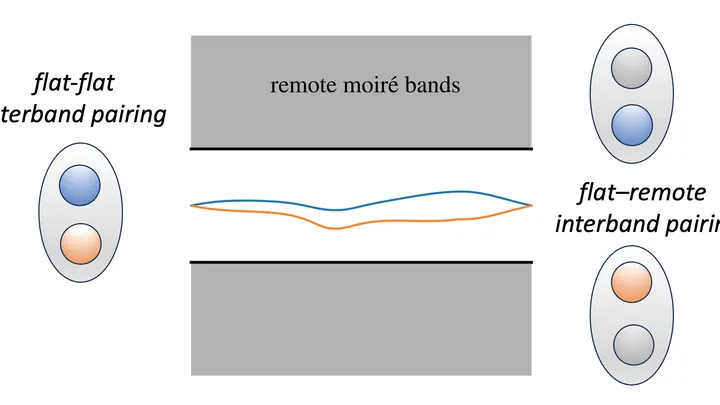
Physicists considered a superfluid where particles move along a "flat" energy band.
Imagine a packed dance floor where dancers glide without any friction — passing through each other without a touch. That's a superfluid. In a neutron star's crust, neutrons could behave this way, but a rigid lattice of ions gets in the way, like suddenly sticking the dance floor full of pillars.
Sound travels through a medium at a certain speed. If the medium moves faster, the sound gets swept along by the flow — like a wood chip pulled into a whirlpool. In superfluid helium — a frictionless liquid — rapid rotation spawns vortex funnels. Inside them, an acoustic black hole forms: a region from which sound cannot return.
A stone falls into a pond, and ripples spread across the water. But if the stone is very small and the water is not quite ordinary, the ripples pass right through it, as if it weren't there.
When you flip a switch, the light doesn't come on immediately — electrons in the wires need time to 'get going' and move together. In ordinary metals and semiconductors, current builds up gradually, like water in a hose when you first open the tap.
A sheet of graphene one atom thick is twisted at a small angle, and it starts behaving like a layered pie with layers slightly rotated relative to each other. At a certain twist angle, this material becomes a superconductor: electrons begin to move in pairs, like dancers in a waltz, without losing energy. But what exactly happens inside has remained a mystery.
A quantum computer is like an orchestra where every musician must hit their note without going flat. But superconducting qubits share a common ailment: random charges accumulate on their electrodes, and the 'note' drifts. Engineers call this charge offset drift, and usually battle it for years.
Superconductivity is the ability of a material to conduct electricity without losses. Ordinary wires heat up, and some energy is lost as heat, but a superconductor carries current with zero resistance.
The quantum Hall effect has long been suspected of superfluidity — the ability to flow without friction. Imagine a cook following a recipe: for each unit of magnetic flux, he must add exactly a certain number of electrons.
A superfluid flows without friction, like water in a perfectly smooth pipe, but the moment it hits an obstacle, the picture changes. In a new study, researchers looked at how a superfluid stream flows around rectangular walls and pits with sharp corners.
In the macroscopic world we know, any motion inevitably decays: friction, a dissipative process that scatters energy, intervenes. But quantum reality has surprises in store.
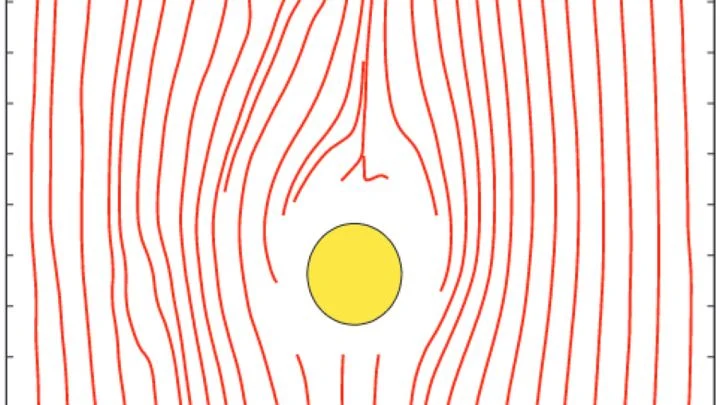
Liquid helium cooled to near absolute zero behaves like two fluids at once: a normal viscous part and a superfluid part that flows without friction. When such a flow hits a cylinder, vortices are born behind it. But sometimes vortices appear in front of the cylinder — where classical laws say they shouldn't be.
Two pieces of graphite rub against each other, and the resistance vanishes as if an invisible film of oil separated them. Previously, this was only seen under a microscope, on tiny contact patches.
Magnetic vortices in superconductors, like whirlpools in water, typically scatter energy and quickly vanish due to internal friction — dissipation. This hampers their use in quantum chips. But in a film of tiny aluminum grains, a vortex gets trapped and resembles a whirlpool in a narrow well: it spins either one way or the other.