Light Instead of Wires: 3 Trillion Bits per Second express
Light can carry information faster than any electronics. But usually, between a computer and a laser sits a digital-to-analog converter — a device that turns zeros and ones into electrical signals. It's the bottleneck.
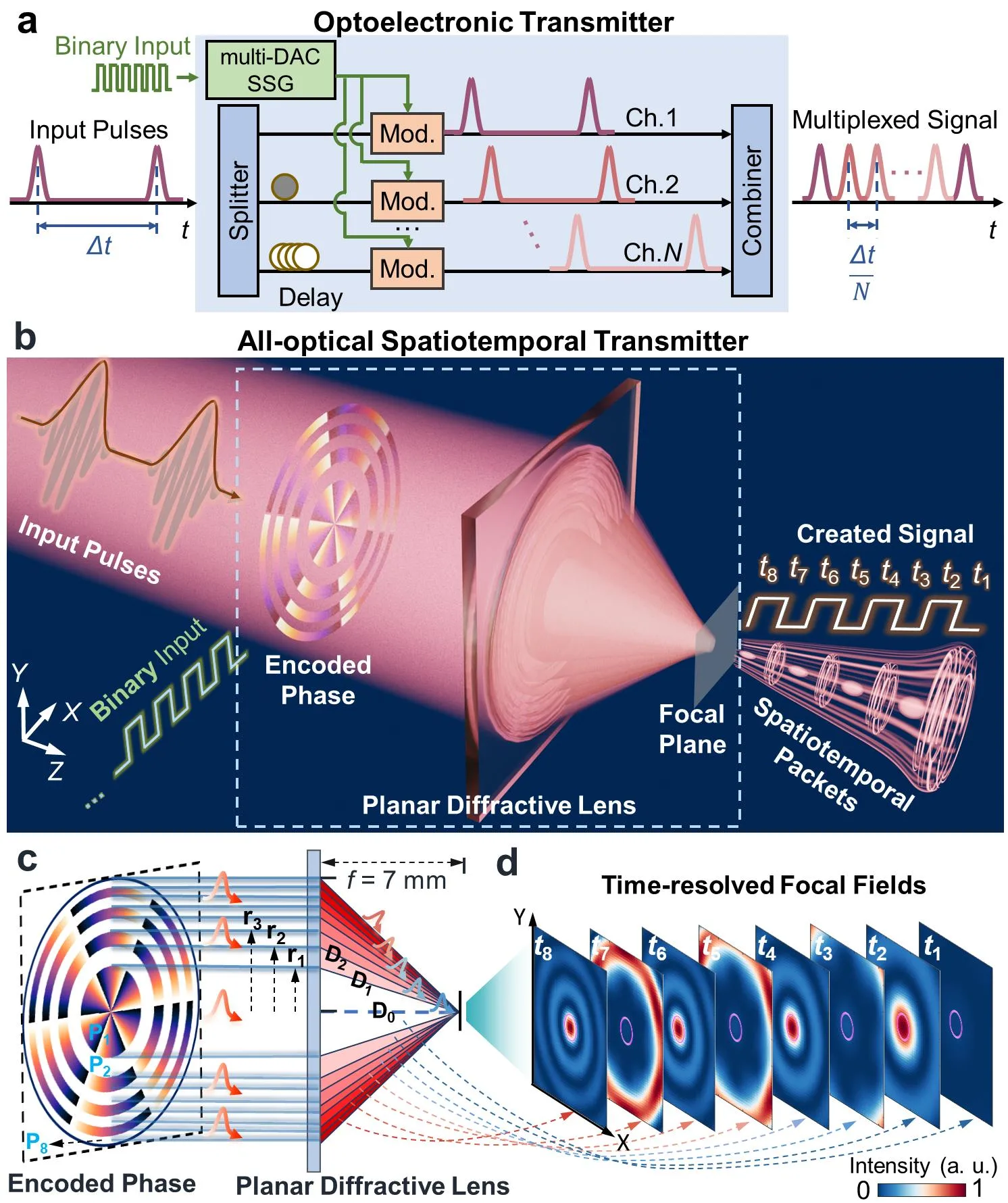
The new transmitter does away with this middleman. A laser beam passes through a flat lens with a controllable phase — a thin plate that twists light waves. At the lens's focus, ultrashort pulses are born — femtosecond flashes (one millionth of a billionth of a second). Each pulse is a bit: a bright flash means "1," a dark one means "0."
By switching the phase pattern on the lens, the authors made light itself shape the data stream. No wires, no synchronization, just light and a lens. In the experiment, they transmitted a 15-by-15-pixel black-and-white image and a color one with 9-bit encoding. The speed was about 3 trillion bits per second — a record for a single channel.
This approach removes two bottlenecks at once: slow electronics and the complex coordination between multiple devices. Light does all the work itself.
Original abstract
as written by the authors arXiv:2604.04005
Exponential growth in global data traffic demands ever-increasing transmission rates--a pursuit fundamentally constrained by the physical limitations of digital-to-analog converters (DACs). Existing strategies to overcome this bottleneck, such as multi-DAC arrays and optical time-division multiplexing, inevitably introduce system complexity and coordination overhead. Here we demonstrate an all-optical spatiotemporal transmitter that generates controllable high-repetition information-carrying femtosecond pulses at the focus of a phase-modulated planar diffractive lens (PDL) through optical-path-induced spatial-to-temporal conversion. Each pulse serves as an information bit, encoding binary data via on-axis focal intensity states corresponding to '0' and '1', achieved by switching between topological and constant phase modulations. High experimental orthogonality between arbitrary bits enables nearly error-free transmission of 15X15-pixel grayscale (8-bit coding) and colour (9-bit coding) images at a record-high single-channel rate of approximately 3 terabits per second (Tbit/s). Free from electronic and coordination bottlenecks, this all-optical transmitter establishes a scalable high-speed single-channel pathway toward ultrahigh-capacity optical communication.
The record speed of 3 Tbit/s is about 375 gigabytes per second. In one second, you could transfer the contents of a 375 GB hard drive.
In Star Trek, data is transmitted through subspace without delays. This technology is a step toward light carrying information as freely as those fictional channels.