Why Red Giants Blink in Rhythm express
Some red giants (huge, old stars) change brightness very slowly: one cycle can last more than a year. Astronomers have long been puzzled about why. One idea: an invisible companion orbits nearby, periodically blocking part of the light. Another: the star itself pulsates, like a heart, but very leisurely: its outer layers alternately contract and expand.
In the new study, they took observational data for 249 such stars. For each, they identified the primary rhythm of brightness variation and its "overtone"—a faster secondary oscillation. It turned out that the phase shift between them reveals whether we are seeing an eclipse by a companion or the star's own pulsation. For most stars, the phase indicated a companion. But for a small group, roughly one in fifty, the pattern matched pulsation, and a very specific kind: the star oscillates as a whole, alternately swelling on one side and then the other.
This type of pulsation had been predicted theoretically, but no reliable examples were known. Now they have been found. This means that stable oscillations, akin to slow breathing, can arise inside red giants. They allow us to peer into the star's depths, which direct observations cannot reach.
Original abstract
as written by the authors arXiv:2604.06563
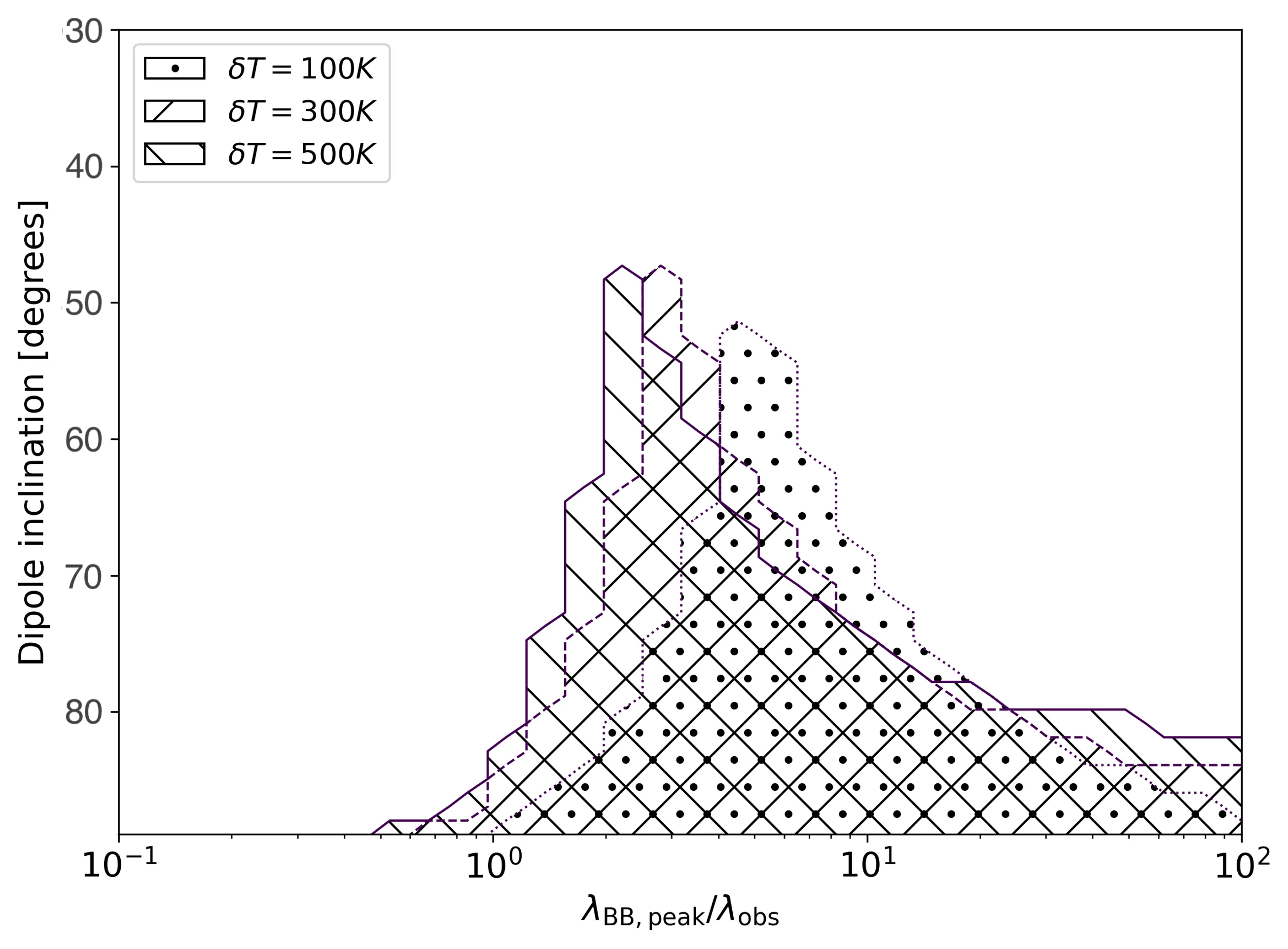
Long secondary periods (LSPs) in luminous red giants remain the only major class of long-period stellar variability without a secure physical origin. Competing hypotheses include binaries with dusty companions and oscillatory convective dipole modes. We identify the physical and geometric conditions under which oscillatory convective dipole modes produce distinctive harmonic signatures that contrast with those expected from binary systems, and apply this diagnostic to a filtered subset of the OGLE-III LSP sample to identify examples consistent with oscillatory convective dipole modes. We model the geometric flux modulation from oscillatory convective dipole modes and map the range of inclinations, temperature amplitudes, and observing wavelengths for which harmonic features are observable. Using OGLE-III I-band light curves, we require statistically significant power at both sequence D and its harmonic, keeping a filtered sample of 249 stars (2.1% of the ridge-selected sample). We apply iterative Lomb-Scargle and weighted Fourier decomposition to isolate the fundamental and harmonic components. The relative phase ($$\Delta\phi$$) between these distinguishes secondary maxima predicted by an inclined dipole from secondary minima caused by eclipsing or ellipsoidal binary systems. The majority of high amplitude stars in the filtered subset show $$\Delta\phi$$ consistent with secondary minima produced by binary systems. However, a small but statistically non-negligible subset exhibits $$\Delta\phi$$ consistent with secondary maxima that are difficult to reconcile by eclipsing or ellipsoidal binaries, and instead match the geometric predictions for highly inclined, non-rotating oscillatory convective dipole modes with temperature amplitudes consistent with published models.
The period of such pulsations can reach 1000 days — nearly three Earth years.
In Stanislaw Lem's novel "Solaris," the planet's ocean also pulsates with inexplicable periodicity, and scientists struggle for a long time to understand its nature.