Brightness variation is the change in an object's observed luminosity over time. In astrophysics, it serves as a powerful remote-sensing tool: because we cannot physically visit most celestial bodies, their changing light carries information about their rotation, shape, surface features, and even the geometry of surrounding space-time. Periodic brightness changes often signal rotation, as a rotating object with uneven surface features or asymmetric emission presents different faces to the observer. Irregular variations can indicate more dynamic processes, such as accretion instabilities, stellar flares, or gravitational lensing effects.
History
The use of brightness variation to infer rotation dates back to the 17th century, when Giovanni Domenico Cassini and others observed spots on Jupiter and the Sun to determine their rotation periods. The technique was later extended to stars and, in the 20th century, to compact objects like pulsars and black hole candidates.
How it works
When an object rotates, regions with different brightness (e.g., sunspots, hot spots, or shadowed areas) move in and out of view, producing a periodic modulation of the total observed flux. The period of the variation matches the rotation period, while the amplitude depends on the contrast between the bright and dark features. In more exotic cases, such as black hole shadows, brightness variations can arise from the orbital motion of hot plasma in the accretion disk, or from the rotation of the black hole itself warping the photon ring. The observed light curve is thus a convolution of the object's intrinsic properties and the relativistic effects of strong gravity.
In practice
Brightness variation is used in exoplanet detection (transit method), stellar rotation studies, and monitoring of active galactic nuclei and black hole accretion flows.
Fun fact
The first exoplanet ever discovered around a Sun-like star, 51 Pegasi b, was found in 1995 via periodic brightness variations caused by the planet's gravitational tug on its host star, not by the planet blocking light.
A light ray passing by a massive body slightly changes its direction, like a stream of water bending around a rock in a creek. In the solar system, there are many such "rocks": planets, their moons, asteroids. And each one, with its own gravity, bends the path of light coming from distant stars.
Light escaping a massive body loses steam. Its frequency dips slightly, and its color shifts toward red. Physicists call this gravitational redshift. In classical theory, it's all clear, but the moment you bring quanta into the picture, trouble starts.
Previously, this shift was modeled as a kind of mode mixer — a device that entangles different states of light.
On the screen is the result of a complex simulation: two planets collided, a shockwave ripples outward. A couple of clicks in an editor, and harsh shadows soften, noise smooths out, the background darkens. This kind of digital retouching (image editing to enhance appearance) has long been part of the scientist’s toolkit.
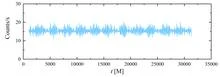
A candle flame in a draft dances: now it flares up, now it almost goes out. Quasars behave much the same way — supermassive black holes in the centers of distant galaxies, surrounded by a scorching disk of infalling matter. Only they flicker not over seconds, but over months and years.
Gravitational wave detectors work like sensitive microphones, picking up the trembling of space from distant cosmic catastrophes. When two black holes merge into one, the newborn object rings like a bell, and that ringing is a unique 'voice' of gravity.
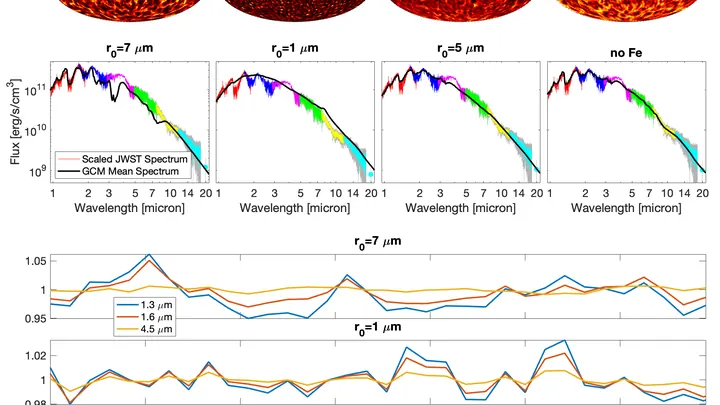
Far beyond the Solar System, a world called VHS 1256B wanders — a giant planet without a star. For a long time, astronomers couldn’t figure out why its brightness jumped by nearly 40% in just a few days. The answer came with the James Webb telescope: it turns out, colossal storms of silicate dust engulf the entire planet.
In 2019, the Event Horizon Telescope gave humanity the first image of a black hole's shadow. Since then, astrophysicists have dreamed of more: seeing how matter moves in the very funnel of spacetime. One of the mysteries is chaos.