The oscillation period is the time required for one complete cycle of a repeating motion, such as a sound wave, a pendulum swing, or a pulsar's pulse. It is the reciprocal of frequency, meaning that a shorter period corresponds to a higher frequency. In acoustics, the period determines the pitch of a sound: shorter periods produce higher notes, while longer periods produce lower notes. In astrophysics, the oscillation period of stars or pulsars provides crucial information about their internal structure, density, and rotation.
History
The concept of oscillation period was formalized by Galileo Galilei in the early 17th century, who discovered that a pendulum's period is independent of its amplitude, leading to the development of accurate timekeeping devices.
How it works
For a simple harmonic oscillator, such as a mass on a spring, the period depends only on the mass and the spring constant, not on the amplitude of the motion. For waves, the period is the time between successive crests passing a fixed point. In more complex systems, like a pulsar—a rotating neutron star emitting beams of radiation—the period is the time for one full rotation, which can be incredibly stable, rivaling atomic clocks. Measuring the period and its variations over time allows scientists to infer properties like the star's magnetic field strength or the presence of companion objects.
In practice
Oscillation periods are used in seismology to study Earth's interior, in telecommunications to synchronize signals, and in astronomy to detect exoplanets via the periodic dimming of stars.
Fun fact
The pulsar PSR J1748-2446ad has an oscillation period of just 1.4 milliseconds, meaning it rotates 716 times per second—faster than the blades of a kitchen blender.
It's like a sprint record: to break it, you need a perfect run-up. But for sub-millisecond pulsars, the run-up is too short. The fastest known pulsar, PSR J1748-2446ad, spins 716 times per second — faster than a kitchen blender. If it were the size of Earth, a point on its equator would move at about 0.24 times the speed of light. But why doesn't any pulsar spin even faster?
Cepheids are stars that pulsate with remarkable regularity: their brightness changes like a lighthouse beam, and the pulsation period is linked to the star's average density. In binary systems where a Cepheid is eclipsed by its companion, astronomers can precisely measure the star's radius and mass.
A quantum particle moves in a circle, passing through several stations. At each station, something happens to it — for example, its properties change slightly. After completing a full circle, the particle returns, but its state is no longer exactly what it was at the start.
Somewhere in the depths of the Milky Way, radio pulses flare up from time to time — rare, steady, like the ticks of a distant metronome. These long-period radio transients were discovered only recently, and they immediately puzzled astronomers.
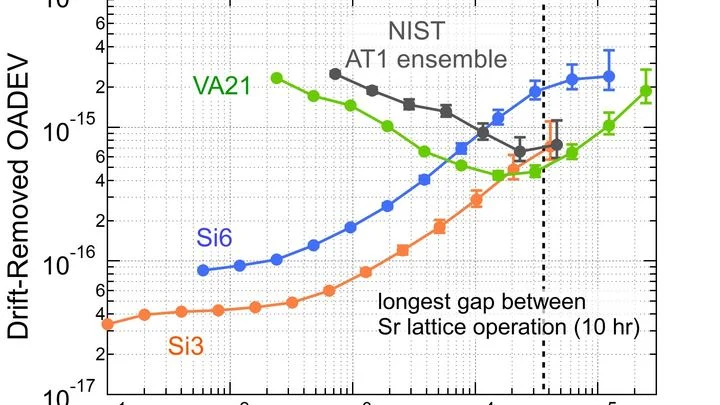
The world's most precise stopwatch still runs with one eye on an old pendulum. Hydrogen masers — the best radio-frequency flywheels (devices that keep the rhythm between comparisons with a reference)—accumulate error because noise between ticks leaks into the final signal.
The very first moment of the universe's existence is like a taut string suddenly struck. It vibrated, and those oscillations froze into galaxies and voids. But physicists suspect there were other vibrations — fast, local, almost like a drumroll against a slow melody.
Moiré patterns are familiar to everyone. Two combs with different spacing, placed on top of each other, show dark fringes. Something similar has emerged in time. Physicists took a cloud of Rydberg atoms, particles with unusually large electron orbits, and illuminated it with two lasers.
In the first fractions of a second after the Big Bang, the universe was a stage of rapid change. A stretched rubber sheet that cools quickly becomes covered with microscopic cracks. A similar process on a cosmic scale could have given rise to cosmic strings — ultra-thin but super-dense threads of energy stretching across the entire universe.
These strings are not just defects in space.
The Sun is constantly struck by blows — magnetic reconnection in the plasma releases energy, making the corona flare up. After each such blow, magnetohydrodynamic waves linger in the plasma loops, like the fading ring of a bell.
Two dead suns circle in an eternal dance. Their orbit is a perfect metronome, keeping time with the accuracy of atomic clocks. But even dead stars can tremble.
Even Jocelyn Bell Burnell, who first detected the strict periodicity of radio signals, noticed that some pulses would suddenly vanish. Today we know: variability is not a whim, but the voice of intricate electrodynamics.
In 2022, astronomers began discovering strange cosmic beacons — long-period radio transients. Unlike fast pulsars, discovered by Jocelyn Bell Burnell in 1967, these objects flared with periods of tens of minutes and hours.
A fundamental string plucked at the moment of the Big Bang doesn't just hum a single note — waves run along it, and occasionally tiny loops peel off. These loops, like tuning forks, begin to ring at their own frequency, producing a very high-pitched sound.
A spinning top whirls at great speed and, instead of a steady hum, emits a quiet buzz — because it is slightly dented. Neutron stars work much the same way: city-sized spheres compressed to such density that a teaspoon of their material weighs as much as a mountain.
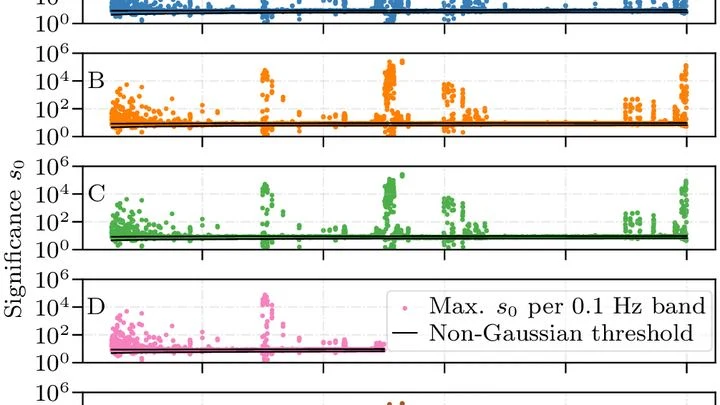
When two supermassive black holes circle each other before merging, they shake spacetime itself, like a speedboat racing across a lake leaves waves in its wake. These waves are called gravitational waves. They travel through the Universe and pass through everything, even the Earth.
Some red giants (huge, old stars) change brightness very slowly: one cycle can last more than a year. Astronomers have long been puzzled about why. One idea: an invisible companion orbits nearby, periodically blocking part of the light. Another: the star itself pulsates, like a heart, but very leisurely: its outer layers alternately contract and expand.
Radio pulsar J1574+4703 behaves like a finicky lighthouse. Instead of shining steadily, it turns its radio beam on in short flashes and then falls silent for long stretches. Objects like this are called 'rotating radio transients', or RRATs for short.
A spinning top that whirls so fast it completes 220 rotations in a single second: that's exactly what China's FAST radio telescope has caught. This is the pulsar PSR J1810-0623, a neutron star the size of a city but with more mass than the Sun.
Rhythmic flashes of a lighthouse in thick fog: that's what searching for pulsars looks like. The lighthouse spins, and its beam periodically sweeps across the telescope. But the fog smears the light, making the period seem slightly different. If the same lighthouse was observed twice, you can compare: the periods should nearly match, and the smearing should be similar.
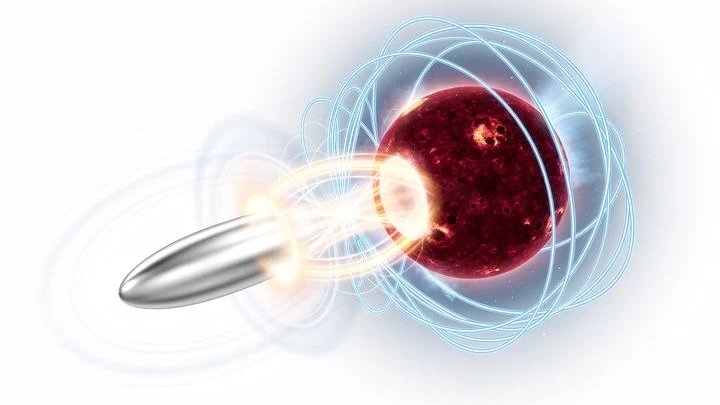
A neutron star the size of a city spins thirty times per second. Its magnetic field is trillions of times stronger than Earth's. Such conditions could spawn a cloud of axions around the star — light particles that no detector has caught yet, but which neatly explain the hidden mass of the Universe.
In a dense ball of hundreds of thousands of stars, what astronomers call a globular cluster, radio telescopes have picked up a faint but very steady rhythm. Every 2.45 milliseconds, that's 408 ticks per second, a radio pulse arrives.
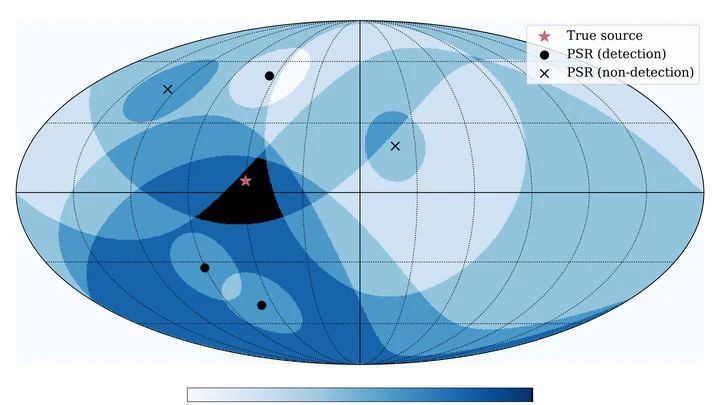
At the center of our Galaxy lurks the supermassive black hole Sagittarius A* — a heavyweight that holds stars in its grip. Astronomers dream of finding pulsars near it: these cosmic lighthouses emit radio pulses with the precision of atomic clocks.
Fluid flows in the narrow gaps between brain cells. It doesn't stay still: each heartbeat pushes it forward, and breathing adds its own waves. This was seen in images ten years ago, but only now have researchers calculated how this pulsing accelerates molecules.
If you drop ink into a stream, it drifts with the current. But if the stream speeds up and slows down, the ink spreads wider.
The neutron star 1E 161348-5055 in the supernova remnant RCW 103 pulses with a period of 6.67 hours. That's very slow for such a compact object, and astronomers long puzzled over what was going on.
The pulsar in the Crab Nebula blinks like a lighthouse: every 33 milliseconds it sends out a radio pulse, and it does so with the precision of atomic clocks. But sometimes its rotation stumbles: the star suddenly speeds up slightly, as if something inside it is shifting.