A Giant Galaxy from the Young Universe express
Through a telescope, you can see a galaxy that looks like a giant glowing pinwheel. Its disk stretches thirty thousand light-years across — a third of the diameter of our Milky Way. But the most astonishing part: this pinwheel already existed just two billion years after the birth of the universe. Such large, orderly star systems were thought to take much longer to assemble.
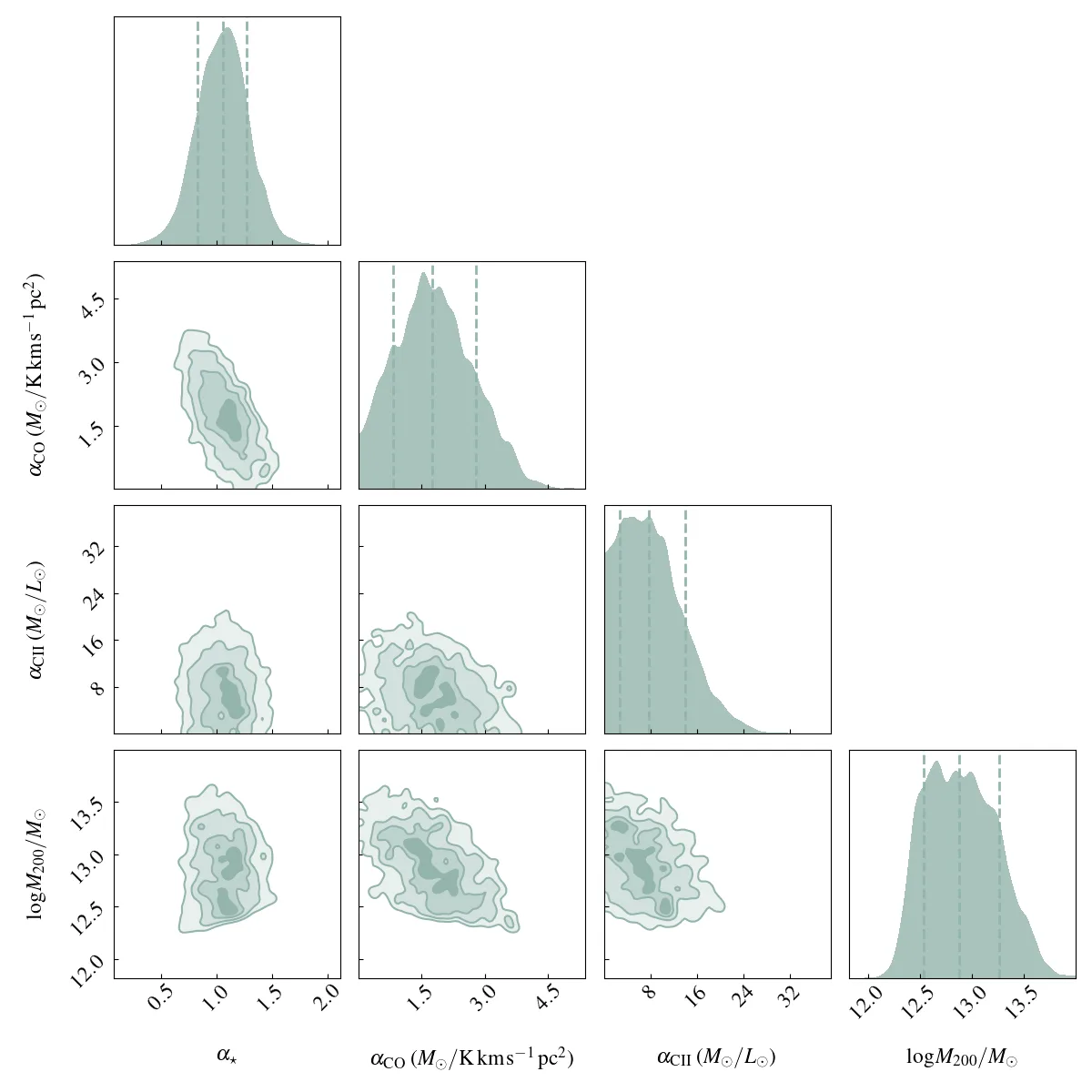
Astronomers aimed two powerful instruments at it: the James Webb Space Telescope and the ground-based ALMA array of radio dishes in the Chilean desert. Using emission from ionized carbon, they measured how fast the gas rotates in different parts of the disk. The outer regions move at five hundred thirty kilometers per second, as if the gas could travel from Moscow to Nizhny Novgorod in one second. Such speed indicates that the galaxy is held together by a vast cloud of invisible dark matter. There is roughly two and a half times more of it than ordinary matter — stars and gas.
Previously, scientists thought such giants grew slowly, over billions of years, gradually pulling in gas from their surroundings. But ADF22.1, at a young age, already reached the size and rotation speed of the most massive spiral galaxies in the modern universe. That means the mechanism that usually stunts galaxy growth, energy outbursts from a supermassive black hole at the center, was not very effective in this galaxy. Gas kept settling calmly onto the disk, and it grew like crazy.
What will happen to this pinwheel next? By comparing it with neighboring galaxies today, astronomers suggest that over billions of years it will transform into an elliptical galaxy — a massive stellar 'ball' without spiral arms. Perhaps one of the giant elliptical galaxies we see around us is an older ADF22.1.
The rotation speed of gas in ADF22.1—530 km/s — is faster than a rifle bullet (about 800 m/s) and one and a half times faster than the speed of sound in air.
The idea that giant galaxies could form very quickly echoes science fiction plots where civilizations find already mature worlds in the early universe — for example, in the series 'Stargate Universe,' the ship 'Destiny' discovers ancient galaxies full of formed stars.