Dark matter deficient dwarf galaxies are small, faint galaxies that contain far less dark matter than expected based on their stellar mass and dynamics. In the standard cosmological model, dark matter provides the gravitational scaffolding around which galaxies form, and it typically outweighs ordinary matter by a factor of five or more in a galaxy like the Milky Way. Dwarf galaxies, being the most dark-matter-dominated systems known, are expected to have extremely high dark matter fractions. Finding dwarfs that lack this halo challenges our understanding of galaxy formation and dark matter's role in it.
History
The first dark matter deficient dwarf galaxy, NGC 1052-DF2, was reported in 2018 by Pieter van Dokkum and colleagues, based on observations with the Dragonfly Telephoto Array. Subsequent discoveries, such as DF4 and DF9, have confirmed that such objects are not unique.
How it works
These galaxies are identified by measuring their total dynamical mass (from the velocities of their stars or gas) and comparing it to the mass of the visible stars and gas. If the dynamical mass is nearly equal to the visible mass, the galaxy is deficient in dark matter. Such objects likely formed through violent interactions — for example, when a larger galaxy strips dark matter from a dwarf during a close encounter, or when two galaxies collide and the dark matter is separated from the stars by tidal forces. The existence of these galaxies suggests that dark matter is not always tightly bound to the luminous components of galaxies and can be removed under the right conditions.
In practice
These galaxies serve as natural laboratories for testing alternative theories of gravity, such as Modified Newtonian Dynamics (MOND), which predicts that dark matter deficient galaxies should be extremely rare or nonexistent.
Fun fact
The galaxy DF9, mentioned in the corpus, is the third such object found in the same region of sky, suggesting that a single catastrophic event may have stripped dark matter from an entire group of dwarf galaxies.
An old stellar ball that has gathered hundreds of thousands of suns has been circling the edge of a dwarf galaxy for billions of years. By all calculations, it should have long ago plunged into the center like a heavy stone into jelly. But the ball holds its ground, and this fact has been nagging astrophysicists for several decades.
A light ray passing near a massive body bends around it, like a runner rounding the corner of a stadium. For a neutron star, this deflection angle is usually assumed to be the same as for a point mass. But if the star is wrapped in an invisible halo of dark matter, the picture changes: light passing through the halo is deflected less than the total mass would predict.
In a distant galaxy, light from hot gas should reveal its composition. The James Webb Telescope split that light into a spectrum, and astronomers saw: oxygen lines too weak.
The night sky seems unchanging, but galaxies constantly exchange matter. The Milky Way, like a great river, absorbs smaller streams — dwarf galaxies. Along with their stars, planets may also come to us.
Imagine a huge stadium packed with people dressed in black. You're standing outside, trying to figure out what's happening inside, even though you can't see a single person. But if two people bump into each other and exchange bright T-shirts, you'd spot a flash of color.
In 1,433 pairs of galaxies scattered across the sky, astronomers noticed an unusual pattern. Neighbors located 'above' or 'below' a massive stellar system contain up to a quarter more oxygen than those lying in the plane of its disk.
In the galaxy NGC 1052 DF2, stars move at only 8 kilometers per second, as if there were no invisible mass around. For comparison: in our Milky Way, outlying stars accelerate to 200 kilometers per second, held by a massive dark matter halo.
Layer by layer, artifact by artifact — an archaeologist reconstructs the history of an ancient settlement. Similarly, astrophysicists sifting through 259 records from LIGO–Virgo–KAGRA saw a clear layered structure among merging black holes.
On November 23, 2023, LIGO detectors caught something strange. The gravitational wave signal from a black hole merger, designated GW231123, pointed to record masses—137 and 101 solar masses, and anomalously fast spin. That would be the most massive and fastest-spinning pair ever detected.
The cosmos resembles silk fabric with threads of the dark web showing through. We only glimpse tiny swatches of the real tapestry — through telescopes, in actual galaxy catalogs. To separate the fundamental signal from astrophysical noise in the cosmic pattern, statistical analysis demands thousands of plausible sketches — synthetic sky maps.
A cosmic detective story spanning a decade and a half has turned up an unexpected clue. The Fermi telescope, which scans the sky in gamma rays, has detected a steady, faint glow enveloping the entire Milky Way. It looks nothing like the light from stars or hot gas — more like a dim, all-pervasive haze.
Dwarf galaxies orbiting the Milky Way look as if they’ve survived a gravitational storm. Their stellar bodies are stretched, scattered by tidal tails, and heated from within.
Within a field of view the size of a grain of sand held up to the eye, hundreds of galaxies lie hidden, smeared into arcs by the massive cluster Abell S1063.
At the center of a tiny galaxy lies a dense clump of stars and dark matter. This clump, called a soliton, is not frozen in place: it quivers and oscillates like jelly on a plate.
Galaxies without dark matter are like beads from which the invisible thread has been ripped. Stretching around the elliptical NGC 1052 is a chain of eight ghostly dim dwarfs: they contain almost none of the mysterious mass that makes spiral arms rotate. Vera Rubin first showed that without the invisible framework, stars would fly apart.
If you squeeze a handful of sand, it gets denser, but at some point the grains press against each other: there's no more room to compress. Some theorists think space behaves similarly at ultra-small distances: it has a limit to divisibility, a kind of 'grain.' In this new study, that principle was applied to the birth of black holes in the early universe — the very ones that…
At the heart of our stellar metropolis — the Galaxy — lurks the supermassive black hole Sagittarius A*. Around it, star S2 whirls in a swift dance. But its movements reveal more than just the hole's pull: an invisible partner joins the dance — dark matter.
A galaxy is like a cosmic highway where stars, like cars, race along circular orbits. Their speed is set by the invisible "cargo" of mass enclosed within the orbit: the more massive the central region, the faster the stars at the periphery.
A dim lightbulb suddenly starts illuminating patterns on the wall that were invisible to the eye. That's roughly how astronomers look at distant dwarf galaxies — tiny stellar islands poor in heavy elements. In some of them, a faint violet glow of ionized helium has been spotted (a specific spectral line He II 4686 Å).
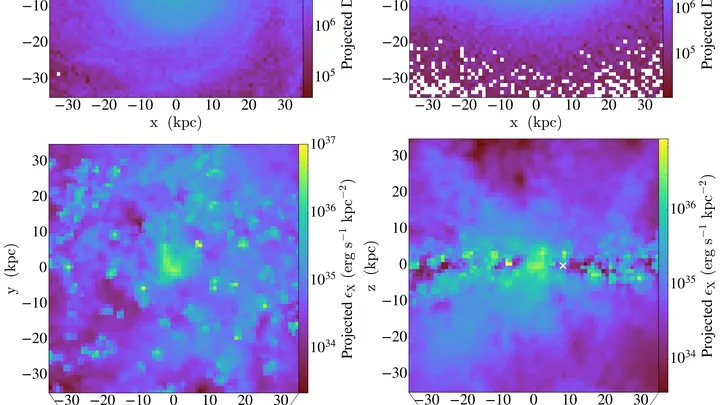
Around our Galaxy, like an invisible crown, stretches a tenuous cloud of gas heated to millions of degrees. It is called the galactic halo. Seeing this glow directly is difficult: it emits soft X-rays that are absorbed by Earth's atmosphere.
A distant city seen through a fogged-up window: bright lights blur, details are lost. That's roughly how astronomers see gas with magnesium ions (magnesium) in our galaxy — the strongest spectral lines "peg the needle," preventing us from knowing how much material is really there.
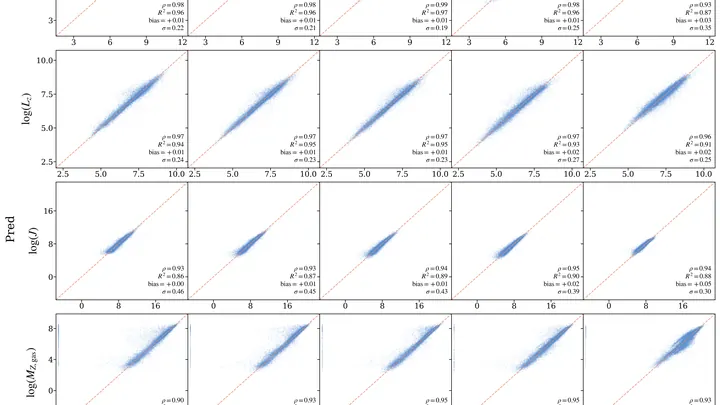
Studying the birth of galaxies requires simulating billions of years of dark matter growth and star formation — even supercomputers handle this slowly.
Conventional dark matter detectors are like a soccer goalkeeper waiting for a powerful shot while the ball barely rolls. The invisible particles filling our galaxy often move too slowly to be noticed by sensitive sensors.
At the edge of the Milky Way, there are stars that move against the general flow, like cars driving in the wrong lane. Previously, it was thought that all of them were remnants of one dwarf galaxy that our Galaxy tore apart and swallowed. But new research shows that there were several such 'oncoming' galaxies.
Through a telescope, you can see a galaxy that looks like a giant glowing pinwheel. Its disk stretches thirty thousand light-years across — a third of the diameter of our Milky Way. But the most astonishing part: this pinwheel already existed just two billion years after the birth of the universe.
Stars on the outskirts of galaxies rotate unexpectedly fast. According to Newton, the farther from the center, the slower the motion should be, like in a round dance, where the outer dancers move more slowly. But in reality, stellar outskirts race along almost as fast as the core, resembling a giant carousel: on it, the outer horses fly faster so as not to fall behind the inner ones.
In the constellation Cetus, 65 million light-years from Earth, three dwarf galaxies nestle: DF2, DF4, and DF9. All have been declared “galaxies without dark matter” — the mysterious invisible substance that usually holds stars together.
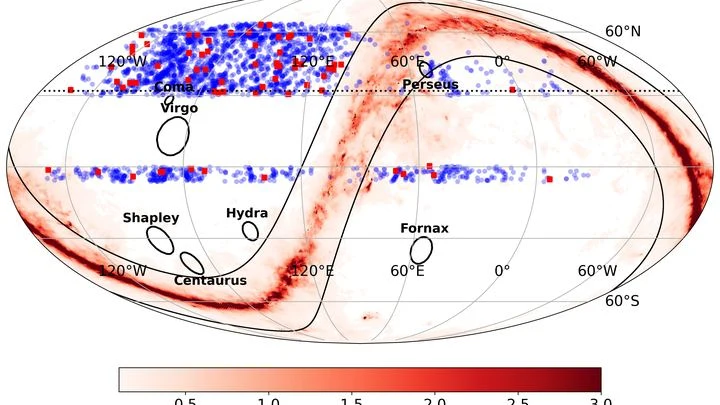
Two spotlights placed side by side: from a distance, their light blends into one patch, and it seems there's a single source. The same happens in space: about 10–20% of faint stars are actually close pairs of identical stars. Individually, they can't be resolved, but together they shine noticeably brighter than a single star with the same parameters.
On the outskirts of the Milky Way, tiny stellar systems hide, so faint that even powerful telescopes barely spot them. Until recently, astronomers knew almost nothing about these objects, dubbed ultra-faint compact satellites.
Dark matter is like an invisible glue that holds galaxies together. It emits no light, but if its particles collide, gamma rays can flash. Scientists hunted for such flashes in dwarf galaxies — small stellar clusters with lots of dark matter and almost no ordinary matter.
The galaxy's kitchen has a recipe for stellar soup. The main ingredient is hydrogen, but the flavor depends on a pinch of metals. Astronomers have now peered into the pots where that pinch is almost absent, and found that the smallest stars are missing.
In the Large Magellanic Cloud, a galaxy that orbits our Milky Way, astronomers have caught five stars that look like fossils from the very distant past. They contain almost no metals, only one-hundredth to one-thousandth of what the Sun has, but they have tens of times more carbon.
The night sky seems full of stars, but between them lurk clouds of gas where not a single star has ever ignited. Such objects are called dark galaxies: they contain enough gas, but it is too diffuse and cold to collapse into stars.
At the center of the Milky Way, a giant stellar cauldron boils. Massive stars are born and die there: each death is a supernova explosion, hurling clouds of charged particles into space.
The Milky Way's stellar disk is like a glowing pinwheel, and тёмное вещество is an invisible cloud around it. For the first time, its shape has been precisely measured. Astronomers tracked the motions of millions of stars and built a 3D map of the тёмное гало out to 160,000 light-years.
NGC 3627, a spiral beauty in the constellation Leo, harbors a trail that fits no standard scenario. A narrow band of cold gas, a molecular trail, stretches more than 8 kiloparsecs (thousands of parsecs, each about 3260 light-years) with a width of about 200 parsecs. That is like a thread as long as a football field and as thick as a pencil.
Someone has thrown an invisible stone into the stellar pond of the Milky Way. The ripples spread not through water but through the motion of stars: in a region 200 by 50 parsecs across, their average vertical velocity is 7 km/s lower than that of their neighbors. The deviation is statistically significant at the 6σ level, so chance cannot explain it.
In 2017, the LIGO and Virgo detectors caught gravitational waves from the merger of two neutron stars. A kilonova flared: a brilliant cosmic explosion thought to forge the heaviest elements in the periodic table. Gold in jewelry, platinum in catalysts, europium in smartphone screens: all of it, according to a beautiful legend, came to us from such catastrophes.